
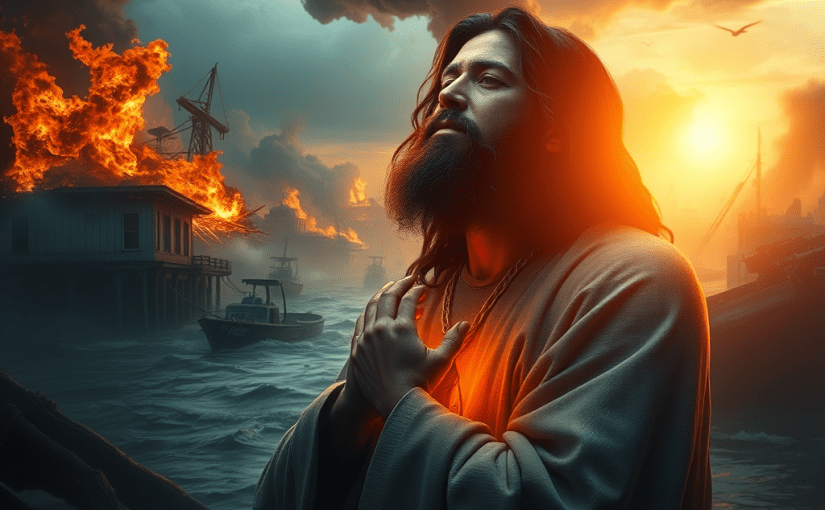
Why does God, who is supposedly all-knowing, all-powerful, and all-loving, allow disasters? Why does God not prevent all accidents, illness, famine, and war? Why does God allow suffering in general?
In 2005, some Christians maintained that, because New Orleans had a reputation for being “sin city,” God sent Hurricane Katrina to punish them. Pat Robertson, a US televangelist, claimed that God had punished Haiti with hurricanes and earthquakes for “making a pact with the devil.” A few centuries ago, John Wesley believed that the great Lisbon earthquake in the 1700s was God’s wrath against sin.
Such explanations must be categorically rejected. In the biblical story of the woman caught in adultery, when asked if she should be stoned to death as the Law of Moses demanded, Jesus replied, “Let the one who has never sinned cast the first stone.” All her accusers walked away because they knew they had sinned too. If God struck New Orleans, Haiti, or Lisbon for their sins, God would have to do the same to all of us.
God did not want or cause an earthquake in Haiti, one of the poorest countries on our planet. A more widespread explanation for Haiti’s poverty and woes is that foreign countries rejected Haiti when its slaves revolted and gained independence, it has had a string of brutal and corrupt governments, and Haiti is geographically located in a hurricane zone and on a fault line.
God does not want or cause suffering in general either. We know that God allows human freedom, which is the cause of most human suffering. God also allows a certain freedom in the natural world. Most of the time, nature serves us well, but natural laws will proceed even if humans are in the way. God did not cause the earthquake in Haiti, the shifting of tectonic plates did.
Getting back to our question of why God allows suffering, we also have to ask: to what extent should God eliminate suffering? Should God eliminate all pain? Pain, which is part of nature, serves us well in most cases. For example, if you put your hand on a hot stove, the pain tells you to withdraw it. If God eliminated our ability to feel pain, we would quickly destroy ourselves. Pain is also a great motivator. Most medical and social breakthroughs have come from seeking to alleviate or prevent pain.
Most of us have experienced a broken heart from being spurned by someone we loved. To eliminate all pain, God would have to make us into robots who could not do unloving things like rejecting people. However, we would also be unable to love since love requires free choice.
Pain also serves us well spiritually. The ecstasy of gaining love and the pain of losing it make us more humble, wise, and compassionate. Suffering should not be glorified; no one should purposefully seek it. However, we can use it as a great teacher.
Just as we suffer if our children suffer, God must suffer with us. In fact, that is what the cross, the central icon of Christianity, is all about. It declares that God knows what it is like to suffer as a human being. God suffers with us. The cross is the universal symbol that God is not in bliss, off somewhere else, while we suffer on earth. God is right in the middle of our pain. God is always on the side of the crucified, no matter what their nationality, race, or religion.
Sometimes, though, the suffering is so senseless that there is no adequate explanation. As Rabbi Harold Kushner said long ago, sometimes all you can do is drop your theological explanations and be with people, hold them in your arms, and cry with them in their grief. That’s what God does. God does not leave us alone in our sorrow.
The international response to Haiti was due to God moving people’s hearts and consciences to reach out and help take this crucified nation off its cross. The response has been like the beginnings of a resurrection: God overcoming horrific pain and death. Perhaps, Haiti will eventually be fully resurrected as a much safer and stronger nation than before. Let us all pray that this is what happens.
Bruce Tallman is a spiritual director and religious educator of adults. www.brucetallman.com
 Intelligent Christian Spirituality