What the world needs now is healthy masculinity

There is a lot of toxic masculinity floating around in the world these days. It most often shows itself socially as violence against women, and politically as dictatorship. People seem enthralled right now with the strong male who claims he will make everything right for their country. Putin and Trump exemplify this.

       Males have been in power for a long time, and in that time, they have done a lot of good – they have been responsible for most of the world’s medical, legal, political, and scientific advances. However, there is no denying they have also done a lot of damage – men have caused most wars and crimes.

       When healthy, every man has four basic instincts: to be a servant-leader, to defend the weak, to be wise, and to be loving. God has given these instincts to men as gifts to be used in the service of others.

       Carl Jung, the great 20th-century psychologist, found that these male instincts manifested in every age and every culture’s history, religion, mythology, and literature. This discovery led Jung to hypothesize that males must participate in a “collective unconscious,” and these instincts, which he called “archetypes,” are the contents of this vast unconscious mind.      

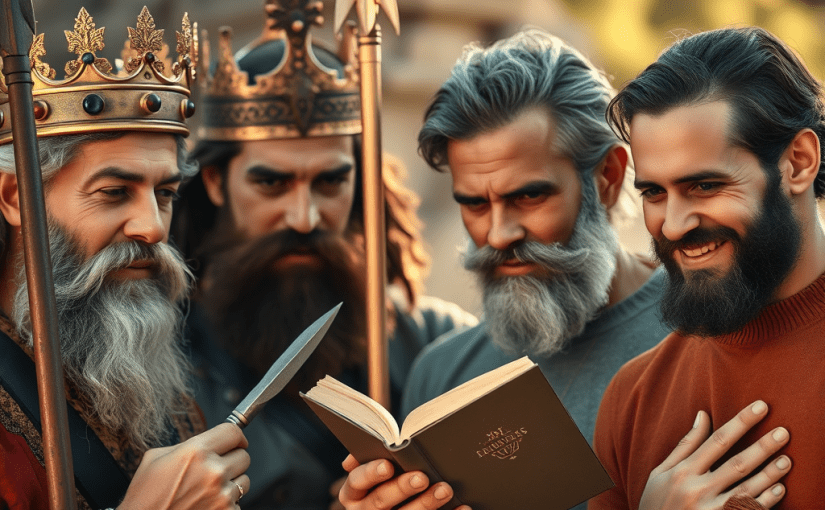
       In the contemporary literature on male spirituality, four archetypes have predominated: the Sovereign, Warrior, Seer, and Lover. These show up in a vast array of ways: the Sovereign manifests as the president, king, CEO, father, or pope; the Warrior is present as the soldier, policeman, sports hero, or prophet; the Seer shows up as the medical doctor, professor, minister, priest, or shaman; the Lover archetype can be seen in the musician, poet, contemplative, or worker for the poor.

    Healthy males keep all four archetypes in balance. When out of balance, the shadow male archetypes start to show up. The anti-Sovereign is the Tyrant, for example, the domineering boss, or the Abdicator – the absent father. The anti-Warrior is the Sadist – the terrorist or bully, or the Masochist – the victim. The anti-Seer is the Manipulator, for example, the negative politician, or the Fool – the men portrayed in television sitcoms and commercials. The anti-Lover is the Addict – to pornography, alcohol, or drugs, or the Frigid – the emotionally dead male.

       The male archetypes are not going to go away, they are hardwired into the male soul. We need the good archetypes to prevent the bad ones from manifesting. Boys need good role models such as Nelson Mandela, Gandhi, Desmond Tutu, the Dalai Lama, and Pope Francis, or the bad archetypes will take over. 

    Jesus had all four archetypes in perfection. Churches refer to him as priest (Seer), prophet (spiritual Warrior), and king (Sovereign), and he is the icon of the loving male (Lover).                      

    The world awaits the coming of males with all four archetypes in this perfect balance. Fortunately, there is an organization that is promoting this, The ManKind Project. It’s goal is to produce  healthy males, men who are kind, thus the “ManKind” name: (see http://www.mkp.org). The Project’s motto is “Changing the world one man at a time.” 

      This is a worldwide men’s liberation movement involving about 100,000 men who train other men in the healthy male archetypes. It is not a specifically religious movement, but it is deeply spiritual. Any man, religious or not, can join. I have been involved for over 25 years, and it has changed my life in numerous positive ways.

Bruce Tallman is the author of Archetypes for Spiritual Direction: Discovering the Heroes Within (Paulist Press, 2005). http://www.brucetallman.com.

Archetypes underlie all religions

Given all the religion-based conflict in the world, perhaps it would help if we tried to emphasize the similarities between religions rather than the differences tha t drive us apart and cause bloodshed. Archetypes provide a valuable common ground since they underlie all faiths.

   Carl Jung, one of the great psychologists of the twentieth century, noticed that certain patterns kept coming up, not only in his patients’ dreams, but also in literature, mythology, history, religion, and daily life in all cultures and all ages.

    From this he surmised that all humans must share in a level of the psyche even deeper than the subconscious mind that his mentor, Sigmund Freud, discovered. Jung called this deeper level the collective unconscious, and the contents of this part of the psyche or soul he called archetypes

    Archetypes are spiritual energy centers and part of the imago Dei, the image of God that God created in the soul, to guide us to fulfilling lives. Jung and others claim that these primordial images are like instincts in that they subconsciously control everything we think, feel, and do.

    Four key archetypes that form the basic structure of the human soul in men and women everywhere are the sovereign, warrior, seer, and lover. Franciscan priest Richard Rohr, Robert Moore, Carol Pearson, Caroline Myss, Robert Bly, and others have written extensively about these four heroic archetypes.

    The sovereign is the benevolent leader or person in charge, the warrior is the one who fights for goodness and justice, the seer is the wise man or woman, and the lover is the one who is passionate for others whether it is a partner, friend, the poor, or the earth.

    As an example of how the sovereign appears everywhere and in every age, consider that throughout history there have been kings, queens, maharajahs, sultans, tsars, emperors, presidents, and prime ministers in various countries, as well as chiefs in native American, Canadian, Brazilian, Australian, and African tribes. The sovereign is also manifest in daily life in the chief executive officer or manager at work, or the father or mother at home.

    There are also anti-heroic or “shadow” archetypes which involve complete possession or complete dispossession by the sovereign, warrior, seer, or lover. For example, if a person is completely possessed by the sovereign archetype, he or she becomes a tyrant. Complete dispossession means the person becomes an abdicator. The other anti-heroic archetypes are the sadist and masochist (warrior shadows), manipulator and fool (seer shadows), and the addict and frigid (lover shadows). 

    These negative archetypes, working subconsciously, can cause great misery in our lives. In fact, the whole post-911 world can be explained in terms of archetypes in the form of tyrants (George W. and Saddam) and sadists (Osama and other terrorists). 

    Negative archetypes can also affect church leadership in the form of bishops and priests who are tyrants ruling with an iron fist, abdicators who don’t teach justice, sadists who condemn everyone’s spirituality and morality but their own, masochists who don’t take care of themselves, manipulators who make the laity fearful, fools who subtly block the ministry of any talented lay person, addicts who abuse children for their own sexual pleasure, and frigids who are burned out, emotionally dead, and cynical.

    People in archetypal roles have great power because they activate the numinous archetypal energies of our souls. This explains the aura that surrounds seers such as the medical doctor, medicine man or woman, shaman, guru, imam, rabbi, priest, or minister. This also explains why the pope and dalai lama draw huge crowds wherever they go. They have double the fascinating numinous power since they are in both the sovereign and seer role.

    The Bible is eternally appealing to the human soul because it is an archetypal book, full of heroic and anti-heroic sovereigns, warriors, seers and lovers. Think, for example, in the Jewish scriptures/Old Testament of King David, Queen Esther, King Saul, Queen Jezebel, Goliath, Samson, Delilah, Samuel, Solomon, Isaiah, Ruth, and the lovers in The Song of Songs.

    The New Testament likewise is full of heroes and anti-heroes. There is Peter (the spiritual abdicator and later, spiritual sovereign), Paul (the spiritual warrior if ever there was one), King Herod, Queen Herodias, Pilate (the political abdicator), centurions and zealots, magi (seers), good and bad priests, John the Baptist, Judas (the manipulator), contemplatives (lovers of God) like Stephen and John the beloved disciple, and so on.

    Churches use archetypal language all the time, whether they know it or not, when they refer to Christ as priest, prophet, king, and supreme lover. Certainly he was in warrior mode when he cleared the moneychangers out of the temple, and there is a graphic, symbolic description in the book of Revelation (19:11-21) of Christ leading the armies of heaven against the forces of evil. To Christians, Jesus had the four foundational archetypes in perfection.

    Since these archetypes are hardwired into the human psyche, they appear in other religions as well. No Muslim would dispute the fact that Mohammed is the sovereign leader of Islam, that he was a physical and spiritual warrior in the wars against the polytheists, and a great seer in receiving the Quran from the archangel Gabriel. 

    Hindus could point to Krishna as a lover when he danced with the gopi cowgirls, Arjuna as a warrior, and great seers like Sri Aurobindo, Vivekananda and others. All Buddhist monks and nuns would come under the seer archetype, and boddhisattvas would be examples of agape lovers, sacrificing their own entrance into nirvana until all sentient beings are enlightened.

    Anyone interested in ministry or leadership in any religion, or in spirituality in general, would do well to familiarize themselves with the heroic and anti-heroic archetypes which have the power to fulfill or destroy any individual, religious tradition, or even whole societies.

Bruce Tallman is author of Archetypes for Spiritual Direction: Discovering the Heroes Within (Paulist Press 2005). See http://www.brucetallman.com.