The rationality of religion and the faith of science

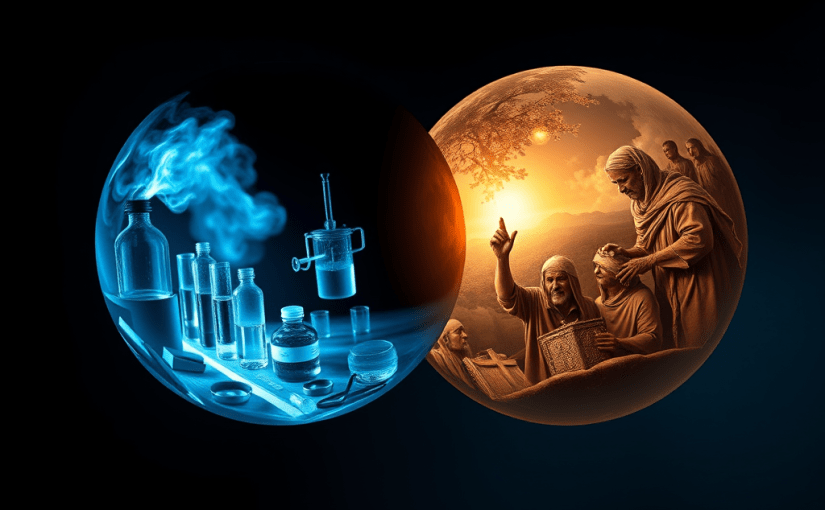
Many today have concluded that religion is fundamentally irrational, and science is the only model of rationality. However, science and religion are more similar than most people think. They both start off beyond reason and become rational later. 

    Anselm in the 11th century defined theology as “faith seeking understanding,” thus balancing those who said all we need is faith with those who claimed all we need is science. In the 13th century, Aquinas carried on Anselm’s agenda of putting divine revelation and human knowledge together. At a time when universities were first forming, these doctors of the church defined the criteria for western scholarship from then on. Since then, most mainline churches have had a healthy respect for the role of reason in religion. In fact, in the Anglican church, they believe the three basic pillars of the church to be tradition, scripture, and reason. Blind faith is immature faith. 

    The great pioneers of science – Copernicus, Kepler, Galileo, Newton, and Darwin were religious and hoped their findings would confirm their faith. They believed all truth comes from the one God; therefore, there can be no ultimate contradiction between religion and science.

    It is true that people become religious from promptings of the heart. The heart is beyond reason, but has reasons of its own, as Pascal said. God is most readily experienced through faith, prayer, ritual, and acts of compassion. However, whereas religion is more intuitive and right-brained, theology is the rational attempt to understand religion and is more left-brained and logical.

    Whether you think science is rational and religion is not depends on your definition of reason. In medieval times, thinkers such as Anselm and Aquinas defined reason as the faculty which knows our place in the universe and that there are divine mysteries beyond human understanding.

However, science eventually predominated to the point where some scientists, such as Richard Dawkins, subscribe to positivism, the belief that only what can be proved by science is rational.

    The truth is that science, like religion, starts beyond reason and then becomes rational. Science is based on the faith that the universe is logical. No scientist would begin to do science if they did not have this faith, if they presupposed the universe is beyond understanding. The scientific search for the simplest theory is motivated by the belief that such a theory exists. Charles Townes, a Nobel Prize winner for physics, said: “Science is so successful, we are enthralled. Many people don’t realize that science involves assumptions and faith…nothing is absolutely proved.”

    Beyond that, science is increasingly coming face-to-face with mystery. The strange, logic-defying things quantum mechanics tells us happen at the subatomic level of the universe make Christian theology seem more and more reasonable by comparison. If you don’t reject science because it is full of mystery, incomplete knowledge, and paradox, why would you reject religion because it is also full of mystery, incomplete knowledge, and paradox?  

    When you plunge into the depths of religion, science, and the universe, you must first let go of rationality and be guided by intuition, imagination, wonder, and awe. However, religion, science, and the universe are all secondarily rational. Religion has theology, science has theories, and the universe has material and spiritual laws.

    Dawkins believes that science and religion are opposites, with science totally rational and religion totally irrational. However, they are on parallel paths of trying to understand the universe, and at a deep level, the differences are superficial.            

Bruce Tallman is a London spiritual director and educator of adults in religion. brucetallman.com 

Exploring Atheism in the Context of Progressive Christianity

Gretta Vosper, director of the Canadian Centre for Progressive Christianity, a United Church of Canada minister, and author of the bestselling With Or Without God: Why the Way We Live Is More Important Than What We Believe, declared she was an atheist in 2001. A minister who is an atheist?

       She said in most mainline churches there is a vast gap between what the clergy know and what the laity believe. What she believes most clergy know is that there is no supernatural being called God and even if there was, God does not intervene in human affairs or respond to prayer. God is merely our own human efforts in the world for justice and peace. She also believes the Bible was just written by humans, there is no heaven, and the Christian creeds are irrelevant. I’m sure most clergy were surprised the United Church let her continue in spite of her atheism. 

    Like most atheists, she has no authentically satisfactory explanation of where everything came from. You have to stop the infinite regress of asking “Where did that come from?” at some point. Asking, as atheists do, “Where did God come from?” makes no sense because the concept of God implies eternality. God has always existed. Atheists could say the same about the universe, but at some point, you are forced to give something God-like qualities like eternal existence. You have to make something into God, either God or the universe. 

    Vosper sees religion as an attempt to deal with chaos in the world. However, how does she explain order in the world? The late Bernard Lonergan, a Jesuit theologian, explained through his concept of “emergent probability” how there can be both order and chaos in the universe because God works through “secondary causes,” such as nature, without violating those causes. God is mystery, and just because we don’t understand exactly how God works does not mean God does not exist.

       I like the approach of biblical scholars who say humans wrote the Bible and therefore it has scientific and historical errors in it, because God works through secondary causes like flawed and limited human beings, but underlying it all, the Bible is inspired by God. 

       Also, in my experience, prayer does work, and I regularly hear from my clients how prayer works in their lives. Some things have to be believed to be seen. If you don’t believe in God’s intervention, you won’t see it, but if you do believe in it, you see it everywhere. Coincidences happen that are too coincidental to be mere coincidences. They are “God-incidences.”

       Progressive Christianity can be helpful, but Vosper’s attempt to leave God out does not address our existential angst. Who do you turn to when human effort fails, you fail yourself, people betray you, or you suddenly find you have cancer and are going to die?

       To be fair to Vosper, I think she has a point: we need to look for the positive common values found in all religions, and this is more important than our various creeds. She is right that our beliefs are meaningless if we do not live our faith. Believing the faith is easy, living it is hard. As G. K. Chesterton said, “Christianity has not failed, it has just never been tried.”

       In fact, it has been tried by individuals who Christians call “saints,” who always put more emphasis on living the faith than on doctrine. As one of the most famous, Francis of Assisi, said, “Preach the gospel wherever you go, using words if necessary.” 

       So yes, let’s be progressive and update our faith in the light of contemporary scholarship, but let’s not throw out God with the childhood religion, as atheists do. Let’s have an adult faith. In God, not Gretta Vosper.

Bruce Tallman is a London spiritual director and educator of adults in religion. www.brucetallman.com

The Absurdity of Atheism in Maher’s ‘Religulous’

 “Religulous,” a mockumentary, is a two-hour assault on religion. The not-very-subtle message is that to be “religious “is “ridiculous.” The title combines the words.

       Bill Maher, the host, delights in skewering the seeming absurdities in religion: babbling in tongues, silly hats, the manipulation by televangelists. I think Jesus himself would likely laugh or weep over our folly. Religions need people like Maher. He is like the court jester employed by wise medieval kings to point out when people were getting too pompous. 

       Maher also attacks the dangerous side of religion: the holy wars, suicide bombings, anti-science, and potentially self-fulfilling prophecies of nuclear end-times. Maher does religion a service by courageously showing us when it is absurd, mindless, and destructive. He mainly attacks Christianity and Judaism, but also dares to criticize Islam. 

       However, he does religion a disservice by presenting the extremes as the norm. There is a danger the uninformed might think this is all religion is.

       He conveniently leaves out when religious people live according to their true values, have a deep spirituality, found service agencies and hospitals, educate and feed the poor, protest war and injustice, promote the sacredness of life and marriage, and constantly remind us life is more than the unbridled pursuit of money and self-centered pleasure.

       He conveniently leaves out the many profound and very rational Jewish, Christian, and Muslim thinkers: Abraham Heschel, Martin Buber, Reinhold Niebuhr, Paul Tillich, Thomas Aquinas, Avicenna, and Averroes, to name a few.

       He conveniently leaves out the constant progression in religious thinking and that atheists are stuck in a time warp in their criticism. Sure, there were absurd things written in the scriptures 2500 years ago, and God was often portrayed as an angry despot. Sure, there were crusades, and the church condemned Galileo hundreds of years ago. However, most believers today have repented of those ways of thinking and left them far behind. 

       This is where Maher totally misses the mark. The inconvenient truth for him and other atheists is that most people in the mainline synagogues, churches, and mosques are not extremists but moderates who believe in a loving God, are in favour of rationality and science, and are themselves critical when their traditions become absurd and dangerous.

       Maher also conveniently leaves out that atheism itself may be dangerous and absurd. Without religion, people make up false gods, for example, absolute ideologies like capitalism and communism. Maher conveniently leaves out that atheists like Hitler, Stalin, and Mao killed 80 million people in the twentieth century, more than all the religious wars in all of history.

       He conveniently leaves out that it might be more rational to believe there is a Supreme Intelligence behind all the order of the universe than to believe it all just happened by chance. He conveniently leaves out that without God, life might seem ultimately absurd when you are suddenly downsized, become sick, or lose a loved one. He conveniently leaves out that God and religious faith may, in fact, be the only real answers to life’s absurdities and dangers.

       Thank you, atheists, for keeping religion honest and accountable, but please don’t try to convince people that religion is all absurdity and destruction, and please be as self-critical as you ask religious people to be.

Bruce Tallman is a London spiritual director and educator of adults in religion. brucetallman.com

Atheists not scientific about religion

    For the past few decades, atheists have been speaking freely about their lack of faith. In part they have been emboldened by two vociferous atheists. In both Richard Dawkins’ The God Delusion and Christopher Hitchens’ God Is Not Great: How Religion Poisons Everything, they take the worst examples of religious folly and advocate getting rid of religion because it is an irrational curse on the human race.

    There is no denying that they are both partially right: religion has been the cause of a lot of irrationalism and evil, witch-hunts and terrorism. However, there is also no denying that they are largely wrong: religion has been responsible for untold good. There is not only unhealthy religion, but also healthy religion.

    As my friend Dr. Larry Cooley, a philosopher of science and religion, put it: “From a scientific viewpoint, Dawkins and Hitchens are unscientific when it comes to religion. In formulating a theory, a competent scientist tries to account for all the data.” It’s surprising that Dawkins, a respected scientist in the field of genetics, would throw out the scientific method when it comes to religion. In arguing that we should get rid of religion, both he and Hitchens have not taken into account all the data about bad science and good religion.

    It would be easy to attack science based on all the evil it has brought upon the human race. Science and the technology that derives from it have brought us all manner of weapons of war: bombs, machine guns, tanks, and biological and chemical warfare. Science has been responsible for the maiming and deaths of hundreds of millions of people.

    Science has also robbed people of hope for the future. I remember thinking in the 1980s that my family and I probably had no future because of the constant threat of nuclear war. Now, people in their twenties tell me they have no future because of the destruction of rain forests, pollution, and global warming brought upon the human race by science and technology: bulldozers, chain saws, cars, planes, and factories. Science is once again threatening our planet with destruction. Science has totally failed to bring us the utopia promised by the Enlightenment. One could argue that science is evil and should be done away with.

    On the other hand, Dawkins and Hitchens have not taken into account all the data about good religion. The World Council of Churches and the Vatican have issued and implemented numerous statements and strategies about war, social justice, poverty, hunger, welfare, and the environment. Most universities and hospitals in the western world began under the sponsorship of Christian churches. Here in London, Ontario, for example, St. Joseph’s Hospital began as a mission of the Sisters of St. Joseph, and Parkwood Hospital began with the Women’s Christian Association. The University of Western Ontario began with Huron College, an Anglican seminary.

    The whole Canadian system of universal health care happened because of the efforts of a Baptist minister, Tommy Douglas. Our legal system and moral code are based on Judeo-Christian precepts. As Michael Coren once said, “Quite simply, without Christian groups and Christian people, the social network of Canada would collapse. This is not hyperbole. Walk along almost any main street and look at the names of the houses, associations, and institutes that work for the poor.”  In London, we have the Salvation Army and numerous soup kitchens sponsored by churches, and most churches educate their congregations about social justice issues and engage in charitable activities here and abroad. 

    Countless missionaries have brought not only religion but also education and medicine to developing countries. I think of my friend Dr. Harold Fast, a Mennonite who lived and died selflessly helping thousands of Muslims as a medical missionary in Pakistan. Save a Family Plan, operating out of St. Peter’s Seminary here in London, has helped tens of thousands of the poorest of the poor in India become self-sufficient.

    On an individual level, religion has given billions of people a sense of significance, that their lives have transcendent value and meaning, that they are more than a cog in the drudgery of daily existence. Religion has brought people a sense of personal ethics, community, comfort, and hope for the future.

    The problem in the world today is not science or religion. The problem, and the glory, is human nature. As human beings, we have the capacity to take these two great endeavors of the human spirit, science and religion, and make them into something very compassionate or very destructive. Dawkins and Hitchens seem to miss altogether the fact that, whether as scientists or religionists, we are capable of unlimited good and evil. Religion, at least, predicts this.

    The most serious criticism of fundamentalist atheists like Dawkins and Hitchens is their inadequate scientific method: not taking into account all the data about healthy religion and unhealthy science makes them incompetent thinkers from their own scientific viewpoint.

Bruce Tallman is a London spiritual director and educator of adults in religion: brucetallman.com.

Exploring the God Debate: Proofs for and Against Existence

THE GOD DELUSION: FACT OR FICTION?

    In 2003, a new book by Richard Dawkins, The God Delusion, was climbing the bestseller charts and giving atheists everywhere powerful fuel for attacking religion. On November 9 eighty people attended a debate sponsored by the Humanist Association of London and Area on “Is There A Loving Creator God?” Here are the key points by the debaters Dr. Goldwin Emerson and Dr. Bruce Tallman.

    EMERSON: NO. THERE IS NO LOVING CREATOR GOD

    The Christian God is reputed to be an all-knowing, all-powerful, benevolent, supreme being who created the universe, answers prayer and influences events on Earth. He is also believed to have sent his son to Earth for the purpose of atoning for the sins of humankind. This description causes skeptics to ask the following:

  1. If the deity is all-knowing, he would know when disasters such as earthquakes and hurricanes are about to happen, and if he is all-powerful, why does he not stop these catastrophes and prevent the death of innocent people? 

2. If this deity is powerful and benevolent, why does he allow humans to be born with defects and incurable diseases? 

3. Millions of believers pray to their deity, asking that he intervene in events on Earth. Why are so many prayers not answered? 

4. Why do Christians claim that Jesus is divine, requiring worship, when no other monotheistic religions make this claim for their prophets? 

 5. As scientific knowledge advances, we learn that many of the world’s problems of pollution, war, global warming, hunger, and disease are human-made problems which, if they are to be solved at all, will need to be solved by human-made solutions. Why is it that Christians claim that God is necessary for ethical behaviour?  Effective ethical codes were established in various early civilizations prior to the existence of Christianity. 

    When asked why their omnipotent, loving God allows so much misery in the world, believers say God moves in mysterious ways, or the universe is unfolding as it should.  These answers are hardly satisfying to skeptics, and one is tempted to side with Sigmund Freud (1870-1937), who said: “A personal god is nothing more than a father figure: desire for such a deity sprang from infantile yearnings for a powerful, protective father, for justice and fairness and life to go on forever. God is simply a projection of these desires, feared and worshiped by human beings out of a sense of helplessness.  Religion belongs to the infancy of the human race; it has been a necessary stage in the transition from childhood to maturity.  It has promoted ethical values which were essential to society. Now that humanity has come of age, however, it should be left behind.”                                                                  For non-theists, the conclusion is that there is no God. On the other hand, there are alternative ways of viewing what has been called God. In the seventeenth century, the Dutch philosopher Spinoza proposed that the belief in God’s activity in the world was merely a way of describing the world’s mathematical and causal principles. For Spinoza there was no need for the concept of divine law: the best guidance is the eternal laws of nature. The famous physicists Stephen Hawking, Albert Einstein, and many more recent scientists and philosophers have expressed a similar view.

     Others may think of God as a quality within themselves, the Ultimate Reality or the Ground of All Being, instead of believing in the traditional Christian concept of God.

     Most liberal Christians accept the firm scientific evidence that the universe is billions of years old and that life on Earth evolved over millions of years; nevertheless, they may still believe that, in some mysterious way, God is a prime mover in this evolution. While religious people also credit God with the origin and existence of love, humanists believe love is a product of evolution. The emotion of love, particularly in mammals, enhances the survival potential of offspring. Considering God as a creator begs the obvious question: Who or what created God?  For humanists, the answer is simple: humans created God.

     It seems that primitive peoples looked for explanations of how the world works and created numerous spirits and gods to account for natural happenings. Over the centuries, many different gods were invented by ancient civilizations, including Egypt, Greece and Rome. One exception was the monotheistic God of the Hebrews. We now accept that the multitude of ancient pagan gods were created in the minds of humans. It is reasonable to conclude that Yahweh was also created in the minds of the Hebrews and became entrenched in the myths contained in the book of Genesis. Thus, humans created God in their own image rather than the other way around.

     Humanists are guided by the principles of rational thought, scientific inquiry, responsibility, ethics, compassion, fairness, and equality, and find it difficult to believe in the Christian concept of God. Instead, we believe that he was created in the minds of early Hebrews. Rather than worshiping the Christian God, humanists celebrate the opportunity of living on our wondrous planet and having the privilege of enjoying the many good fortunes available to us. In other words, they try to follow a philosophy of loving and revering life like believers love and revere God.

TALLMAN: YES. THERE IS A LOVING CREATOR GOD

    Nonbelievers usually do away with the idea of a Creator by ascribing God-like qualities such as infinity and eternity to the universe. However, Albert Einstein and Isaac Newton, the two greatest scientists who ever lived, both believed that the universe is finite, and modern astronomers all agree that the universe began with a Big Bang about fourteen billion years ago. They have also done computer projections that show that the universe will end in about one hundred billion years. Monotheistic religions believe that nothing caused God to exist, God exists infinitely and eternally by God’s own nature, and God caused the Big Bang.

    Believing scientists like Pierre Teilhard de Chardin, an expert on the fossil remains of evolution, have noted that evolution on our planet has proceeded from matter (rocks and water) to life (plants and animals) to thought (humans) to spirit (the great religions that continue to spread across the world) because humans are “homo religiousus,” that is, “hardwired for God”. The fact that the whole natural world has evolved in a spiritual direction, from matter to life to thought to spirit, is evidence that God is directing the whole evolutionary process.

    Many nonbelievers say they only believe in things for which there is scientific evidence. Although we cannot scientifically prove there is a God, there is evidence of the creativity of a Creator all around us: the sun, lightning, rainbows, flowers, mountains, peacocks, giraffes, children, and on and on. It’s as if the whole creation is shouting, “There is a God!” As one contemplative said, “ If you want to see God, just open your eyes and wake up!”

    Just as there is plenty of evidence that there is a creator God, the evidence of a loving God is all around us. First of all, there is far more good than evil in the world. Evil is always only a corruption of something that was originally good. For example, illness is always only a corruption of original health. 

    Doctors estimate that only about three percent of the population has a major illness at any one time; health predominates by far. If there is seven percent unemployment, it means there is ninety-three percent employment. Criminologists estimate only two percent of the population are criminals, the other ninety-eight percent are law-abiding citizens. So good is foundational, and evil is secondary. We take the good for granted because it is just so everyday and commonplace. Again, we need to open our eyes.

    The greatest proof that there is a loving God is that love is the central thing in life. This requires no argument since lovers, poets, philosophers, and mystics have been proclaiming it for centuries, and we all know in our hearts that it is true. If there is no God of love, why is good far more predominant than evil, and why is love the central thing in life? Atheists have no good explanation for this.

    Although God is loving, all-powerful, and all-knowing, God is also self-limiting. Natural laws serve us well the vast majority of the time, so God chooses not to interfere with them. If God interfered with them every time they might cause suffering, the world would be chaotic. Similarly, God chooses not to take away our free will, even when we misuse it and cause suffering, because otherwise, we would be robots, and there would be no real love in the world.

    God constantly works within us, trying to motivate us to love one another, prevent suffering, and bring greater good out of evil. Indeed, life is full of the overcoming of suffering. However, sometimes, we disobey God and cause suffering on a massive scale, such as killing millions of innocent people in the twentieth century. The real question here is not “How can God allow suffering?” but “How can human beings allow it?”             

    God does allow suffering, but only so that the highest human virtues: compassion, wisdom, heroism, service to others, and self-sacrifice, can emerge in response. If God took away all suffering life would lose its profundity.

    The crucifixion of Christ is the great symbol that God suffers with us and is right in the center of our pain, trying to alleviate it. And the resurrection of Christ is the great symbol that all suffering is finally overcome by God in heaven.

    Life on Earth is evolving in a spiritual direction; religion and spirituality constantly spring up everywhere because we are hardwired for God, good is foundational, love is central, and there are answers to suffering. All these things testify that there is indeed a loving, creator God.

Concluding Remark

    The two statements represent different ways of viewing our universe. One is religious, the other non-religious. These two positions are offered so that readers may better understand both and make their own choices on these important concerns.

On God and Suffering: Dialogue with an Atheist

After completing his PhD in religious studies, my friend Leon became an atheist! 

    After that, he and I got into debates over the existence of God that would rage on for whole weekends, but it all seemed to get down to the problem of suffering. Given the wonders of our world, belief in a Creator would be easy if it were not for all the suffering. 

    Here is a summary of Leon’s toughest questions and my best answers on God and suffering.

Leon: How can you believe in a good God when there is so much suffering and evil in the world?

Bruce: I believe good is foundational, and suffering and evil are secondary. Evil is always only a corruption of something that was originally good. For example, illness is a corruption of original health. War is a corruption of original peace. God created everything good in the beginning. Good, not evil, is the bottom line in life.

Leon: If God is the Creator, God is the cause of everything. God must, therefore, cause suffering. 

Bruce: God does not want or cause suffering and evil. Secondary causes, that is, natural laws and human freedom, cause suffering. So that we would not live in chaos, God created the laws of nature, which normally serve us well. 

    However, nature blindly follows its laws, much as an avalanche obeys gravity, whether humans are in the way or not. Also, you can’t have true love without freedom of choice, so God created humans with free will. But sometimes, we make wrong choices and sin. If most of the suffering in the world is caused by our wrong choices, the question is not “How can God allow suffering?” but rather “How can humans allow it?”

Leon: If God does not want suffering, what does God do to alleviate it? I don’t think God cares.

Bruce: The Bible teaches us how to overcome evil and suffering by obeying God’s laws. It also teaches us that we can call upon God at any time for help with suffering and that true happiness lies in having a loving relationship with God.

Leon: But if there is a loving and all-powerful God, why would there be any suffering?

Bruce: Paradoxically, although suffering is the main reason people don’t believe in God, God is the ultimate answer to suffering. If there is a loving and all-powerful God, then suffering must make sense, although we may not immediately understand it. Trust in God’s goodness provides hope in the midst of suffering, thus eliminating the worst suffering, that is, meaningless suffering.

Leon: I still think there is more suffering than good, which disproves there is a loving God.

Bruce: Beyond foundational goodness, there is “secondary goodness”, that is, our response to suffering. This is how all the helping professions arose: medicine, law, psychology, social work, etc. All progress is a response to suffering. Good abounds, and God is in charge.

Leon: But if there is a loving God who is in charge, why would he allow suffering?

Bruce: God does not normally allow us to suffer and only allows suffering and evil so that higher values and attitudes such as humility, compassion, forgiveness and wisdom might emerge.

Leon: I still don’t see a God anywhere out there helping us with suffering. Where is God anyway?

Bruce: God is invisible, but we can see that God has created us with great defences against suffering. Everyone comes with some built-in, standard equipment: a brain, the greatest problem-solver in the world, and the human spirit, the great urge to fight against suffering. 

    God has also given us people who aid us in avoiding suffering and who are great supports when we do suffer: parents, spouses, and friends. Through people and angels, God either protects us from suffering and evil or helps us to get through it. God comforts us, encourages us, carries us through suffering, and works with us to bring secondary goodness out of suffering and evil.

Leon: I still don’t think God actively cares. God just sits up there and watches us suffer.

Bruce: The Christian belief is that God suffers when we suffer. If God is everywhere (including within us) and knows everything, and we are God’s children, then God knows and feels our pain. God is not some detached sky-god. The Cross is the great symbol that God suffers with us.

Leon: Suffering is so horrible, though. Life is so hard and so meaningless. What’s the point of it?

Bruce: Christ on the Cross transformed suffering, showing that suffering can have meaning. He showed us that to suffer for others is the deepest love.

Leon: I still don’t think there is any final answer to suffering.

Bruce: Often, all you can do is accompany the suffering person, not give them your answers, but if there is a final answer, it is that God overcomes all suffering in heaven forever. God gives believers ultimate and eternal joy, peace, happiness, and love. Things began as “very good” (Genesis 1:31), the end is even better, and the middle is good in spite of negative news reports. All is well that ends well, but you have to have faith to see the goodness of God in all things.

Bruce Tallman is a spiritual director and author: http://www.brucetallman.com

HUMAN PURPOSE LOST AND FOUND

The new cosmology resonates with Christian faith –

God cannot be reduced to the creation event –

something must have come before Creation – 

God is not reducible to the universe –

even though people pray to the universe

or ask the universe to do things for them

“the universe” is a code name for “God”

but people are afraid to admit God into their life

because it is not cool these days to be religious –

God is not the universe nor separate from it

but God’s Presence is in and flows thru ongoing creation

modern atheism did not arise with science

but atheism got a kickstart with Copernicus’ heliocentrism –

humans kicked out of the center of the universe

to the periphery of a vast impersonal cosmos 

humans irrelevant to the cosmic story –

humans no longer the perfection of the universe

but an accidental side show

gave birth to existentialism – we have no god-ordained purpose –

we create our own purpose by what we do

Gandhi retrieved and the West lost a religious view of reality –

a view of the importance of being and truth

the West reduced the human purpose to practical efficiency –

concerned with means not ends –

no longer aware of the intrinsic God-given value 

of being human – we only focus on what humans 

can do for other humans – particularly the rich 

our only purpose: producing and consuming things

only religion kept a notion of our intrinsic value –

the Church’s mission to discover honest-to-goodness truth

through open dialogue between humans

requires reverence and respect for lawful diversity

“The Church’s purpose is to keep unity in essentials

freedom in non-essentials, and charity in all things”

– Pope John XXIII

but the Church cannot brag about any of this –

it is the work of the Holy Spirit

to call forth many religious – hermits/monks/nuns

who have consecrated their lives to prayer –

praising God and interceding for God’s People –

this has gone on since the Desert Mothers/Fathers

and is the living source of the spiritual life of the Church.

THE DISASTER OF MODERNITY

The disaster of modernity:

since the Enlightenment, the intellectuals

in trying to grow beyond the mythic stage to the rational stage

killed the mythic God in the “death of God” movement

but in doing so they truncated their own spiritual growth

they did not go on to higher understandings of God

they repressed their own spiritual intelligence –

and the West has never recovered


modernism emphasized the intellectual and technological

and labeled our ancient/natural subjectivity as “superstition”

and this created a disconnect

between heartless individuals

and heartless institutions


and this created atheism – some atheists

have no religious awareness/strivings in them

have lauded/applauded humans so much they forgot God

have such a distorted view of God

they do not reject the God of the gospels

who they do not know

but rather they reject a caricature of God

who they have imagined


our western preoccupation with practicality

and means not ends

resulted in a total loss of values

and seeing life as a whole

so we became prisoners of urgency/

short-term consequences/

erratic/meaningless lives


non-dual thinking is the answer

non-dual thinking is both/and thinking

never either/or thinking –

it includes and honors all the previous stages


spirituality that ignores psychological dynamics

and psychology that ignores our spiritual nature

cannot be an adequate guide for people

who want to integrate

the quest for holiness

and the desire for wholeness.

THE EVOLUTION OF BELIEF

In 139 C.E. (Common Era), Ptolemy, a Greek astronomer,

developed a system of circles within circles

which became the primary astronomical model

for 1500 years!


for 15 centuries everyone believed

this was how the universe operated

but the accretion of more and more untested beliefs

along with increasingly sophisticated science/history/psychology

caused some Christians, desperately trying to keep up

to assert increasingly unbelievable things

like the existence of hell – a place of eternal torture –

what could anyone do in their brief lifespan to warrant that? –

this belief was the projection of our worst fear onto God

made God into an Absolute Demon/Monster

and created scepticism/atheism

 hell exists, but it is a God-forsaking mental state not a place

7 centuries before Teilhard de Chardin

St. Angela of Foligno saw the whole evolving creation as

a divine milieu – a universe pregnant with God – a heaven


in Fall/Redemption traditional spirituality

the quest is for perfection

and the goal is to keep the soul clean

but in Quantum Theology/Spirituality no perfection exists –

imperfection is integral to all nature –

and holiness is cosmic hospitality – welcoming all things –

and the goal is to keep the soul green/

evergreen/ever-growing


7 centuries before, and surprisingly like, Quantum Theology

Meister Eckhart’s writings on the soul

answered the fundamental philosophical/theological questions:

“who are we?/why do we exist?”

which supply the basic purpose/direction of our lives


no one but Meister Eckhart

according to Matthew Fox

so thoroughly integrated

biblical theology/spirituality/

prophecy/mysticism/

faith/reason/

art/life.


THE RISE AND FALL OF THE NEW ATHEISM

Justin Brierley, host of the “Unbelievable?” podcast, which hosts Christians and atheists in dialogue, likes to thank atheists for reviving Christian thinking.

    Brierley’s new book The Surprising Rebirth of Belief in God: Why the New Atheism Grew Old and Secular Thinkers Are Considering Christianity Again is part of a new wave of tomes such as two by Alister McGrath: The Dawkins Delusion: Atheist Fundamentalism and the Denial of the Divine and Coming to Faith Through Dawkins: Twelve Essays on the Pathway from New Atheism to Christianity in which a dozen secular thinkers found their way to belief in God through reading criticism of Richard Dawkins. Even Deepak Chopra weighs in with a chapter on “Dawkins and his Delusions” in his book The Future of God.

    The “four horsemen of the atheist apocalypse,” Dawkins, Christopher Hitchens, Sam Harris, and Daniel Dennett were very popular from about 2000 to 2010 but have fallen out of vogue since then.

    The new atheism arose because of a perfect storm of events: American fundamentalist criticism of evolution, resulting in a ban on teaching the scientific theory in some schools; ongoing aggression by religious evangelists who considered atheists either foolish or evil; the 9/11 attack on the World Trade Center by fundamentalist Muslims; and sex scandals perpetrated by priests and covered up by bishops.

    The storm resulted in a counter storm of books by atheist scientists such as Harris and Dawkins, notably Dawkins’ The God Delusion, and writers such as Dennett and Hitchens, notably Hitchens’ God is not Great: How Religion Poisons Everything.

    However, the atheist counter storm resulted in a counter storm from Protestant philosophers such as William Lane Craig, Alvin Plantinga, Tim Keller, and John Lennox.

   The new atheism came to be seen as deeply flawed for two main reasons. First, they cherry-picked their approach to religion, straw-manning their opponents by just focusing on the worst aspects of religion. Their simplistic approach to religious faith failed to take into account all the good religions have done for centuries: providing billions of people with deep meaning in their lives, pastoral care during hard times, and building charities, hospitals, schools, and universities around the world.

    Secondly, they failed to apply their critical standards to themselves. They only got as far as Kierkegaard’s ethical stage, and have not examined the shadow side of atheism, for example atheist political regimes in Soviet Russia and Communist China that slaughtered millions of people. They did not own their own sin, which Kierkegaard noted, prompts the next stage after ethics, the religious stage.

    Part of their problem was that, as Catholic Bishop Robert Barron pointed out, they were rhetoricians, great at arguing their point but naïve about the depths of theological thinking. Also, they were in love with “scientism,” the belief that science has all the answers, an unprovable hypothesis which is therefore rejected by true scientists.

    True scientists recognize the limits of science. Science can only answer “how questions,” for example, how we got here through evolution. It is incapable of answering “why questions,” for example, “what is the purpose of my life?” That is a meaning and value question which is in the realm of religion not science.

    As Bishop Barron also noted, when atheists try to formulate their values, they usually latch on to “the brotherhood of man” or other values that come from Christianity. So, they unconsciously criticize Christianity with Christian values. This is fair, since any religion is only as perfect or imperfect as the people who compose it. If they do not live up to their professed values, they deserve to be criticized.

    In short, the two big mistakes of the new atheists were to unfairly overdo their criticism of religion, and to not look at the dark side of atheism.                               


Bruce Tallman is a religious educator of adults, spiritual director, and marriage coach . http://www.brucetallman.com