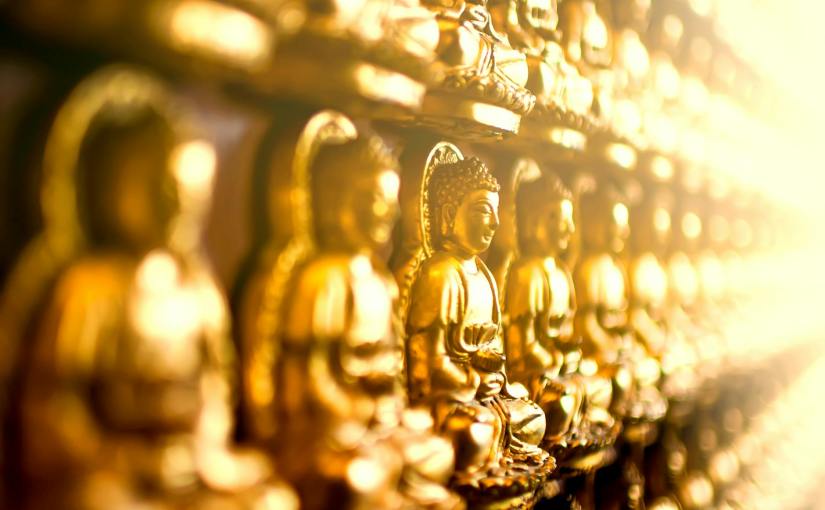
BUDDHA’S DILEMMA

Science has discovered that chaos is everywhere

and has a necessary role in universal life –

chaos creates creativity –

and the consequent struggle to survive

results in unexpected benefits

when you ask “Why is my life not working?”

and discover your shadow beneath the “persona” –

the mask you and everyone wears – the “smiley face”

you can discover your True Self beneath the mask


the pharisaic equation: holiness = perfection

results in denial of the shadow

so the shadow functions autonomously

and, having a mind of its own

comes out sideways and causes scandals

when those attempting to be righteous

least expect it – they find themselves

with their pants down

in the glaring light of publicity

which exposes their shame

for all to see


Descartes was a philosopher

who never faced his shadow –

he lived totally in his head –

nothing is more alien to shadow-work

than Descartes’ famous dictum –

the foundation of western philosophy –

“cogito ergo sum” – “I think therefore I am” –

the statement of an alienated being

so divorced from his True Self

that he must seek proof of his own existence

in the fact that he thinks


Buddha long ago went a step further –

feeling the idea of “atman” (self) –

the foundation of Vedic beliefs –

was responsible for the corruption of Vedic priests

and the underlying caste system

which caused untold suffering of millions –

so Buddha taught “anatman” (no self) –

there is no separate/individual/independent self –

and so Buddhists started worshipping “emptiness”

until Buddha found that was worse than worshipping atman.

 

UNITY OF COSMOS AND RELIGIONS IN CHRIST

We recognize now that Descartes’ “I think therefore I am”

reduces self and God to concepts

making it impossible to experience

the full mystery of God or self.


Beyond Descartes, the social and cultural living conditions

of modern humans have changed so much

through natural/human/social sciences/technology

we now literally live in a new age/new era of human history.


Quantum principle: concepts like ‘God’ and ‘divinity’

are human constructs used sparingly in quantum theology

because they may limit, not enhance, our understanding

of life’s ultimate source and meaning.


The Cosmic Christ was alive well before Jesus –

for indigenous cultures much of their myth and ritual

comes from the experiences of shamans

tuned in to the Universal/Great Spirit.

Having a psychic crisis is part of the training of shamans –

wounded healers can heal others undergoing a similar crisis –

the work of shamans foreshadows the Cross and Resurrection.


The purpose of the universe up to the time of Christ:

to produce Christ, the most excellent of all beings

incarnating the divinity of the universe.

The purpose of the universe since Christ:

for everyone to become/put on the mind of Christ.

The purpose of the universe is Christ and Christs.


A cosmos without Christ is a body without a head –

it cannot function nor hold itself together.

Christ is the head/exemplar of the universe’s purpose :

union and transformation in God.


 John Paul II in noting the commonality of religions

clearly saw the Cosmic Christ everywhere

and followed the concern of the Second Vatican Council

with world peace/world unity

because there can be no global peace

without peace between religions –

a peace that science and technology cannot give.


COSMOGENESIS: THE EVOLUTION OF LOVE

Science has shown us:

– all life comes from a single event, the Big Bang

– the universe is not a static, fixed event

it is a ‘cosmogenesis’ – ongoing creativity

– all life participates in this birthing

and is deeply connected.


Teilhard described evolution as a “biological ascent

towards greater unity and complexity

in which qualitative differences spontaneously arise.”


According to Raimundo Panikkar’s ‘cosmotheandrism’

– we cannot say ‘I’ without the divine

– we cannot say ‘Thou’ without consciousness

– we cannot say ‘It’ without the world –

all three are necessary for cosmogenesis.


Descartes’ ‘cogito ergo sum’ (‘I think therefore I am’)

arrives at his ‘self’ as an objective reality, a ‘thing’

and then arrives at ‘God’ as another ‘thing’

another finite being

instead of transcendent and infinite.


Looking straight at our ‘self’ makes us uncomfortable

so the essence of bravery is to live without self-deception –

the more we get to know our judgmentalism/arrogance/pettiness

– the less they can sink their fangs into us

– the more they lose their power

– the more we can love.


“The purpose of spiritual books like Introduction to the Devout Life

is to bring us to the love of God despite

the thousand darts of mockery

worldly people will throw at you.”

– Francis de Sales


We need Teilhard/Panikkar/de Sales to overcome the world

and keep cosmogenesis/cosmotheandrism/the evolution of Love/

the galaxies and stars

flowing like a mighty river.

REUNITING SPIRITUALITY AND RELIGION

God, who is not in time and space

has to do with being not nonbeing

is better than anything we can conceive

and transcends all our heart’s desires.

Sacred marriage, the object of all our desires

is a powerful archetypal symbol

of the union of all women and men in God.

But with Descartes’ dictum “I think therefore I am”

the self-thinking individual

replaced the transcendent self

united to the whole cosmos.

No longer one with the cosmos and God

human beings could now possess the cosmos

and play God.

Likewise, when science displaced religion

(in the Enlightenment mind anyway)

mass and energy were considered

to be the ultimate reality/god

for, never created or destroyed

they are eternal and omnipresent.

God, if considered at all, became

energy, or at most, Spirit

but devoid of religious content.

During the twentieth century

‘spirituality’ came to be identified

with the realm of private thought and experience

‘religion’ came to be identified

with institutions/formal rituals/official doctrines.

Spirituality connoted positivity and authenticity

religion connoted negativity (thou shalt not) and rigidity.

Previously, religion and spirituality were one.

The western world therefore needs wise women and men

and mysticism from the East

to put religion and spirituality back together and

to penetrate more deeply into the gospel of Jesus the Christ.

Otherwise, the west will be devoured by

rationalism/scientism/materialism/pride.

The western world, driven by survival of the fittest

and capitalism, hates compassion, calls it weakness

lets cruelty outweigh mercy and throws off humans

our conscience, Christianity, whatever makes us feel guilty.

But some people, like Thomas Merton, chose conscience

even though it meant living in anguish and constant questioning.

According to Ken Wilber

there are three major stages of consciousness:

ego/ethnic/world

and five major lines of intelligence:

spiritual/moral/interpersonal/cognitive/emotional.

According to Elizabeth Johnson

this consciousness/intelligence is embedded in the universe

and integral to the whole evolutionary process

culminating in the human mind and spirit –

humans perfect the universe.

Franciscans think of themselves as Christian humanists

reflecting the goodness of God.

God can best be understood through our humanity

therefore, anthropology is as important as theology

in understanding the mystery of God.

To alleviate the anguish of doubt and questioning

people prematurely surrender themselves

to Someone ‘larger than life’

some authoritarian who imposes answers

so the questioner no longer has to question

or be in doubt –

thus, they save meaning but lose their soul.

However, the restless pilgrim spirit

is the unstoppable essence of Christianity

right from the beginning:

God calls each of us like Abraham

to leave our family/wealth/comfort zone –

everything for the sake of the Lord.

“God made us for himself

and our hearts are restless

until they rest in God.” – Augustine

Healthy religion includes both peace and spiritual restlessness.