Exploring Divine Love Amidst Human Pain

Why does God, who is supposedly all-knowing, all-powerful, and all-loving, allow disasters? Why does God not prevent all accidents, illness, famine, and war? Why does God allow suffering in general?

       In 2005, some Christians maintained that, because New Orleans had a reputation for being “sin city,” God sent Hurricane Katrina to punish them. Pat Robertson, a US televangelist, claimed that God had punished Haiti with hurricanes and earthquakes for “making a pact with the devil.” A few centuries ago, John Wesley believed that the great Lisbon earthquake in the 1700s was God’s wrath against sin. 

       Such explanations must be categorically rejected. In the biblical story of the woman caught in adultery, when asked if she should be stoned to death as the Law of Moses demanded, Jesus replied, “Let the one who has never sinned cast the first stone.” All her accusers walked away because they knew they had sinned too. If God struck New Orleans, Haiti, or Lisbon for their sins, God would have to do the same to all of us. 

      God did not want or cause an earthquake in Haiti, one of the poorest countries on our planet. A more widespread explanation for Haiti’s poverty and woes is that foreign countries rejected Haiti when its slaves revolted and gained independence, it has had a string of brutal and corrupt governments, and Haiti is geographically located in a hurricane zone and on a fault line.

       God does not want or cause suffering in general either. We know that God allows human freedom, which is the cause of most human suffering. God also allows a certain freedom in the natural world. Most of the time, nature serves us well, but natural laws will proceed even if humans are in the way. God did not cause the earthquake in Haiti, the shifting of tectonic plates did.

       Getting back to our question of why God allows suffering, we also have to ask: to what extent should God eliminate suffering? Should God eliminate all pain? Pain, which is part of nature, serves us well in most cases. For example, if you put your hand on a hot stove, the pain tells you to withdraw it. If God eliminated our ability to feel pain, we would quickly destroy ourselves. Pain is also a great motivator. Most medical and social breakthroughs have come from seeking to alleviate or prevent pain.

       Most of us have experienced a broken heart from being spurned by someone we loved. To eliminate all pain, God would have to make us into robots who could not do unloving things like rejecting people. However, we would also be unable to love since love requires free choice. 

       Pain also serves us well spiritually. The ecstasy of gaining love and the pain of losing it make us more humble, wise, and compassionate. Suffering should not be glorified; no one should purposefully seek it. However, we can use it as a great teacher.

       Just as we suffer if our children suffer, God must suffer with us. In fact, that is what the cross, the central icon of Christianity, is all about. It declares that God knows what it is like to suffer as a human being. God suffers with us. The cross is the universal symbol that God is not in bliss, off somewhere else, while we suffer on earth. God is right in the middle of our pain. God is always on the side of the crucified, no matter what their nationality, race, or religion.

              Sometimes, though, the suffering is so senseless that there is no adequate explanation. As Rabbi Harold Kushner said long ago, sometimes all you can do is drop your theological explanations and be with people, hold them in your arms, and cry with them in their grief. That’s what God does. God does not leave us alone in our sorrow.

       The international response to Haiti was due to God moving people’s hearts and consciences to reach out and help take this crucified nation off its cross. The response has been like the beginnings of a resurrection: God overcoming horrific pain and death. Perhaps, Haiti will eventually be fully resurrected as a much safer and stronger nation than before. Let us all pray that this is what happens.

       Bruce Tallman is a spiritual director and religious educator of adults. www.brucetallman.com

What the world needs now is healthy masculinity

There is a lot of toxic masculinity floating around in the world these days. It most often shows itself socially as violence against women, and politically as dictatorship. People seem enthralled right now with the strong male who claims he will make everything right for their country. Putin and Trump exemplify this.

       Males have been in power for a long time, and in that time, they have done a lot of good – they have been responsible for most of the world’s medical, legal, political, and scientific advances. However, there is no denying they have also done a lot of damage – men have caused most wars and crimes.

       When healthy, every man has four basic instincts: to be a servant-leader, to defend the weak, to be wise, and to be loving. God has given these instincts to men as gifts to be used in the service of others.

       Carl Jung, the great 20th-century psychologist, found that these male instincts manifested in every age and every culture’s history, religion, mythology, and literature. This discovery led Jung to hypothesize that males must participate in a “collective unconscious,” and these instincts, which he called “archetypes,” are the contents of this vast unconscious mind.      

       In the contemporary literature on male spirituality, four archetypes have predominated: the Sovereign, Warrior, Seer, and Lover. These show up in a vast array of ways: the Sovereign manifests as the president, king, CEO, father, or pope; the Warrior is present as the soldier, policeman, sports hero, or prophet; the Seer shows up as the medical doctor, professor, minister, priest, or shaman; the Lover archetype can be seen in the musician, poet, contemplative, or worker for the poor.

    Healthy males keep all four archetypes in balance. When out of balance, the shadow male archetypes start to show up. The anti-Sovereign is the Tyrant, for example, the domineering boss, or the Abdicator – the absent father. The anti-Warrior is the Sadist – the terrorist or bully, or the Masochist – the victim. The anti-Seer is the Manipulator, for example, the negative politician, or the Fool – the men portrayed in television sitcoms and commercials. The anti-Lover is the Addict – to pornography, alcohol, or drugs, or the Frigid – the emotionally dead male.

       The male archetypes are not going to go away, they are hardwired into the male soul. We need the good archetypes to prevent the bad ones from manifesting. Boys need good role models such as Nelson Mandela, Gandhi, Desmond Tutu, the Dalai Lama, and Pope Francis, or the bad archetypes will take over. 

    Jesus had all four archetypes in perfection. Churches refer to him as priest (Seer), prophet (spiritual Warrior), and king (Sovereign), and he is the icon of the loving male (Lover).                      

    The world awaits the coming of males with all four archetypes in this perfect balance. Fortunately, there is an organization that is promoting this, The ManKind Project. It’s goal is to produce  healthy males, men who are kind, thus the “ManKind” name: (see http://www.mkp.org). The Project’s motto is “Changing the world one man at a time.” 

      This is a worldwide men’s liberation movement involving about 100,000 men who train other men in the healthy male archetypes. It is not a specifically religious movement, but it is deeply spiritual. Any man, religious or not, can join. I have been involved for over 25 years, and it has changed my life in numerous positive ways.

Bruce Tallman is the author of Archetypes for Spiritual Direction: Discovering the Heroes Within (Paulist Press, 2005). http://www.brucetallman.com.

From Winning to Losing: Navigating life’s Challenges

The universe is all about loss – things are constantly becoming, that is, changing. Nothing stands still, so we are constantly losing the way things were. Loss is built into the very fabric of reality and is essential to all life. Every creature is born, grows, and then dies.

       The first half of life is about winning, getting, and accumulating. Most people gain an education, their first big job, a spouse, a house, and children in the first half of life. The second half of life is about losing: the children grow up and move out, friends start dying, your spouse may leave you or die, you may be downsized, you retire, you may move out of your house, and your health starts to deteriorate.

       Eastern societies had a way of coping with these losses. There were four recognized stages of life: student, householder, withdrawal from active life to contemplate your losses and death, and finally, leaving everything to become a holy man or woman. In Western societies, there is no conscious process like this – you are supposed to keep accumulating throughout your life.

       Therefore, it’s a shock when we start to lose, but contrary to what we all believe, we are more losers than winners in Western societies. Loss always begets sadness, and the rapid change in our culture means rapid loss. However, we have no structured life stages that can help us cope with this. This may explain why we have suffered an epidemic of depression, as witnessed by the high proportion of the population that is on anti-depressants.

       We believe we are a society of winners because the media emphasizes the lifestyles of the rich and famous. What it doesn’t highlight is the thousands of people who tried but failed at becoming an American or Canadian Idol, or the five hundred individuals who applied for one job and didn’t get it, or the team that lost. The media makes everyone who is not a superstar feel inadequate, and so, alongside the epidemic of depression, we also struggle with a plague of diminished self-esteem.

       All these losses have four main purposes. First, to gain wisdom. In the first half of life, you grow in knowledge and material things; in the second half, you are meant to grow in wisdom about spiritual things, a spirituality of subtraction. The second purpose is to gain compassion. You can only open your heart to the suffering of others to the extent that you have suffered yourself. Thirdly, all these small losses are meant to prepare you for the biggest loss of all, your own death, in which you literally lose everything. Finally, these losses are meant to motivate you to search for and find the only permanent thing, that is, God.

       In the face of financial meltdowns and all the other losses in our lives, the only real losers are the ones who have not gained compassion for the setbacks and struggles of others and the wisdom to know that all of us die and all things pass away except God.

       Christians believe in a man who was arguably the biggest loser of all time. He started his earthly life in an adoring family and was adored by wise men and angels. He ended his life on earth publicly humiliated and put to a grisly death by the secular authorities as a criminal and by the religious authorities as a heretic. He failed his divine mission, failed everyone, even God.

       However, Jesus clung to the bitter end to his faith that the one thing no one can lose is God’s love, and so God rewarded him for this faithfulness. Two thousand years later, he still has more followers than anyone in history, people who come together to adore the wisest and most compassionate person who ever lived and, therefore, the biggest winner of all.

Bruce Tallman is a London spiritual director and educator of adults in religion.. http://www.brucetallman.com.

Hypocrisy: not just religion!

People may refuse to attend religious institutions for a multitude of reasons, but in my spiritual direction practice, if I ask Christians if they belong to any spiritual community, they often reply they don’t go to church because churches are full of hypocrites. I imagine people of other faiths have the same reason for not going to synagogues, mosques, or temples. 

       What is hypocrisy? It’s pretending to be what you aren’t. It’s espousing high ideals (compassion and generosity) on Sunday, and then living by a different set of values (competition and greed) the rest of the week. Hypocrisy is the opposite of authenticity and sincerity.

        Non-religious people usually do not mind religious people who are authentic and sincere, who “walk their talk.” What they do mind are religious people who engage in hypocrisy. In this they are in good company. The only thing that made Jesus angry was hypocrisy. 

       Jesus handled hypocrisy in three basic ways. He used vitriol, blasting self-righteous religious people: “You hypocrites, you brood of vipers! You are like whitewashed tombs: beautiful on the outside but full of corruption within!” Or he got physical, clearing the temple of moneychangers and demanding to know why the religious authorities had allowed God’s house of prayer to become a den of robbers? Or he used humour: “Friend, why do you try to remove the sliver of wood in your brother’s eye, when you haven’t removed the log in your own?”

       I am often tempted to use humour in my practice: “Don’t let your idea that the church is full of hypocrites stop you from coming. There’s always room for one more!” Although I don’t use it, this joke might make the non-churchgoer think because it implies that perhaps they are not living in complete accord with their highest ideals either.

       The person who judges another as a hypocrite must have high ideals and be living up to those ideals themselves, or they have no right to make that judgment. However, our society as a whole, not just the church, is filled with hypocrisy. 

       We tell our children not to gossip or drink and then do it ourselves. We say we love our spouses in Valentine’s cards and then treat them badly the rest of the year. Unions say they are going on strike to serve the public better when it seems like their real motive is even higher pay. Corporate advertising is often deceptive. Politicians espouse high ideals and then fight for power.

       A helpful way to look at all this might be: hypocrisy and authenticity are on a continuum, and everyone, both in religion and society, is somewhere on the continuum. In both religion and society, the actions of some do not match their ideals at all, and for some, their actions and ideals are totally integrated. The latter are called “saints” in religion, and “together” in society.

       Churches, like the rest of society, do have hypocrites. However, no church I know of claims to be a society of the perfect. Going to church does not mean you no longer have human weaknesses and are not exposed to temptations like the rest of us. Most churchgoers I know are very aware of their imperfections and go because they need God’s help and the support of a religious community in living their faith. In other words, they go out of humility, not pride.

       In short, to those who judge churchgoers as hypocrites, I would only ask two questions: “Friend, where are you on the continuum?” And “Have you removed the log in your own eye?”

Bruce Tallman is a London spiritual director and educator of adults in religion.

Seeing God and Humans at Work in All Avoids Pitfalls

If you understand that God works with, in, and through things without violating their essential nature, you can avoid many contemporary pitfalls. 

    To begin at the beginning, God created laws of nature, such as the law of complexity/consciousness, which means God and nature constantly co-create more complex, conscious, and free creatures. 

    John Polkinghorne, a physicist and Anglican priest, stated in his “free-process defence” of the existence of God in spite of evil: God allows nature a certain amount of freedom because it is better to have a creative world free to make mistakes than a mechanical world ruled by a cosmic tyrant.

    Evolution is so full of false starts that it would be easy to conclude it is just a random process. However, it is a divine/natural process that, overall, is heading in a spiritual direction: from matter to life to thought to spirit. We can see this in the movement from our planet’s original chemical soup to plants, animals, humans, and religions. Sri Aurobindo (Hindu), Pierre Teilhard de Chardin (Christian), and Ken Wilber (Buddhist) all agree about spiritual evolution.

    The increasingly free natural world co-created with God free human beings. God made humans with free will because it is better to have a world with people who make mistakes than one of perfectly programmed machines. Robots cannot love. For love, you need freedom. This is the “free-will defence” of God’s existence despite evil.

    With nature, God co-created humans with the intrinsic law of love: a deep desire for absolute goodness, truth, beauty, and love. In other words, what everyone wants is God, whether they know it or not. It would be easy to get so caught up with all the sins of humans that you miss our overall goodness: most people want to love and be good. On the other hand, you could get so caught up with the goodness of humans, as the human potential movement often does, that you could naively miss our sins and need of God.

    Similarly, the writing of scripture is a divine/human process. God co-created the scriptures with the human authors without violating their freedom. On the one hand, you could get so caught up with all the scientific and historical errors in scripture that it would be easy to conclude it is all a human fabrication, as John Spong and Marcus Borg have done.         

    On the other hand, you could get so caught up with the divine inspiration of scripture that you make it infallible in all things and fail to see that, while it may be inerrant on matters of faith and morals, it is not a science or history textbook, it is a faith document. Believing in the absolute infallibility of scripture closes people off from science, makes them fundamentalists, and contributes to the rise of scientific atheism in our culture.

    Similarly, Jesus was and is a divine/human person. The Spirit never violated the essential human and divine nature of Jesus but co-created his life, death, and resurrection with him. It would be easy to get so caught up searching for the historical Jesus that you miss his overall divinity. On the other hand, it would be easy to get so caught up in his divinity that you miss his humanity and his message of social justice, as Christians have largely done until the last hundred years or so.

    Churches are also divine/human co-creations. No church, synagogue, or mosque is a society of the perfect. Even Christian saints, such as Peter and Paul, and Jewish heroes, such as Abraham and Moses, were as full of human foibles as present-day imams. You could get so caught up in church scandals that it would be easy to miss the overall goodness of churches and conclude they are just an all-too-human enterprise. Most of the time, churches quietly go about doing good, but this rarely gets in the news. 

    On the other hand, you could focus so fully on the divine side of churches that you become triumphalist and believe the church has all the answers and doesn’t need to learn from science, psychology, history, and other religions. God works with churches, letting them make mistakes, but also guiding churches, other religions, and people who are “spiritual but not religious” towards the reign of Spirit. 

    At this crucial time in human history, in spite of all the doomsday predictions about the climate and economy there also seems to be a massive outpouring of Spirit going on in peoples’ hearts and souls. So, we need to avoid the pitfall of despair, as if God was not involved with and through the whole process. Again, God does not violate our freedom to make mistakes and wise decisions. God draws and invites us rather than forcing and driving us. 

Bruce Tallman is a London spiritual director and educator of adults in religion. http://www.brucetallman.com

The Secret: Understanding the Law of Attraction and Its Flaws

The Secret was a book by Rhonda Byrne that became a self-help phenomenon because it was cleverly mass-marketed as “the secret to life” that all the greatest people down through history have known – now being revealed to the public! It promised greatness for everyone, Oprah Winfrey endorsed it, and so it was a mega-bestseller.

       The Secret is “the law of attraction” – whatever you focus on, positive or negative, you draw to yourself. In general, this law is true: if you focus on becoming a doctor, your chances of becoming one are much greater than if you focus on being an airline pilot. If you worry all the time about becoming ill, you may make yourself sick.

       The problem with the Secret, from a Christian point of view, is that it takes things too far. Advocates of the Secret tell you that whatever happens to you in life, you have drawn to yourself. The underlying message is that you are totallyresponsible for your life. If you are homeless, for example, it is because you want to be homeless. It has nothing at all to do with corporations cutting wages and downsizing jobs while the government simultaneously lifts rent controls so that your income disappears while your expenses skyrocket.

       This philosophy allows us to conveniently blame the victim. That way, you do not need to be compassionate towards anyone because whatever has happened to them, they brought upon themselves, whether they are refugees, battered wives, or schizophrenics.

       The disturbing thing is that this philosophy also infects a lot of Christians. It’s part of the “prosperity gospel,” that is, if you have worldly success, it must be because God is blessing you, whereas if things are not going well, you must have drawn it upon yourself.

       One of my directees (person receiving spiritual direction) has chronic fatigue syndrome. She has tried repeatedly to identify what sin in her past God is punishing her for but can’t come up with anything that deserves such a severe illness. She laughs, “If tomorrow they found a pill that would cure this, would that suddenly make me a righteous person?”

       The Book of Job in the Jewish scriptures was meant to end all simplistic reward/punishment religious thinking. Until then, the thinking was that your external life was a sign of God’s blessing or wrath. 

       Job suddenly loses all his wealth and his family and becomes sick. His religious friends tell him that it must be due to some unconfessed sin in his life, but Job protests his innocence. We learn that God agrees Job is an innocent man, and there is no necessary correlation between what happens to you in life and where you stand in God’s eyes. 

       In the end, God reveals God’s glory to Job, showing him that there are things that utterly transcend human understanding. As John Henry Newman wrote in his famous prayer, “Perhaps my sickness serves God, though I know not how.” Perhaps our faithfulness under trials will inspire someone else to hope in God.

       Jesus always struggled with the Pharisees to have them put compassion before their purity laws. His story of the Good Samaritan is a classic example of this, where the religious leaders refuse to compassionately treat a man who has been robbed and beaten because it would make them ritually impure. So, they avoid him, whereas a man from Samaria, a land considered full of heretics, goes out of his way to take care of the injured man.

       At one point, Jesus says to the Pharisees, “Do you think those laborers upon whom the tower of Siloam fell were any more evil than anyone else?” Things happen that defy rational explanation. Other parts of Scripture state that the righteous can expect trials and persecution if they do not follow the crowd. Thus, virtue can actually attract suffering to us.       

    Job is meant to be a foreshadowing of Jesus, the totally righteous man who has the worst injustice fall upon him: being publicly humiliated and put to death as a criminal and heretic. The crucifixion is the ultimate demonstration that very bad things can happen to very good people through no fault of their own.

      Being responsible for our actions is important, and the Secret has some good points, but the main problem from a Christian point of view is that it exalts personal responsibility over compassion.

Bruce Tallman is a spiritual director and educator of adults in religion. http://www.brucetallman.com.

The Historical Reality of Jesus: Myths vs. Truth

Within Christianity in the past thirty years, there have been persistent attempts to recast the basic tenets of Christianity itself. One of the most remarkable attempts came from Tom Harpur, who noted in The Pagan Christ that other cultures had myths about the dying and rising god, and therefore, the early church just made up a myth about the dying and rising Jesus. 

    Myths in many cultures have been powerful carriers of cosmic truths, and the early church knew this. However, according to Harpur, over the course of its first three hundred years, the church gradually came to claim that the myth they had made up was a historical reality called Jesus Christ.

    My sense is that Harpur is either not being true to himself or has somehow forgotten his theological studies as an Anglican priest. Every student of Christian theology is taught that the distinctiveness of the Jewish God was that this God acted in history. One of the most dramatic examples of this was when God liberated the Hebrew slaves from Egypt. God acted throughout Jewish history from the time of Abraham to the kings and prophets. 

    This experience of God acting in history simply continued in the most dramatic way of all when God became human in Jesus Christ. God acting in history was not a new idea that the early church made up. The church did not try to change a myth into a reality. Rather, it proclaimed that all the myths of other cultures suddenly became a reality when Christ was born. This was Paul’s basic approach when he told the Greeks and Romans that Jesus was their Unknown God.

    Harpur is right that God has always been incarnate in all of God’s creation, and therefore, there are many paths to God, but the traditional belief of the church has been that God was incarnate in a special way in Christ and therefore, Christ is a specialpath to God. This idea that the Infinite Ruler of the Universe can be in a specific location in a special way is, again, not a new Christian idea. Jews believed that God was present in a special way in the sanctuary of the temple. Catholics, Anglicans, and Lutherans have taken the special incarnation of God a step further in their belief that the cosmic Christ is incarnate in a very special way in the communion host.

    It makes sense that God would not just tell us how to live, as God did in the Ten Commandments, but God would also showus how to live by becoming human. In Christ, God gave us a three year audio-visual demonstration of what a true human being is and also what God is really like.

    There were many witnesses to the specialness of Jesus before, during, and after his life. First, there is the ancient scriptural record. Before the historical Jesus appeared, there were dozens of prophecies recorded in the Jewish scriptures of what the Messiah would be like: royal, suffering, and divine. Jesus fulfilled all these prophecies, particularly the ones by the prophet Isaiah, who said that a child will be born who will be called “Mighty God” and “Everlasting Father” and will have a kingdom without end (Isaiah 9: 6-8). This suffering servant will be “pierced for our sins”, but “by his wounds, we are healed” (Isaiah 53:5)

    Then there is the vision of the prophet Daniel of a man who was led into the presence of  God. God gave this man everlasting authority, sovereign power, and glory, and the people of every nation worshiped him (Daniel 7:13-14). There are many other Jewish prophecies like this.

    During Christ’s life, he gave great and sublime teachings such as the Sermon on the Mount, in which he first focused on the nature of true happiness in the Beatitudes. The rest of Christ’s teachings also extended and completed the spirit of the Law and the Prophets.

    Another witness is the astounding miracles: Jesus calming the raging sea, multiplying food for the hungry, healing all manner of illnesses, driving out evil spirits, and raising a man to life who had been dead for four days!

    Even if we overlook the miracles, there is the witness of the way Christ lived. His courage, integrity, wisdom, and compassion were so complete they must have had a supernatural source.

    There is the witness of the appearances of Christ after his resurrection to hundreds of disciples, and there is the New Testament record of miracles performed in the name of Jesus by these disciples.

    There is also the witness of people dying for their faith in Christ, the record of all the martyrs in the early church. No one would lay down their life for some mythical human being. Then there is the record of the ongoing growth of the church through the centuries and of so many present-day martyrs.

    Put all this together, and one is almost forced to conclude that in Jesus, something extremely special was going on. In fact, it all points to one reality: that God was in Christ, reconciling the world to God. In the birth of Christ, God gave us the greatest gift of all: God in the form of a human being.

Bruce Tallman is a London spiritual director and educator of adults in religion www.brucetallman.com  

The Power of Wisdom in an Internet Age

Wise people value wisdom above all for it is the source of peace in the midst of information chaos. Knowledge now doubles every six months, and this overwhelming barrage of information makes it increasingly difficult to discern what has lasting value. However, by holding to principles of wisdom that have withstood the test of time, our future-shocked culture can survive.

    Jesus, Buddha, King Solomon, and Socrates, all revered as exceptionally wise men of the ancient world, have some particularly relevant thoughts for our present age. They all agree that wisdom is more precious than money or anything else you could desire because it is the source of all truly good things. Wisdom, not information, is what is ultimately important.

    Studying wisdom cross-culturally reveals seven key principles.

1. God Exists. Many scientists, including Einstein, believe that anyone who pursues science with their whole heart inevitably comes to the conclusion that there must exist an Intelligence behind everything that is vastly superior to the human mind. 

    God constitutes the source, sustenance, and goal of all things whether in the scientific age, information age, new age, or any age. The wisdom literature of western religion repeats over and over “The fool says in their heart ‘There is no God’”.

2. Accept Your Humanity. The three great monotheistic religions, Judaism, Christianity, and Islam, agree that the ancient message of the Garden of Eden remains true: all our problems begin with pride, with denying our place in the scheme of things, with wanting to be like God.

    Through the Internet we have fifty million computers at our fingertips. This gives us the god-like quality of instant knowledge about anything, which can tempt us to think we have all the answers and are, in fact, God. Bloated with information, we have no room for wisdom.

    False pride easily blinds us to our limitations, creatureliness, and humanness, but all major religions agree that the essence of wisdom consists in forgiving yourself for being human. If the first principle of wisdom is “There is a God”, the second one is “You are not God”. If pride causes all our problems, humility, that is, accepting our humanity, is the solution.

3. All Wisdom Comes From God. King Solomon states over and over that wisdom begins and ends with recognition of God’s supreme wisdom. You may not understand things, but God does. Similarly Socrates maintains that intellectual humility marks the first quality of the wise person: the realization that you lack wisdom and do not have all the answers. The wise listen much more than they speak.

4. All Things Pass Away Except God. Like Jesus, Buddha taught that everything passes away, and sorrow derives from putting too much stock in this world. 

    The epidemic of depression in our culture stems, at least partly, from ever-accelerating change in which we constantly lose people, things, lifestyles, and beliefs we had clung to. Instant access to infinite information has only sped up the change/loss process. Many find they cannot keep up.

    Therefore, hold everything lightly: your health, spouse, children, friends, job, wealth, reputation, ambitions, ministry, and theology, for they all inevitably change. Wisdom teaches that true joy and peace comes from clinging only to God, for God alone lasts.

5. Purify Your Desires. God wants lasting love, truth, and peace but the commercialization of the Internet places all the treasures, pleasures, and temptations of the world before us in an unprecedented way. We must use the great gift of this technology wisely, to bring us what is truly good and life-giving rather than the ever-increasing hawking of earthly wares and human bodies.

6. Wisdom Means Compassion. Christ exhorted us to love our enemies. Similarly, Buddha stated that compassion, even for adversaries, arises when we realize the suffering of all beings. Many people have become news addicts and, through an endless parade of woe in the media, anesthetized to other peoples’ pain. However, in spite of “compassion fatigue” we still need to reach out and try to comfort those who are suffering.

7. Wisdom Sees the Oneness of All Things. Wisdom thinks constantly in terms of unity, and realizes that whatever we do to others we do to ourselves. Therefore it always strives to create community and to take care of all people, creatures, and the Earth. Social and environmental justice are natural outflows of wisdom. The information age tends to fragment people into ever smaller interest groups. We need to use the world wide web to bring people with divergent views together in dialogue.

    In conclusion, there are three main ways to gain wisdom: pray for it, study it, and imitate it. Every major religion has a body of wisdom literature, a collection of reflections of its founders, greatest saints, and prophets whose lives can be emulated. In particular , we could all grow spiritually by imitating Jesus, who is considered by Christians to be the Wisdom of God in the flesh. Only by following the wisdom of the ancients will we transform the information age into an age of true peace and love. 

Bruce Tallman is a spiritual director and educator of adults in religion. http://www.brucetallman.com.    

Is Trump or Harris Anti-Christ or Scapegoat?

Kamala Harris has been accused by Trump of being the “anti-Christ.” Subsequently, some of his followers have argued that Harris, if elected President of the United States, will be responsible for the slaughter of millions of children as she tries to get Roe vs Wade reinstated. She has also allowed millions of illegal aliens to flood across the US border, and they are all rapists and murderers.

    On the other hand, the Harris camp points out that, in the Christian scriptures, the devil is called the “Father of Lies,” and Trump is seen as an unrepentant liar. He has deceived half the population of the United States with his lies, spews racism and hatred, is obsessed with power, wants to be the most powerful person in the world, and tried to destroy democracy by inciting the January 6 attempt to overthrow the US government.

    In either case, although both claim to be Christian, they are promoting the exact opposite of Christ’s teaching to “love your enemies.” They both are preaching the anti-gospel by demonizing their opponents.

    Rene Girard (1923-2015), a French philosopher, claimed that whenever things go wrong in a society, the political leaders will try to gain or hold onto power by scapegoating some group, that is, proclaiming the group is the cause of all the society’s problems. Therefore, the solution is to banish or kill off that group, and then all will be well again. This was Hitler’s basic strategy in the Second World War: the Jewish race was the cause of all of Germany’s problems and, therefore, must be eliminated.

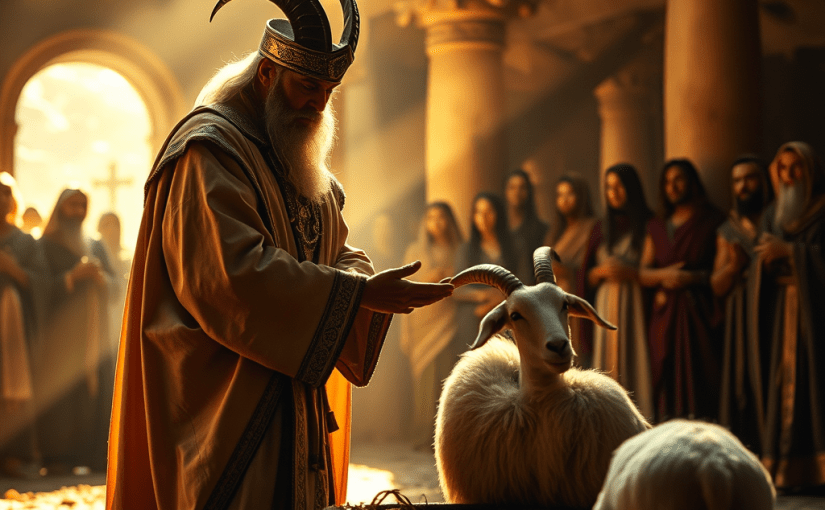
    “Scapegoat” is an interesting word. Its roots come from the ancient Jewish practice of, once a year, having the High Priest pray and lay his hands on the head of a goat, thus symbolically transferring all the sins of the Israelites from the previous year onto the goat, which was then banished to die in the desert. Then, everyone celebrates being cleansed of their sins – until their sins start to cause problems again.

    Scapegoating works in a perverse way in any culture because it allows all the pent-up fear, anger and hatred of that culture to be focused on a persecuted and usually defenceless and innocent minority group. It also conveniently allows the persecuting group to escape looking at their own sins as the cause of the culture’s problems and take responsibility for the culture’s flaws.

    The first step in scapegoating is to dehumanize your chosen enemy by calling them denigrating names such as ”anti-Christ.” So, they are both scapegoating the other party. Neither Trump nor Harris is the anti-Christ. They are limited human beings like the rest of us who are convinced their own point of view is right and simultaneously choosing not to see anything positive in their opponent. 

    The Trump camp has been emphasizing as their main argument that when Trump was president, there were no wars and no inflation, as if Joe Biden and Kamala Harris were personally responsible for the wars in Ukraine and Israel, and as if inflation was not a consequence of the government giving out billions of free dollars to keep the economy afloat during the Covid shutdown.

    The Harris camp has been pressing as their main argument that Trump is a fascist, and if he is elected with total legal immunity, it will be the end of women’s rights and of democracy.

    It is far too late, but it might have helped if both of them had meditated on and tried to follow Jesus, the ultimate scapegoat, who Christians claim took away the sins of the whole world by sacrificing himself on the cross. In this case, he is both the High Priest and victim of our scapegoating, both the G.O.A.T. (Greatest Of All Time) and the goat. 

    However, this approach only works if Christians do not use Christ’s redeeming work on the cross as an excuse to let themselves off the hook of owning their own sins and scapegoating as the cause of all their problems. God takes away our sins, but that doesn’t mean we don’t have to change our lives.

    Christians, and all of us, need to own how often we do not love our enemies.

Bruce Tallman is an educator of adults in religion. http://www.brucetallman.com

Spiritual Warriors: Beyond Patriarchy and Pleasure

In medieval royal courts, the joker/jester

was seen as a symbol of Christ –

pricking the balloon of patriarchal pomposity

overturning people’s applecarts

and worldviews –

Christ was and still is the glittering joker

dancing in the dragon’s jaws –

laughing at the precariousness of life

when Eternity is at hand

when we let go of patriarchy

we do not abandon ourselves to evil

we come home to a relational God

who created relational human beings

who enjoy pleasure

but “If we abandon ourselves to pleasure alone

the pleasure principle leads to despair 

since life becomes meaningless” 

– Seneca, Stoic philosopher

we also need to reclaim the warrior archetype 

from the military

we need to fight against the war machine and injustice

for the true warrior is spiritual –

true mystics and prophets are spiritual warriors

Mohammed was a spiritual warrior

and, by the grace of God, a genius of literature –

it is not just the message

but the fusion of poetry and prose

that makes the Quran a masterpiece

Mohammed, like Moses and Jesus

created not just a ‘revival’ but also an ‘awakening’ –

revivals are personal/emotional conversions 

of individuals –

awakenings are cultural revitalizations

that restructure not only social institutions

but also the very purposes and goals 

of civilizations.