Archetypes underlie all religions

Given all the religion-based conflict in the world, perhaps it would help if we tried to emphasize the similarities between religions rather than the differences tha t drive us apart and cause bloodshed. Archetypes provide a valuable common ground since they underlie all faiths.

   Carl Jung, one of the great psychologists of the twentieth century, noticed that certain patterns kept coming up, not only in his patients’ dreams, but also in literature, mythology, history, religion, and daily life in all cultures and all ages.

    From this he surmised that all humans must share in a level of the psyche even deeper than the subconscious mind that his mentor, Sigmund Freud, discovered. Jung called this deeper level the collective unconscious, and the contents of this part of the psyche or soul he called archetypes

    Archetypes are spiritual energy centers and part of the imago Dei, the image of God that God created in the soul, to guide us to fulfilling lives. Jung and others claim that these primordial images are like instincts in that they subconsciously control everything we think, feel, and do.

    Four key archetypes that form the basic structure of the human soul in men and women everywhere are the sovereign, warrior, seer, and lover. Franciscan priest Richard Rohr, Robert Moore, Carol Pearson, Caroline Myss, Robert Bly, and others have written extensively about these four heroic archetypes.

    The sovereign is the benevolent leader or person in charge, the warrior is the one who fights for goodness and justice, the seer is the wise man or woman, and the lover is the one who is passionate for others whether it is a partner, friend, the poor, or the earth.

    As an example of how the sovereign appears everywhere and in every age, consider that throughout history there have been kings, queens, maharajahs, sultans, tsars, emperors, presidents, and prime ministers in various countries, as well as chiefs in native American, Canadian, Brazilian, Australian, and African tribes. The sovereign is also manifest in daily life in the chief executive officer or manager at work, or the father or mother at home.

    There are also anti-heroic or “shadow” archetypes which involve complete possession or complete dispossession by the sovereign, warrior, seer, or lover. For example, if a person is completely possessed by the sovereign archetype, he or she becomes a tyrant. Complete dispossession means the person becomes an abdicator. The other anti-heroic archetypes are the sadist and masochist (warrior shadows), manipulator and fool (seer shadows), and the addict and frigid (lover shadows). 

    These negative archetypes, working subconsciously, can cause great misery in our lives. In fact, the whole post-911 world can be explained in terms of archetypes in the form of tyrants (George W. and Saddam) and sadists (Osama and other terrorists). 

    Negative archetypes can also affect church leadership in the form of bishops and priests who are tyrants ruling with an iron fist, abdicators who don’t teach justice, sadists who condemn everyone’s spirituality and morality but their own, masochists who don’t take care of themselves, manipulators who make the laity fearful, fools who subtly block the ministry of any talented lay person, addicts who abuse children for their own sexual pleasure, and frigids who are burned out, emotionally dead, and cynical.

    People in archetypal roles have great power because they activate the numinous archetypal energies of our souls. This explains the aura that surrounds seers such as the medical doctor, medicine man or woman, shaman, guru, imam, rabbi, priest, or minister. This also explains why the pope and dalai lama draw huge crowds wherever they go. They have double the fascinating numinous power since they are in both the sovereign and seer role.

    The Bible is eternally appealing to the human soul because it is an archetypal book, full of heroic and anti-heroic sovereigns, warriors, seers and lovers. Think, for example, in the Jewish scriptures/Old Testament of King David, Queen Esther, King Saul, Queen Jezebel, Goliath, Samson, Delilah, Samuel, Solomon, Isaiah, Ruth, and the lovers in The Song of Songs.

    The New Testament likewise is full of heroes and anti-heroes. There is Peter (the spiritual abdicator and later, spiritual sovereign), Paul (the spiritual warrior if ever there was one), King Herod, Queen Herodias, Pilate (the political abdicator), centurions and zealots, magi (seers), good and bad priests, John the Baptist, Judas (the manipulator), contemplatives (lovers of God) like Stephen and John the beloved disciple, and so on.

    Churches use archetypal language all the time, whether they know it or not, when they refer to Christ as priest, prophet, king, and supreme lover. Certainly he was in warrior mode when he cleared the moneychangers out of the temple, and there is a graphic, symbolic description in the book of Revelation (19:11-21) of Christ leading the armies of heaven against the forces of evil. To Christians, Jesus had the four foundational archetypes in perfection.

    Since these archetypes are hardwired into the human psyche, they appear in other religions as well. No Muslim would dispute the fact that Mohammed is the sovereign leader of Islam, that he was a physical and spiritual warrior in the wars against the polytheists, and a great seer in receiving the Quran from the archangel Gabriel. 

    Hindus could point to Krishna as a lover when he danced with the gopi cowgirls, Arjuna as a warrior, and great seers like Sri Aurobindo, Vivekananda and others. All Buddhist monks and nuns would come under the seer archetype, and boddhisattvas would be examples of agape lovers, sacrificing their own entrance into nirvana until all sentient beings are enlightened.

    Anyone interested in ministry or leadership in any religion, or in spirituality in general, would do well to familiarize themselves with the heroic and anti-heroic archetypes which have the power to fulfill or destroy any individual, religious tradition, or even whole societies.

Bruce Tallman is author of Archetypes for Spiritual Direction: Discovering the Heroes Within (Paulist Press 2005). See http://www.brucetallman.com.

Is Trump or Harris Anti-Christ or Scapegoat?

Kamala Harris has been accused by Trump of being the “anti-Christ.” Subsequently, some of his followers have argued that Harris, if elected President of the United States, will be responsible for the slaughter of millions of children as she tries to get Roe vs Wade reinstated. She has also allowed millions of illegal aliens to flood across the US border, and they are all rapists and murderers.

    On the other hand, the Harris camp points out that, in the Christian scriptures, the devil is called the “Father of Lies,” and Trump is seen as an unrepentant liar. He has deceived half the population of the United States with his lies, spews racism and hatred, is obsessed with power, wants to be the most powerful person in the world, and tried to destroy democracy by inciting the January 6 attempt to overthrow the US government.

    In either case, although both claim to be Christian, they are promoting the exact opposite of Christ’s teaching to “love your enemies.” They both are preaching the anti-gospel by demonizing their opponents.

    Rene Girard (1923-2015), a French philosopher, claimed that whenever things go wrong in a society, the political leaders will try to gain or hold onto power by scapegoating some group, that is, proclaiming the group is the cause of all the society’s problems. Therefore, the solution is to banish or kill off that group, and then all will be well again. This was Hitler’s basic strategy in the Second World War: the Jewish race was the cause of all of Germany’s problems and, therefore, must be eliminated.

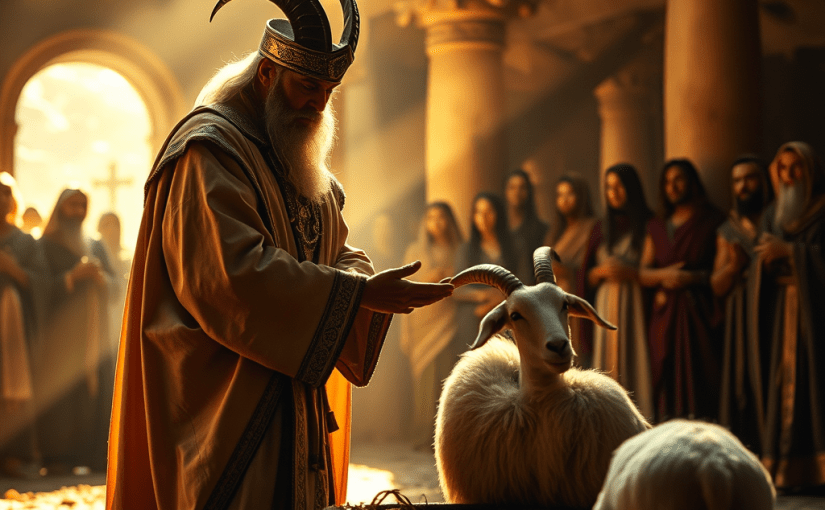
    “Scapegoat” is an interesting word. Its roots come from the ancient Jewish practice of, once a year, having the High Priest pray and lay his hands on the head of a goat, thus symbolically transferring all the sins of the Israelites from the previous year onto the goat, which was then banished to die in the desert. Then, everyone celebrates being cleansed of their sins – until their sins start to cause problems again.

    Scapegoating works in a perverse way in any culture because it allows all the pent-up fear, anger and hatred of that culture to be focused on a persecuted and usually defenceless and innocent minority group. It also conveniently allows the persecuting group to escape looking at their own sins as the cause of the culture’s problems and take responsibility for the culture’s flaws.

    The first step in scapegoating is to dehumanize your chosen enemy by calling them denigrating names such as ”anti-Christ.” So, they are both scapegoating the other party. Neither Trump nor Harris is the anti-Christ. They are limited human beings like the rest of us who are convinced their own point of view is right and simultaneously choosing not to see anything positive in their opponent. 

    The Trump camp has been emphasizing as their main argument that when Trump was president, there were no wars and no inflation, as if Joe Biden and Kamala Harris were personally responsible for the wars in Ukraine and Israel, and as if inflation was not a consequence of the government giving out billions of free dollars to keep the economy afloat during the Covid shutdown.

    The Harris camp has been pressing as their main argument that Trump is a fascist, and if he is elected with total legal immunity, it will be the end of women’s rights and of democracy.

    It is far too late, but it might have helped if both of them had meditated on and tried to follow Jesus, the ultimate scapegoat, who Christians claim took away the sins of the whole world by sacrificing himself on the cross. In this case, he is both the High Priest and victim of our scapegoating, both the G.O.A.T. (Greatest Of All Time) and the goat. 

    However, this approach only works if Christians do not use Christ’s redeeming work on the cross as an excuse to let themselves off the hook of owning their own sins and scapegoating as the cause of all their problems. God takes away our sins, but that doesn’t mean we don’t have to change our lives.

    Christians, and all of us, need to own how often we do not love our enemies.

Bruce Tallman is an educator of adults in religion. http://www.brucetallman.com

Three Truths of Wisdom: Confucianism and Christianity Explored

Confucian wisdom has three components:

cultivation of the person

meaningful action nourished by heavenly splendor

harmony of one’s wisdom with the wisdom of others

Christian wisdom knows the soul needs three truths:

knowledge of God’s goodness

knowledge of self

cure for the world’s woes in constant/humble/prayer

in Confucianism, filial piety

does not equal blind obedience/subservience

to age and authority –

a son will correct his father 

when he knows his father is wrong

similarly, the minister will correct the prince 

when the prince is wrong

in Christianity the beginning of wisdom 

and nondual consciousness

involves seeing not only the goodness of things

but also their weakness/failure/dark side

the ‘prosperity gospel’ on the other hand

tries to see only the good side of things

and divides everything into either/or

good/bad – there is no realism/

no middle ground

and so the ‘prosperity gospel’ weaves 

Christianity and the American dream of wealth together

breeding fanaticism and unbalance

the Second Vatican Council (1962-1965)

recognized that the institutions/laws/

modes of thinking of earlier generations

were not well adapted to contemporary realities

but the Council Fathers/Bishops/Archbishops

wanted to aid those trying to preserve three truths:

the holiness/natural dignity/greatness

of ordinary life and its superlative value

much as Confucianism does.

Understanding Spirituality Through Great Thinkers

Martin Buber was the great spiritual interpreter of relationships

Gustavo Gutierrez of liberation

Karl Rahner of ordinary experience

Paul Tillich of cultural trends

Ken Wilber of everything

Wilber and Tillich:

everyone has a spirituality: an ultimate concern:

– archaic spirituality (food/sex/survival)

– magic spirituality (rituals/voodoo/Santeria)

– mythic spirituality (fundamentalism/literalism/exclusivism)

– rational spirituality (reason/materialism/science)

– pluralist spirituality (postmodernism/relativism/skepticism)

– systems spirituality (deep ecology/Gaiaism/interconnectedness)

– integral spirituality (inclusivism/developmentalism/

inner and communal transformation)

Buber: “Spirituality and life is about community 

not the lone individual”

in a Christian society, people produce goods and services

for the good of all/the common good

not for the profits of the owners

all work is done for a transcendent purpose:

building the kingdom/queendom/kindom of God 

where all people and creatures are taken care of

However, Christianity is not the only place of God’s rule:

Chakravartin, the universal Hindu king in India

Ashoka, the first Buddhist monarch in Buddhism

Shih Tuang Hi, the first Taoist emperor of a united kingdom in China

all governed by Heaven’s Mandate

under Heaven’s Law

so Mother Teresa taught her sisters

never to try to convert a Muslim/Hindu/Buddhist

by talking about Jesus

or promoting Christianity

but rather by being Jesus to them.

COSMIC SHIFTS IN CONSCIOUSNESS

The only direction of evolution is “convergence” –

which is both positive and creative –

the creation of evermore complex life forms

the “Axial Period” within that positive direction

happened between 800 and 200 years before Christ 

in China (Confucius and Lao Tzu)/India (Buddha)/

Persia (Zoroaster)/Israel (Prophets)

all arose and transformed everything

that human beings could be

Hugh and Richard Saint Victor

Christian philosophers/mystics 

wrote in the 12th century that there are three eyes:

the first eye of flesh gives us sight

the second eye of reason gives us meditation/reflection

and the third eye of contemplation gives us true understanding –

the ability to see with the eyes of the heart –

the brothers Saint Victor continued the God-given

unfolding of human consciousness

but in Buddhism and Christianity there has also always been

a “contemptus mundi” – a contempt for the world

however, churches in the postmodern world 

can no longer pretend they are the only sources of grace 

and that the Holy Spirit is not active in all civilizations

or churches will continue to become irrelevant/fringe groups  

the tradition of churches condemning their best thinkers 

like Meister Eckhart (who in 1329 was labelled a heretic)

means that the real victim was not Eckhart himself 

but Christianity since Eckhart’s “Creation Spirituality “

which is Jewish/biblical/prophetic

was replaced by an anti-intellectual asceticism

which is apolitical/dualistic/introverted not world-shaking

still, conscious evolution goes on – 

Christianity finally shifted from the fall/redemption 

Era of Peter from Constantine’s Holy Roman Empire 

in 310 AD to the 1960s – the beginning of the Era of John

a mystic of the Cosmic Christ

who promoted Cosmic Consciousness

and noted that even Peter was a mystic –

for he repeated three times

“Lord, you know that I love you” (John 21:15-17).

WOMEN ASCENDING

According to the great theologian Paul Tillich

anxiety appears in three forms:

anxiety of death

anxiety of meaninglessness

anxiety of condemnation

another great theologian Karl Barth

wrote that God condemns no one to hell – 

we create our own hell –

thus in Church Dogmatics Barth radically departed

from John Calvin’s doctrine of double predestination –

God predestines some to heaven

and some to hell – what kind of God would do that?

so, Barth favored a simple predestination to heaven

however, people can create hells for other people –

going beyond Barth, higher education allowed women 

to create postcolonial/liberation/inculturated theologies –

the spread of women’s voices across the world

gave them the power to address unjust global structures

of finance and business

and to connect capitalism/colonialism/racism

the basic motivation in healthy Christianity 

is based in union with God –

from there the sacred water keeps flowing

and washes away all women’s sense 

of inferiority/unworthiness/low self-esteem

but women today can get caught up

in perfectionism – “having it all” – 

making unrealistic demands on themselves

the pursuit of excellence on the other hand 

allows women to take pleasure 

in striving to meet their own high standards

without castigating themselves 

they learned that loving themselves

means embracing their own

strengths and weaknesses

insights and stupidities

successes and failures

body and soul

badness and goodness

finiteness and infiniteness

so there is no longer any shame or self-condemnation.

The Fifth Awakening

Awakenings occur when society’s old institutions break down:

the First Awakening (1730-1760) in North America

ended European forms of religion

and ushered in Protestant Evangelicalism

the Second Awakening (1800-1830) 

ended Calvinist dominance of theology

the Third Awakening (1890 – 1920) had two parts:

the social gospel and Pentecostalism

the Fourth Awakening (1962-1965)

was the Second Vatican Council

the Fifth Great Awakening has been happening 

since the 1970s thru the new science

which does not prove or disprove the existence of God 

nor does it contradict the basic beliefs of our faith

what the believer looks for in science is not proof

but a more accurate understanding of reality

The Tao of Physics by Fritjof Capra showed how 

outstanding scientists shocked by 

relativity and quantum theory

turned to Eastern mysticism to understand reality

and Carl Jung’s belief that all humans 

are communally connected and interdependent 

led to his theory of the Collective Unconscious

which fit well with the quantum universe

and Jesus, like mystics everywhere, was a unitive thinker 

who talked about his unity with the poor: 

“To the extent you took care of one of these 

sisters and brothers of mine, even the least of them, 

you did it to me”

– Matthew 25: 31-46

to love Christ is to take care of the most needy –

that is why ministers of the gospel, as Henri Nouwen put it 

must be “wounded healers” 

or they cannot enter authentically into the suffering

of a dislocated world/

a rootless generation/

a dying person

unless they have experienced the awakening of suffering 

in their own heart.

TEACHINGS OF THE LIVING CHRIST

The birthing of the universe is miraculous:

one-trillionth of a % faster = universe flies apart

one-trillionth of a % slower = universe collapses into itself

only God could pull this off

only God is able to do all things

including bringing life out of death

as with Christ

according to the Buddhist saint Thich Nhat Hahn

“After Buddha’s death devotion turned 

from the Dharmakaya (the teaching)

to the Eternal Buddha (the Teacher)

Buddha became in Mahayana Buddhism

the Buddha of Faith/the Living Buddha

like the Christ of Faith/the Living Christ”

(Living Buddha, Living Christ)

Jesus taught thru the Bible that love takes place

in personal care for:

children: “Let the little children come to me

and do not hinder them, for the kingdom of heaven 

belongs to such as these” (Matthew 19:14)

parents: “Honor your father and mother

that your days may be long in the land 

that the Lord your God is giving you” (Exodus 20:12)

the sick and poor: “Come to meall you who are weary 

and burdened, and I will give you rest –

take my yoke upon you and learn from me

for I am gentle and humble in heart” (Matthew 11: 28-30)

Jesus also taught thru the Church 

“Contemplative prayer is a gift/a grace

that can only be accepted in humility and poverty” 

(Catechism of the Catholic Church)

and he taught thru the saints 

like Teresa of Avila 

that “If you get to the fifth inner mansion

there is absolute certainty

that God has planted Godself

in the center of your soul

and at that point your only desire

is to do God’s will”

(The Interior Castle).

SCIENCE VERSUS RELIGION AND MEANING?

Forty percent of chemists/physicists/astronomers

have a religious affiliation 

but forty percent of Americans believe 

science and religion are incompatible/in conflict

science is about objective truth about Nature

but Spirit first of all goes out of itself as Nature

so Nature is objective Spirit/

unselfconscious Spirit/slumbering Spirit

Plato’s “visible/sensible God”

and Nature is a dynamic god

not an inert background for Mind

as the ancient Egyptians thought

to Dietrich Bonhoeffer “religion”

is the “garment of Christianity”

its outward form not its essence

and when essence is lost

religious institutions like churches die 

and are reborn as something new

death and rebirth is a pattern

in all major religions:

life/death/resurrection/reincarnation

the Moon is the great symbol of this –

religion is about symbolism 

the source of meaning

and humans by Nature are meaning-seekers:

even so-called “primitive” tribes

believe the Moon 

is the abode of souls 

awaiting reincarnation

and the Moon expands with souls as it waxes

and releases souls as it wanes

the Moon dies/resurrects/

reincarnates as something new

it may not be a scientific fact 

science is all about facts

but the Moon-belief

is objectively and truly meaningful

and soul-satisfying.

SPIRITUALITY BEFORE BIBLE

A Jesuit approached a guru

and asked to be initiated

into the art of praying without ceasing

the guru said “Concentrate on your breathing

and the air you breathe in and out is God

and stay with that awareness”

the Jesuit soon realized

prayer is as easy

as breathing

and that with the guru’s method

praying without ceasing is easy-

all of us are praying without ceasing

as we breathe

as long as we are aware


but constant awareness is the great challenge

for all of us, not just Hindus and Jesuits –

and in addition, the challenge for Buddhist practice

is to hold the sadness of Samsara

and the vision of the Eastern Sun

at the same time –

to hold sadness at our broken/illusory world

and the joy of heaven

simultaneously

and in constant awareness


but any type of prayer, Eastern or Western,

is powerful –

it was three hundred years of praying

that came before and led to

the Nicene Creed

and to choosing what books went in the Bible

and what did not make the cut –

the Gospels of Peter/Mary/Magdalene/Phillip/Thomas/

Gospel of Truth/Gospel to the Egyptians/Secret Book of James –

prayer came before choosing

the Canon of Scripture –

the officially sanctioned books by the Church –

the Bible and Creeds came after the prayer of the Church


the Bible and Creeds are not unimportant

but they are not foundational

spirituality/prayer is.