
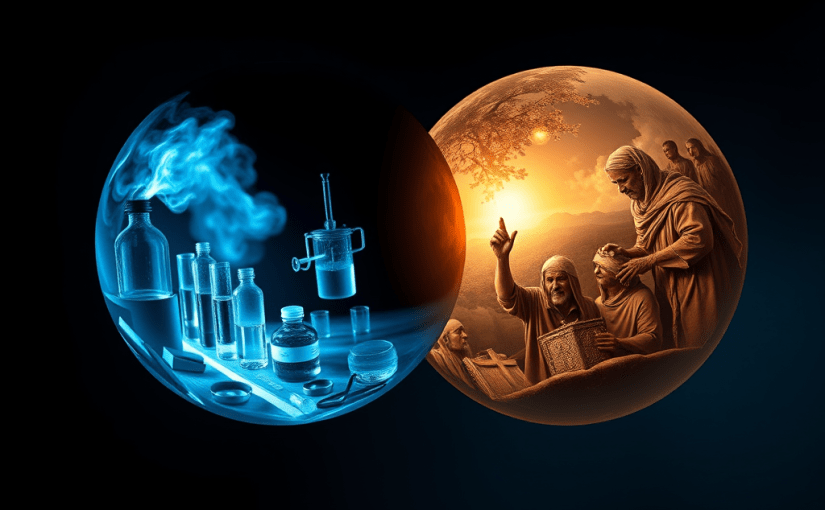
For the past few decades, atheists have been speaking freely about their lack of faith. In part they have been emboldened by two vociferous atheists. In both Richard Dawkins’ The God Delusion and Christopher Hitchens’ God Is Not Great: How Religion Poisons Everything, they take the worst examples of religious folly and advocate getting rid of religion because it is an irrational curse on the human race.
There is no denying that they are both partially right: religion has been the cause of a lot of irrationalism and evil, witch-hunts and terrorism. However, there is also no denying that they are largely wrong: religion has been responsible for untold good. There is not only unhealthy religion, but also healthy religion.
As my friend Dr. Larry Cooley, a philosopher of science and religion, put it: “From a scientific viewpoint, Dawkins and Hitchens are unscientific when it comes to religion. In formulating a theory, a competent scientist tries to account for all the data.” It’s surprising that Dawkins, a respected scientist in the field of genetics, would throw out the scientific method when it comes to religion. In arguing that we should get rid of religion, both he and Hitchens have not taken into account all the data about bad science and good religion.
It would be easy to attack science based on all the evil it has brought upon the human race. Science and the technology that derives from it have brought us all manner of weapons of war: bombs, machine guns, tanks, and biological and chemical warfare. Science has been responsible for the maiming and deaths of hundreds of millions of people.
Science has also robbed people of hope for the future. I remember thinking in the 1980s that my family and I probably had no future because of the constant threat of nuclear war. Now, people in their twenties tell me they have no future because of the destruction of rain forests, pollution, and global warming brought upon the human race by science and technology: bulldozers, chain saws, cars, planes, and factories. Science is once again threatening our planet with destruction. Science has totally failed to bring us the utopia promised by the Enlightenment. One could argue that science is evil and should be done away with.
On the other hand, Dawkins and Hitchens have not taken into account all the data about good religion. The World Council of Churches and the Vatican have issued and implemented numerous statements and strategies about war, social justice, poverty, hunger, welfare, and the environment. Most universities and hospitals in the western world began under the sponsorship of Christian churches. Here in London, Ontario, for example, St. Joseph’s Hospital began as a mission of the Sisters of St. Joseph, and Parkwood Hospital began with the Women’s Christian Association. The University of Western Ontario began with Huron College, an Anglican seminary.
The whole Canadian system of universal health care happened because of the efforts of a Baptist minister, Tommy Douglas. Our legal system and moral code are based on Judeo-Christian precepts. As Michael Coren once said, “Quite simply, without Christian groups and Christian people, the social network of Canada would collapse. This is not hyperbole. Walk along almost any main street and look at the names of the houses, associations, and institutes that work for the poor.” In London, we have the Salvation Army and numerous soup kitchens sponsored by churches, and most churches educate their congregations about social justice issues and engage in charitable activities here and abroad.
Countless missionaries have brought not only religion but also education and medicine to developing countries. I think of my friend Dr. Harold Fast, a Mennonite who lived and died selflessly helping thousands of Muslims as a medical missionary in Pakistan. Save a Family Plan, operating out of St. Peter’s Seminary here in London, has helped tens of thousands of the poorest of the poor in India become self-sufficient.
On an individual level, religion has given billions of people a sense of significance, that their lives have transcendent value and meaning, that they are more than a cog in the drudgery of daily existence. Religion has brought people a sense of personal ethics, community, comfort, and hope for the future.
The problem in the world today is not science or religion. The problem, and the glory, is human nature. As human beings, we have the capacity to take these two great endeavors of the human spirit, science and religion, and make them into something very compassionate or very destructive. Dawkins and Hitchens seem to miss altogether the fact that, whether as scientists or religionists, we are capable of unlimited good and evil. Religion, at least, predicts this.
The most serious criticism of fundamentalist atheists like Dawkins and Hitchens is their inadequate scientific method: not taking into account all the data about healthy religion and unhealthy science makes them incompetent thinkers from their own scientific viewpoint.
Bruce Tallman is a London spiritual director and educator of adults in religion: brucetallman.com.


 Intelligent Christian Spirituality