BEWARE THE CHEESE MONKS!

Modern values focus on individualism

postmodern values focus on relativism

and often both result in nihilism and meaninglessness.

We all have limitless wealth –

the whole Creation is given to us by God

but we get so caught up in individualistic or relativistic

competition/defeat/victory

that we no longer see

what is right in front of us.


A competitive society is violent

so the apparent passivity Jesus preached

in the Sermon on the Mount –

turn the other cheek – seems absurd

but is actually subversive resistance

which forces perpetrators to face

their own violence.


What Thomas Merton rejected in the “world”

was not wealth or ambition

but the world’s triviality –

its fads/advertising/masks of hypocrisy

which even his comrades he disparagingly called

the “cheese monks” got caught up in –

as if their true calling/purpose was to produce

excellent cheeses or liqueurs!


The Catholic Church got so off track

that sex scandals broke it –

one third of people raised Catholic

vacated the premises

and with the pandemic

another third departed.


If real transformation never happens for Christians

then for professional church staff

their work becomes just a career

and for lay people church becomes something

one just attends, an afterthought

instead of the living Body of Christ

which heals the “world” and its violence

by giving it profundity.


THE EROTIC UNIVERSE

In early Christianity, theology and prayer

were never divorced. Evagrius of Pontus (345-399 CE):

“The theologian is the one who prays

and the one who prays is a theologian.”


Later on, Thomas à Kempis wrote in The Imitation of Christ

“If you look at Creation, the Creator

withdraws his gaze from you.”

So, Christians have had an anti-Creation/

anti-body/anti-sexuality spirituality

which is ironically contrary to the Creation-centered

spirituality of the Bible.


But the theory of evolution changed all that –

evolution does not degrade humans

it shows us we are an integral part

of a vast web of earthly relationships.

But science only tells us ‘how’ we got here –

we need religion to tell us ‘why’ we are here – our purpose.


The idea of Christian cosmology

is in the Greek Fathers of the Church

particularly Irenaeus, who wrote that, in Christ,

the universe finds its meaning and goal.


The Uni-Verse, the One Verse, the One Poem

is thoroughly relational/communal/erotic –

wanting union even at the molecular level –

‘gravity’ is ‘mutual attraction between bodies’ – ‘eroticism’ –

its all part of the love that makes the Universe go round –

to ‘be’ is to ‘be with’ – the ‘we’ always precedes the ‘I’

just as the sexual union of a man and woman precedes children –

no one can say “I did it all on my own”

or “I did it my way – alone.”


Mantras are not words that mediate rational meaning –

they are vehicles that carry the spirit to one’s depths

and give us solitude to make us ‘uselessly present’ to God

which connects us to love in our depths

which connects us to others –

solitude is thus the erotic foundation

upon which community is built –

the purpose of life is the same as the purpose

of the Universe – to make love.

UNITY SURPASSING MODERNITY

The Perennial Philosophy highlighted

the “Great Nest of Being”

which was the universal worldview of humanity

until modernity reared its methuselah head.


Going beyond modernity

since the turn of the millennium has been

a growing awareness of commonality

between religions, and unity of all sciences –

a general visioning of all things as interrelated.


However major dualisms still persist:

heaven vs Earth/spirit vs body/human vs animal/

sacred vs secular – all these dualisms

which falsify life/nature/God

since God works thru both/and polarities

not either/or dualisms – God is in and beyond

the Earth/body/nature/culture/life.


Photosynthesis, one of the key factors in life

happened when chlorophyll molecules served everything

by capturing solar energy and converting it into

food and energy for others

3,000,000,000 years ago.


Nature serves us and Law serves us

and so our will delights in Law

but we cannot fulfill all laws

so the Cosmic Christ emerged from within the universe

as Jesus the Christ who lived under the Law

and experienced all our temptations/compulsions

in order to redeem/liberate us from the Law

with the Divine Love that goes beyond Law.


Following Jesus, Christian social action

finds God in politics/work/social programs –

anything that betters human life –

because Christ became human

and every human is another Christ

and we cannot let Christ live

in physical/spiritual squalor –

“As you do to the least, you do to Me”

– Jesus the Unitive Thinker in Matthew 25:40.

UNPOSSESSIVENESS

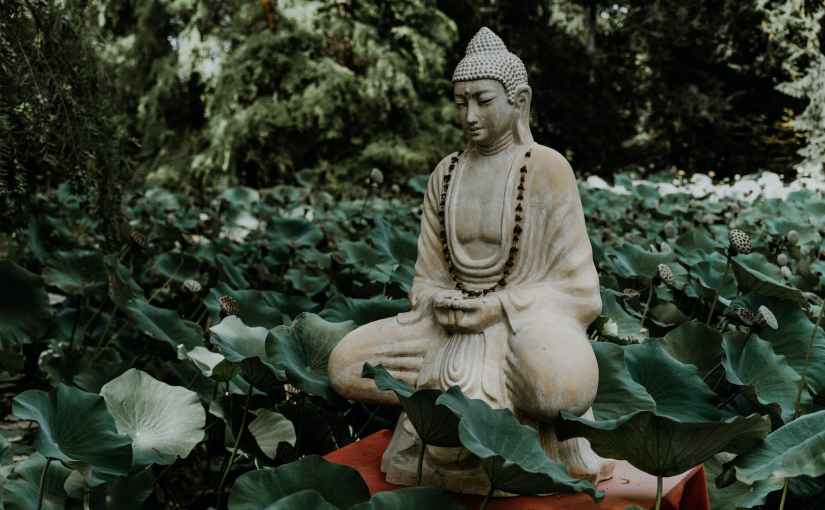
There is the historical Buddha, Guatama

and there is the living Buddha within us all

who, like the Image of God/Cosmic Christ within

transcends all space/time/concepts

and is constantly Present.


Saint Pope John Paul II wrote that Buddhism

is “negative atheism” but the Second Vatican Council

saw that “Buddhism recognizes the radical insufficiency

of this shifting world, and teaches a Way

to absolute freedom and supreme enlightenment

through our own efforts and higher assistance” –

presumably help from Bodhisattvas.


Buddhists practice detachment

but Meister Eckhart taught liberation

thru “unpossessiveness” –

detachment involves rejecting the world

but unpossessiveness makes us lighthearted

and free to follow God.


Even in our daily sufferings/frustration/pain

we can experience God’s action transforming us

if we are faithful to the Inner Calling

of the living Buddha/Image of God/Cosmic Christ.


Canadian poet/singer Leonard Cohen:

“There is a crack in everything –

that’s how the light gets in.”

Canadian folk legend/activist Bruce Cockburn:

“You have to kick at the darkness

till it bleeds daylight.”

You must fight to create the cracks

that let in the light.


But the 81 stanzas

of the Tao Te Ching by Lao Tzu

suggest the Way of Peace and Surrender

is always superior to the Way of Force.

THE SOFTNESS OF GOD

The mythologist Joseph Campbell’s view of God is hard/

transcendent/anonymous – a God untouched by pain

and life is a horrendous Divine Comedy

in which “all things take place by strife” (Heraclitus).


Paul Tillich’s approach to God is theological/psychological

and Raimundo Panikkar’s is interreligious/philosophical –

Panikkar believed in ‘cosmotheandrism’ –

the nondual inter-being of created and divine realities –

both approaches lend themselves to soft compassion.


Muslims believe all truth – including Jewish

and Christian truth – was simultaneously present

in Mohammed’s enraptured soul –

critics bewildered by the randomness of the Quranic Suras

try to grasp the Ocean of Prophecy

with the Thimble of Rationality.


All of us have five processes simultaneously happening:

cognition (awareness of what is)/

morals (awareness of what should be)/

the full range of emotions/interpersonal relations/

and Maslow’s hierarchy of needs –

plus, according to psychologists

we all think 60,000 thoughts a day –

no wonder we are so complicated/conflicted/full of strife!


We work on ourselves in order to help others

and we help others in order to work on ourselves –

to accept the parts of ourselves – our homeless shadows

and inner prostitutes – we have rejected

and this inner work is hard.


Among lovers, true love is to shut down your options/

tie the knot/give your all to one person

in a world of infinite choice/infinite insatiability

where everything has its price –

this too is hard

very hard

and requires help from God

who is Infinitely Soft

Infinite Softness/Infinite Tenderness/

Infinite Mercy/Infinite Motherhood.


THE CHRIST-MIND OF BUDDHA

The nuclear physicist David Bohm clearly explains

how a “particle view of matter”

harms all the sciences

as well as how we think and live

and therefore harms society and its future.


The universe is not a static framework

of separate particles – therefore if Jesu

is the Christ and alive today we need a Christology

that is organic/interrelated/dynamic/cosmic.


Buddhists have this with their cosmic lineage

of wonderful/interconnected/universal Buddhas –

when they say they believe in the Buddha

their faith is in this lineage not in the one

historical Buddha – Gautama – of our era.


The Buddha-mind or Buddha-nature

can be compared to the Image of God within us

or having the mind of Christ (1 Corinthians 2:16)/

being one spirit with Christ/the Cosmic Christ within.

This Buddha-mind/Christ-mind/Image of God within

integrates Buddhism/Christianity/Judaism –

we are all talking about the same thing.


A key concept for Meister Eckhart was conformity

to the mind of Christ/conformity to God/deiformity –

this union with God within us transforms our knowledge

of God/births God into the world/transforms the world

so that “our hands become gloves for the hands of God”

– Frederick Buechner


But John of the Cross and Ignatius of Loyola agree:

mystics open themselves to cosmic forces of good

and evil – many locutions and visions from the devil

are similar to those of God, therefore

constant discernment of spirits is necessary:

is this ecstatic rapture from the Holy One

or from the Father of Lies

and Deception?

BUTTERFLIES AND DEATH

Convergent evolution comes from and heads towards

maximum consciousness/Alpha and Omega/the Cosmic Christ.

The human soul that was always there becomes conscious

when human consciousness emerges

from the general groping of Nature towards self-reflection.

We are unique in that we reflect on things.

We are the universe becoming conscious of itself/

reflecting on itself/learning to direct itself

and its unconscious groping processes.


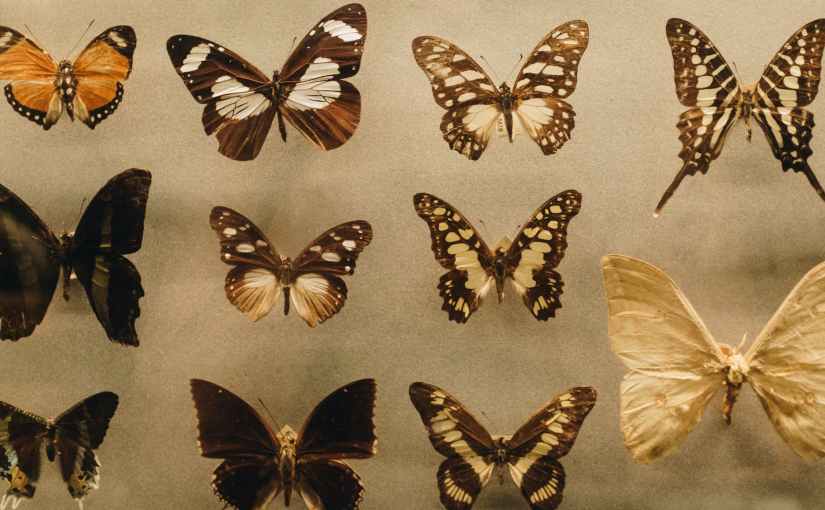
The original Greek word for “soul,” “psyche”

literally means “butterfly” because the soul/true self

is elusive/hard to pin down in an exotic butterfly case.


Fundamentalists need humility to understand

the Absolute Truth they think they have

only exists in the Mind of God –

humans are always groping/searching for their soul.


And arguments for the immortality of the soul

do not alleviate the universal/inescapable/

existential anxiety about death

which cannot be argued away –

fear of death drives humans toward evil

and so “Reasonable people, devoted to rationalism

fail to perceive either the depths of evil

or the depths of the holy.” -Dietrich Bonhoeffer


Not overthinking about death

and living in the Now with the Divine Present

alleviates the death-grip of evil:

Breathing in I relax my body

(reduces stress)

Breathing out I smile

(relaxes hundreds of facial muscles)

Dwelling in the Present Moment

(brings happiness here and now)

I know it is a Wonderful Moment

(brings pleasure/peace of mind/spirit/soul).

THE STRAWBERRY OF GOD’S EYE

A Fourth Awakening of Christianity may be coming –

postmodern Christianity started in the 1960s and is more

pluralistic/egalitarian/experimental/environmental.

Harvey Cox, a Harvard sociologist/theologian thought

a 1500 year “Age of Belief” was ending

and an “Age of Spirituality” was beginning.

Some think the 300-year-old “Enlightenment” has fizzled:

people no longer trust science for all the answers.

Phyllis Tickle described an ongoing “Christian rummage sale:”

every 500 years or so everything changes –

500 AD Christianity became the Holy Roman Empire

1000 AD the Western and Eastern Churches split

1500 AD the Protestant Reformation

20th Century: the Second Vatican Council.


“In the monomyth of the Hero’s Journey

the normal rites of passage are magnified: you separate

from ordinary life and enter a world of supernatural wonders/

overcome fabulous challenges/return with boons

for all mankind.” – Joseph Campbell


After the first millennium, the “wandering ascetic”

was abolished – monks were ordered to “leave the world”

and live in monasteries. However, now we see

that ordinary, everyday life abounds with fabulous challenges:

opportunities to practice holiness/honesty/commitment/

trust/compassion/patience/forgiveness – we used to think

holiness consists of heroic deeds somewhere else

but it is all right here/right now.


Canadian folk music legend Bruce Cockburn:

“If you don’t see beyond normal sight

you can get trapped forever in the fraying-rope/

uneasy/anxious treadmill our culture is on.

You never see that the whole world is full

of the Spirit’s light/life/love.”


It is true that in the cosmic scale you are nothing

but “Do you not know that your name

is written in heaven?” (Luke 10:20) –

to God you are everything – the apple

of God’s eye – the strawberry of God’s “I.”


LGBTQA HAVE GIFTS TO GIVE CHURCHES

The criticism by Pope Francis of laws criminalizing homosexuality (London Free Press, January 26) was hailed as a new milestone by gay rights advocates, but it fits with his overall approach, based on the Catechism of the Catholic Church, that gay people must be welcomed and respected by the church rather than marginalized or discriminated against. “We are all children of God and God loves us as we are” he said. 

    Personally, I find it helpful when thinking about this issue to keep in mind Richard Rohr’s tricycle. Rohr, a Franciscan priest, says that the front wheel is your own personal experience: does this religious teaching make sense given what you have experienced? Then you check your experience against the back wheels of scripture and tradition.

    My own experience of life is that God loves diversity – there are so many varieties of plants, animals, and birds. No two moons, planets, stars, or galaxies are exactly alike. The same holds for people, we are all different. Perhaps God loves sexual diversity too.

    Some of my own life experience with sexually diverse people is as follows (with names changed to protect confidentiality).

    Walter, who was not interested in sex at all, fits the new category, asexuality (the ‘A’ in LGBTQA). Ronald was a devout Catholic I met in the early 1980s. Among the staff where we worked, the heterosexual married and single staff were all jumping from one bed to another. My wife Grace and I, and Ronald and his gay partner, were the only monogamous couples. This blew apart any stereotypes I had about gay men. Arnold, a devout Lutheran, seemed to be a woman trapped in a man’s body. He had the voice and all the mannerisms of a woman.

    Lawrence, a youth minister, told me he wasn’t sure he was gay. We were both concerned that if he came out of the closet, he would lose both his job and his marriage. So, for two years we explored all the reasons why he might not be gay. Finally, we concluded that he was in fact gay, did not choose it, and was born this way. He said he knew it all along but wanted to double check it with a trained spiritual director.

    My experience with gays is most of them would love to be straight so they could fit in with the majority, but they cannot deny how they were created. As Ronald said to me “I did not choose to be gay – why would anyone choose to be persecuted?”

    Fr. James Martin, a Jesuit priest whose book Building a Bridge addresses how the Catholic church and the LGBTQA community can get along, has had positive meetings with Pope Francis about this, and spoke in London a few years ago. He started off by asking “When did you choose to be white, heterosexual, male or female, short or tall?”

    He also made many suggestions about how any religious community could constructively approach LGBTQA people. First, like all of us, LGBTQA people are much more than their sexual lives, so do not reduce them to this. For Catholics, he reminded us that if a LGBTQA person was baptized as a Catholic as a child, you don’t have to try to get them into Catholicism. They already are Catholic and part of the church.

    Not only that but LGBTQA people bring a lot of gifts to any church. They know the suffering of the marginalized and therefore can minister more effectively to outsiders than a straight person can. So, they should be included as part of the church’s ministry.

    As far as the back wheels of the tricycle go, although the scriptures contain a few verses some interpret as anti-homosexual, they also contain many other things we now see as outdated, such as stoning to death people who work Saturdays (the Sabbath)!

     In general, the scriptural message is one of love and inclusion of everyone. Jesus never said anything about homosexuals and repeatedly reached out to the marginalized – prostitutes, the crippled, blind, and lepers. It is no stretch to believe he would welcome LGBTQA people. And Christian tradition has always taught that we are to imitate Jesus.

Bruce Tallman is a spiritual director and religious educator of adults. www.brucetallman.com/books



INTEGRALISM A WAY OUT OF POLARIZED WORLDVIEWS

It goes without saying that debate is polarized today. The left is convinced they are right. The right know they have the truth. Going beyond both into underlying worldviews might create understanding and help alleviate the conflict.

    Currently there are three predominant worldviews at work in our society: traditional, modern, and postmodern. Each has its own strengths and pathologies. A fourth approach, integralism, takes the best from those three and lets go of the negative stuff.

    People in the traditionalist worldview hold positive values like fairness, honesty, duty, honour, patriotism, making sacrifices for the greater good, and traditional religion. These are the good people who voted for Donald Trump, not because they liked him personally but because he spoke their language about tradition. He was going to restore things to the way they used to be, and “make America great again.” They felt it would be hard to bring this about and so they needed a tough guy like Trump to make it happen.

    The pathology of this worldview is that it tends to be ethnocentric. It focuses on “our group” being totally right and everyone else being wrong. It is an “us versus them” mentality. This can result in racism, homophobia, and xenophobia, that is, fear of strangers or anyone different than us. So, it is not surprising that it is against having a never-ending influx of immigrants. People here can get stuck in rigid law and order.

    The second worldview, the modern, also has many positive values, mainly about independent thought and empowerment of the individual. The modern worldview is in favour of science, rationality, freedom, democracy, capitalism and global markets.

    The shadow side of modernism has been an insensitivity to minorities and those who through no fault of their own cannot keep up with the competition. It is marked by over-consumption of the world’s resources and resulting environmental degradation. And as the individual triumphs, there is no sense of community and the greater good.

    The postmodern worldview began around 1968 according to Richard Rohr, Ken Wilber, and others. On the positive side, postmodernism is obsessed with human rights and the absolute equality of all people, particularly women, blacks, indigenous people, people of colour, LGBTQ and the handicapped. It is sensitive to minorities and the marginalized. People who hold this worldview tend to be world-centric not ethnocentric. They want to include all groups, including the natural world, and so are extremely environmentally conscious. People who believe in progressive religion would fit in here.

    The pathology of this approach lies in the tendency of every new level of development to be overly-critical of the worldview that preceded it. So, postmodernism tends to be anti-modern. It is anti-capitalism, ignoring all the good things capitalism has brought us. It is wary of all hierarchies that could create inequality and believes there are no absolute, objective truths. In a post-truth world, people can get stuck in chaotic relativism and disorder.

    Those who hold the integral worldview try to live by Wilber’s dictum of “transcend and include.” This means that you keep developing, constantly working on transcending your previous worldviews, but also try to include all the positive things from each earlier stage of development.

    Integralists try to escape rigid order and chaotic disorder and bring about a healthy reordering of things. There are many people who are trying to do this such as Jeff Salzman with his podcast, The Daily Evolver,and Steve McIntosh with his book Developmental Politics. In religion, besides Rohr, there is Catholic bishop Robert Barron with his Word on Fire podcast, Brian McLaren, a major Protestant thinker with books like A New Kind of Christianity and Pope Francis with his “integral ecology” outlined in his 2015 encyclical “On Care for Our Common Home.”

    What the world needs now is to respect and include the positive values behind others’ worldviews, let go of the negatives and learn to work together to bring about a new post-pandemic reordering of society and life.


Bruce Tallman is a spiritual director and religious educator of adults. http://www.brucetallman.com