Boost Your Spiritual Growth with These Easy Practices

If you adopt any of the following suggestions, it will have a big impact on your spiritual growth.

    Get to know a homeless person and try to find out how they became homeless.

    Read the scriptures of another religion.

    Start the day with prayer, meditation, scripture reading, or any spiritual reading. It will set the tone for the day.

    At the end of the day, keep a spiritual diary and record where you met God that day or what God taught you. Record your prayers and review them later to see if they were answered.

    Use natural breaks in the day, like meals, coffee breaks, or when you shower, drive, exercise or wait in line to think of others in prayer.

    Extend your present daily spiritual practice from 15 to 30 minutes or 30 minutes to an hour.

    Adopt a child or family in a developing nation through World Vision or a local charity like Save-A-Family-Plan and develop a relationship by writing back when they write you.

    Volunteer to visit people in jail, read to the blind, be a friend to the mentally ill, or help prepare meals and clean up at a local church soup kitchen.

    Hire the person on the traffic island with the sign that says they will work for food or money.

    Attend the place of worship of your own faith regularly if you do not do so.

    Prepare yourself before going to your place of worship by praying or reviewing the readings beforehand.

    Visit the place of worship of another denomination. For example, if you are Presbyterian attend a Mennonite service.

    Visit the place of worship of another religion. Christians could attend a local mosque. Muslims could attend a synagogue.

    Get to know someone of a different religion and find out what they believe.

    Check out www.beliefnet.com, a vast website where you can learn about any spiritual or religious tradition and dialogue with those in it.

     Join an online prayer community like that at  www.sacredspace.ie. You can put your prayer requests out there and pray for the requests of others.

    Get to know the writings of a major spiritual thinker like Thich Nhat Hahn or Henri Nouwen.

    Do a “retreat at home.” Take a whole morning, afternoon, or evening once a week or once a month to pray or meditate more deeply.

    Attend a local retreat center like the Michaelite Fathers just outside London, or Five Oaks in Paris, Ontario.

    Get to know the Enneagram, a powerful tool for spiritual growth and awareness at http://www.enneagraminstitute.com.

    Learn new ways of praying, like Centering Prayer, Ignatian Prayer, Taize Prayer, or learn new ways of reading scripture, such as Lectio Divina.

    All these things will help you on your spiritual journey.

Bruce Tallman is a London spiritual director and educator of adults in religion.

http://www.brucetallman.com

What the world needs now is healthy masculinity

There is a lot of toxic masculinity floating around in the world these days. It most often shows itself socially as violence against women, and politically as dictatorship. People seem enthralled right now with the strong male who claims he will make everything right for their country. Putin and Trump exemplify this.

       Males have been in power for a long time, and in that time, they have done a lot of good – they have been responsible for most of the world’s medical, legal, political, and scientific advances. However, there is no denying they have also done a lot of damage – men have caused most wars and crimes.

       When healthy, every man has four basic instincts: to be a servant-leader, to defend the weak, to be wise, and to be loving. God has given these instincts to men as gifts to be used in the service of others.

       Carl Jung, the great 20th-century psychologist, found that these male instincts manifested in every age and every culture’s history, religion, mythology, and literature. This discovery led Jung to hypothesize that males must participate in a “collective unconscious,” and these instincts, which he called “archetypes,” are the contents of this vast unconscious mind.      

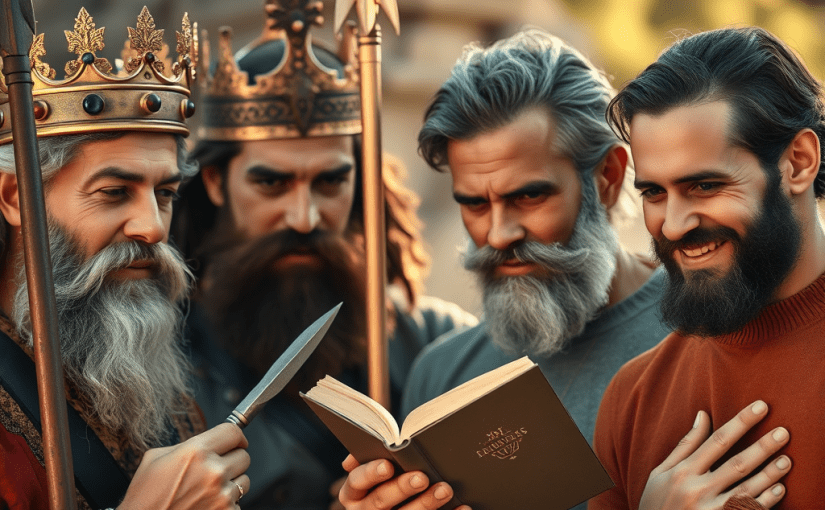
       In the contemporary literature on male spirituality, four archetypes have predominated: the Sovereign, Warrior, Seer, and Lover. These show up in a vast array of ways: the Sovereign manifests as the president, king, CEO, father, or pope; the Warrior is present as the soldier, policeman, sports hero, or prophet; the Seer shows up as the medical doctor, professor, minister, priest, or shaman; the Lover archetype can be seen in the musician, poet, contemplative, or worker for the poor.

    Healthy males keep all four archetypes in balance. When out of balance, the shadow male archetypes start to show up. The anti-Sovereign is the Tyrant, for example, the domineering boss, or the Abdicator – the absent father. The anti-Warrior is the Sadist – the terrorist or bully, or the Masochist – the victim. The anti-Seer is the Manipulator, for example, the negative politician, or the Fool – the men portrayed in television sitcoms and commercials. The anti-Lover is the Addict – to pornography, alcohol, or drugs, or the Frigid – the emotionally dead male.

       The male archetypes are not going to go away, they are hardwired into the male soul. We need the good archetypes to prevent the bad ones from manifesting. Boys need good role models such as Nelson Mandela, Gandhi, Desmond Tutu, the Dalai Lama, and Pope Francis, or the bad archetypes will take over. 

    Jesus had all four archetypes in perfection. Churches refer to him as priest (Seer), prophet (spiritual Warrior), and king (Sovereign), and he is the icon of the loving male (Lover).                      

    The world awaits the coming of males with all four archetypes in this perfect balance. Fortunately, there is an organization that is promoting this, The ManKind Project. It’s goal is to produce  healthy males, men who are kind, thus the “ManKind” name: (see http://www.mkp.org). The Project’s motto is “Changing the world one man at a time.” 

      This is a worldwide men’s liberation movement involving about 100,000 men who train other men in the healthy male archetypes. It is not a specifically religious movement, but it is deeply spiritual. Any man, religious or not, can join. I have been involved for over 25 years, and it has changed my life in numerous positive ways.

Bruce Tallman is the author of Archetypes for Spiritual Direction: Discovering the Heroes Within (Paulist Press, 2005). http://www.brucetallman.com.

Debunking Myths Between Catholicism and Anglicanism

Etiquette in interchurch dialogue nowadays prescribes emphasizing your own church’s weaknesses and the other church’s strengths. However, Connie Woodcock, an Anglican, breached this in attacking the Catholic Church based on stereotypes in “Thanks but no thanks, Pope Benedict.” Bob Ripley, a United Church of Canada minister, was much more balanced in “Rome bends rules in a conservative way,” but even with him, a few stereotypes slipped through.

       In the interests of reconciling Protestants and Catholics, it needs to be said that, while there is some truth in both sides’ stereotypes of the other, the reality is far more complex.

       Before I begin attacking stereotypes on both sides, I want to note “the sudden invitation to become a Roman Catholic while remaining Anglican” was not an “ill-conceived attempt at church poaching” as Woodcock claimed. It was simply the Pope’s response to numerous requests from Anglicans. Also, the format Benedict proposed is not new. Ukrainian Catholics, who are part of the Catholic Church, have their own distinct liturgy, and their priests can marry, but bishops are celibate.

       Woodcock’s first stereotype about “why Catholicism turns us off” is “the Pope’s infallibility.” Ripley likewise said, “The authority of the Pope is, of course, non-negotiable.” The reality is Catholics consider 99.99% of what the Pope says to be “authoritative,” not “infallible,” and we are taught to follow our own informed conscience, not blind obedience.

       Woodcock also complains about Catholicism’s treatment of women with “second-class standing.” The reality is that every priest is aware that most Catholic parishes would not survive without the immense contribution of women.

       Woodcock rails against Catholic teaching on birth control, but the reality is the Catholic church promotes the Billings method of natural family planning which is quite safe and effective in preventing unwanted conception.

       She also derides “top-down imposition,” but the reality is that Catholic lay people regularly give their input to priests and bishops in parish and diocesan councils. Woodcock states that in Anglicanism, there is “lots of room for varying shades of opinion,” whereas she seems to think Catholicism is one monolithic block. The reality is there are social justice people, evangelicals, liberals, conservatives, charismatics, intellectuals, prophets, and mystics of every kind all inside the Catholic Church.

       On the other hand, Catholics often hold the stereotype that the Anglican faith originated with Henry VIII, but the reality is that the Church in England was one of the earliest established, and Henry merely built upon what already existed.

       Catholics also have the stereotype that the United Church of Canada is exceedingly liberal, anything goes, and there is no central authority. The reality is there are many conservative United Churchers, and the church is governed by a central General Council that sets policy for it every three years.

       All Christians would be much more tolerant of each other if we focused on reality rather than stereotypes.

Bruce Tallman is a London spiritual director. www.brucetallman.com

Understanding Spirituality: The Essence of Consciousness

    God is Mother as much as Father. God as Mother is welcoming, warm, and inclusive. Returning to God as Mother would be a return to compassion and wisdom as a way of life.

The most foundational thing in existence is not matter, atoms, or quarks, but consciousness or spirit. Ultimately, we live in a spiritual universe.

    The bottom line is not money; it is God’s love. So, reality is foundationally safe and benevolent. Ultimately, it is not a scary universe. 

    God does not love us because we are good. God loves us because God is good.

    Salvation is not perfect morality. It is letting the dance/wind/fire of God flow through you.

    True religion is humble, not judgmental. It says, “Maybe I am the problem here, not you.”

    Love is to recognize the oneness of all things. God is in all of us, I am in you and you are in me, and we are all in this together. 

    God is not a concept to be believed in. God is a reality to be experienced.

    God, who is infinitely perfect and blessed, in an act of sheer goodness, created humans to share in God’s blessed life. That is our ultimate purpose.

        All the world’s major religions have identified the main problem as the ego.

    All the world’s major religions have identified the main problem as the ego.

    We all need to stop focusing on which worldview or religion is superior and start focusing on inner transformation by letting go of our egos.

    The only way to let go of ego is awareness of it. Ego is unconsciousness, so awareness kills it.

    The foundation of all justice is that our equality is intrinsic and founded on God’s love, not earned. Through no doing of our own, we are all equally loved by God.

    A teacher imparts knowledge or techniques. A master teaches by his or her way of life.

    All the great spiritual masters say: wake up: God has a plan for the creation. The plan is that God be all in all. This is the ultimate purpose of the cosmos. Do not shut God out of your life!

    The rich person may be poor, blind, and naked in God’s sight. Or not. The poor person may be rich in God’s sight. Or not. Outward state is no indicator of God’s favor or disfavor.

    “Ten thousand difficulties do not make a doubt.” – John Henry Newman

    To have everything, desire nothing.

    The garden of Eden, paradise, heaven, and God are within us, and it is the knowledge of good and evil, and the judgmentalism that comes with it, that keeps us out of the unity of all things.

    Life has always been a struggle and always will be. The fact life is hard does not mean it is not good. If the universe was perfect, there wouldn’t be anything to do. God made life good not easy.

    If we accept whatever God gives us: honor or dishonor, long life or short, health or sickness, riches or poverty, then we are free indeed.

    God is the only true object of desire because God alone has all love, knowledge, truth, justice, peace, freedom, and wisdom.

Bruce Tallman is a spiritual director and educator of adults in religion. http://www.brucetallman.com

Christianity needs to befriend contemporary spirituality

Twenty years ago, Eckhart Tolle’s books, The Power of Now and A New Earth sold millions of copies, and more recently Tolle facilitated what was probably the largest classroom in human history: 1.2 million people simultaneously online. 

       This great spiritual teacher’s vast popularity has led to the predictable reaction of some conservative Christians who have branded Tolle as a threat to Christianity and a leader of what used to be called the “New Age” movement, which is really simply contemporary spirituality. This is unfortunate because first of all, Jesus said “those who are not against us are for us,” and secondly Tolle can give us fresh new insights into the depths of the teachings of Christ.

       A Rabbi once told me that many Jews believe that non-Jewish people who live by the Ten Commandments, whether consciously or not, are on their side. Tolle, while not explicitly claiming to be Christian, is certainly not anti-Christian. If anything, he seems to bring to light things in Christianity that have been buried for centuries.

       One could easily argue that Tolle is a latent Christian and capable of helping many people become latent Christians, in that he subscribes to many of the same values as Christians, such as peace and detachment from materialism and consumerism. Also, in A New Earth he quotes Jesus more than anyone else, and the endnotes are almost all references to the New Testament.

       Throughout The Power of Now you could replace the word “Now” with “God” and the meaning would not change. His basic message in the book is that we need to live in the present moment, the Now, not in the past or future. Jesus said similar things, for example, “take no thought for tomorrow,” that is, don’t worry about the future or past, live now. He also said the reign of God is “at hand” that is, here and now.

       In A New Earth Tolle engages in a brilliant analysis of how the ego causes all our problems and how we must let go of it to live fully. Jesus taught that if you lose your small self you find you true self, your self in God.

       Richard Rohr, one of the most enlightened Catholic priests in the world, believes that Tolle could be seen as part of the “Sacrament of the Present Moment” tradition made popular by Brother Lawrence, Francisco de Osuna, and Jean Pierre de Caussade hundreds of years ago. Rohr sees Tolle as no threat to Christianity because Tolle is not teaching doctrines or dogmas, he is teaching practices just as John Wesley taught methods, and Ignatius of Loyola taught exercises, meant to help people overcome their prideful self, the ego.

       Rohr also believes that, although Tolle never explicitly states his theology, he is not a pantheist (all things are God), but rather a panentheist (all things are in God). The few times Tolle does speak of God he says things like “God is the One Life in and beyond all forms of life.”

       Rohr further believes that Catholics, who have a much longer tradition and are more familiar with mystics like John of the Cross and Meister Eckhart, will more easily embrace Tolle than Protestants whose tradition began in the sixteenth century. Tolle in fact adopted Meister Eckhart’s name when he realized he was also called to be a spiritual teacher.

       If Christians want to be relevant, they need to respond to the “signs of the times” by engaging contemporary people who are SBNR, that is, spiritual but not religious, in dialogue. What is needed is intelligent Christianity, capable of sifting out the good wheat in the current “zeitgeist,” or “prevailing thoughts of a culture,”  and letting the chaff blow away. Otherwise, Christianity may miss the opportunity to understand its own teachings more deeply and seem irrelevant to millions of people outside the church. These people might be more interested in the church if the church was more interested in contemporary spirituality.

Bruce Tallman is a spiritual director and educator of adults in religion. http://www.brucetallman.com

Exploring the God Debate: Proofs for and Against Existence

THE GOD DELUSION: FACT OR FICTION?

    In 2003, a new book by Richard Dawkins, The God Delusion, was climbing the bestseller charts and giving atheists everywhere powerful fuel for attacking religion. On November 9 eighty people attended a debate sponsored by the Humanist Association of London and Area on “Is There A Loving Creator God?” Here are the key points by the debaters Dr. Goldwin Emerson and Dr. Bruce Tallman.

    EMERSON: NO. THERE IS NO LOVING CREATOR GOD

    The Christian God is reputed to be an all-knowing, all-powerful, benevolent, supreme being who created the universe, answers prayer and influences events on Earth. He is also believed to have sent his son to Earth for the purpose of atoning for the sins of humankind. This description causes skeptics to ask the following:

  1. If the deity is all-knowing, he would know when disasters such as earthquakes and hurricanes are about to happen, and if he is all-powerful, why does he not stop these catastrophes and prevent the death of innocent people? 

2. If this deity is powerful and benevolent, why does he allow humans to be born with defects and incurable diseases? 

3. Millions of believers pray to their deity, asking that he intervene in events on Earth. Why are so many prayers not answered? 

4. Why do Christians claim that Jesus is divine, requiring worship, when no other monotheistic religions make this claim for their prophets? 

 5. As scientific knowledge advances, we learn that many of the world’s problems of pollution, war, global warming, hunger, and disease are human-made problems which, if they are to be solved at all, will need to be solved by human-made solutions. Why is it that Christians claim that God is necessary for ethical behaviour?  Effective ethical codes were established in various early civilizations prior to the existence of Christianity. 

    When asked why their omnipotent, loving God allows so much misery in the world, believers say God moves in mysterious ways, or the universe is unfolding as it should.  These answers are hardly satisfying to skeptics, and one is tempted to side with Sigmund Freud (1870-1937), who said: “A personal god is nothing more than a father figure: desire for such a deity sprang from infantile yearnings for a powerful, protective father, for justice and fairness and life to go on forever. God is simply a projection of these desires, feared and worshiped by human beings out of a sense of helplessness.  Religion belongs to the infancy of the human race; it has been a necessary stage in the transition from childhood to maturity.  It has promoted ethical values which were essential to society. Now that humanity has come of age, however, it should be left behind.”                                                                  For non-theists, the conclusion is that there is no God. On the other hand, there are alternative ways of viewing what has been called God. In the seventeenth century, the Dutch philosopher Spinoza proposed that the belief in God’s activity in the world was merely a way of describing the world’s mathematical and causal principles. For Spinoza there was no need for the concept of divine law: the best guidance is the eternal laws of nature. The famous physicists Stephen Hawking, Albert Einstein, and many more recent scientists and philosophers have expressed a similar view.

     Others may think of God as a quality within themselves, the Ultimate Reality or the Ground of All Being, instead of believing in the traditional Christian concept of God.

     Most liberal Christians accept the firm scientific evidence that the universe is billions of years old and that life on Earth evolved over millions of years; nevertheless, they may still believe that, in some mysterious way, God is a prime mover in this evolution. While religious people also credit God with the origin and existence of love, humanists believe love is a product of evolution. The emotion of love, particularly in mammals, enhances the survival potential of offspring. Considering God as a creator begs the obvious question: Who or what created God?  For humanists, the answer is simple: humans created God.

     It seems that primitive peoples looked for explanations of how the world works and created numerous spirits and gods to account for natural happenings. Over the centuries, many different gods were invented by ancient civilizations, including Egypt, Greece and Rome. One exception was the monotheistic God of the Hebrews. We now accept that the multitude of ancient pagan gods were created in the minds of humans. It is reasonable to conclude that Yahweh was also created in the minds of the Hebrews and became entrenched in the myths contained in the book of Genesis. Thus, humans created God in their own image rather than the other way around.

     Humanists are guided by the principles of rational thought, scientific inquiry, responsibility, ethics, compassion, fairness, and equality, and find it difficult to believe in the Christian concept of God. Instead, we believe that he was created in the minds of early Hebrews. Rather than worshiping the Christian God, humanists celebrate the opportunity of living on our wondrous planet and having the privilege of enjoying the many good fortunes available to us. In other words, they try to follow a philosophy of loving and revering life like believers love and revere God.

TALLMAN: YES. THERE IS A LOVING CREATOR GOD

    Nonbelievers usually do away with the idea of a Creator by ascribing God-like qualities such as infinity and eternity to the universe. However, Albert Einstein and Isaac Newton, the two greatest scientists who ever lived, both believed that the universe is finite, and modern astronomers all agree that the universe began with a Big Bang about fourteen billion years ago. They have also done computer projections that show that the universe will end in about one hundred billion years. Monotheistic religions believe that nothing caused God to exist, God exists infinitely and eternally by God’s own nature, and God caused the Big Bang.

    Believing scientists like Pierre Teilhard de Chardin, an expert on the fossil remains of evolution, have noted that evolution on our planet has proceeded from matter (rocks and water) to life (plants and animals) to thought (humans) to spirit (the great religions that continue to spread across the world) because humans are “homo religiousus,” that is, “hardwired for God”. The fact that the whole natural world has evolved in a spiritual direction, from matter to life to thought to spirit, is evidence that God is directing the whole evolutionary process.

    Many nonbelievers say they only believe in things for which there is scientific evidence. Although we cannot scientifically prove there is a God, there is evidence of the creativity of a Creator all around us: the sun, lightning, rainbows, flowers, mountains, peacocks, giraffes, children, and on and on. It’s as if the whole creation is shouting, “There is a God!” As one contemplative said, “ If you want to see God, just open your eyes and wake up!”

    Just as there is plenty of evidence that there is a creator God, the evidence of a loving God is all around us. First of all, there is far more good than evil in the world. Evil is always only a corruption of something that was originally good. For example, illness is always only a corruption of original health. 

    Doctors estimate that only about three percent of the population has a major illness at any one time; health predominates by far. If there is seven percent unemployment, it means there is ninety-three percent employment. Criminologists estimate only two percent of the population are criminals, the other ninety-eight percent are law-abiding citizens. So good is foundational, and evil is secondary. We take the good for granted because it is just so everyday and commonplace. Again, we need to open our eyes.

    The greatest proof that there is a loving God is that love is the central thing in life. This requires no argument since lovers, poets, philosophers, and mystics have been proclaiming it for centuries, and we all know in our hearts that it is true. If there is no God of love, why is good far more predominant than evil, and why is love the central thing in life? Atheists have no good explanation for this.

    Although God is loving, all-powerful, and all-knowing, God is also self-limiting. Natural laws serve us well the vast majority of the time, so God chooses not to interfere with them. If God interfered with them every time they might cause suffering, the world would be chaotic. Similarly, God chooses not to take away our free will, even when we misuse it and cause suffering, because otherwise, we would be robots, and there would be no real love in the world.

    God constantly works within us, trying to motivate us to love one another, prevent suffering, and bring greater good out of evil. Indeed, life is full of the overcoming of suffering. However, sometimes, we disobey God and cause suffering on a massive scale, such as killing millions of innocent people in the twentieth century. The real question here is not “How can God allow suffering?” but “How can human beings allow it?”             

    God does allow suffering, but only so that the highest human virtues: compassion, wisdom, heroism, service to others, and self-sacrifice, can emerge in response. If God took away all suffering life would lose its profundity.

    The crucifixion of Christ is the great symbol that God suffers with us and is right in the center of our pain, trying to alleviate it. And the resurrection of Christ is the great symbol that all suffering is finally overcome by God in heaven.

    Life on Earth is evolving in a spiritual direction; religion and spirituality constantly spring up everywhere because we are hardwired for God, good is foundational, love is central, and there are answers to suffering. All these things testify that there is indeed a loving, creator God.

Concluding Remark

    The two statements represent different ways of viewing our universe. One is religious, the other non-religious. These two positions are offered so that readers may better understand both and make their own choices on these important concerns.


Archetypes underlie all religions

Given all the religion-based conflict in the world, perhaps it would help if we tried to emphasize the similarities between religions rather than the differences tha t drive us apart and cause bloodshed. Archetypes provide a valuable common ground since they underlie all faiths.

   Carl Jung, one of the great psychologists of the twentieth century, noticed that certain patterns kept coming up, not only in his patients’ dreams, but also in literature, mythology, history, religion, and daily life in all cultures and all ages.

    From this he surmised that all humans must share in a level of the psyche even deeper than the subconscious mind that his mentor, Sigmund Freud, discovered. Jung called this deeper level the collective unconscious, and the contents of this part of the psyche or soul he called archetypes

    Archetypes are spiritual energy centers and part of the imago Dei, the image of God that God created in the soul, to guide us to fulfilling lives. Jung and others claim that these primordial images are like instincts in that they subconsciously control everything we think, feel, and do.

    Four key archetypes that form the basic structure of the human soul in men and women everywhere are the sovereign, warrior, seer, and lover. Franciscan priest Richard Rohr, Robert Moore, Carol Pearson, Caroline Myss, Robert Bly, and others have written extensively about these four heroic archetypes.

    The sovereign is the benevolent leader or person in charge, the warrior is the one who fights for goodness and justice, the seer is the wise man or woman, and the lover is the one who is passionate for others whether it is a partner, friend, the poor, or the earth.

    As an example of how the sovereign appears everywhere and in every age, consider that throughout history there have been kings, queens, maharajahs, sultans, tsars, emperors, presidents, and prime ministers in various countries, as well as chiefs in native American, Canadian, Brazilian, Australian, and African tribes. The sovereign is also manifest in daily life in the chief executive officer or manager at work, or the father or mother at home.

    There are also anti-heroic or “shadow” archetypes which involve complete possession or complete dispossession by the sovereign, warrior, seer, or lover. For example, if a person is completely possessed by the sovereign archetype, he or she becomes a tyrant. Complete dispossession means the person becomes an abdicator. The other anti-heroic archetypes are the sadist and masochist (warrior shadows), manipulator and fool (seer shadows), and the addict and frigid (lover shadows). 

    These negative archetypes, working subconsciously, can cause great misery in our lives. In fact, the whole post-911 world can be explained in terms of archetypes in the form of tyrants (George W. and Saddam) and sadists (Osama and other terrorists). 

    Negative archetypes can also affect church leadership in the form of bishops and priests who are tyrants ruling with an iron fist, abdicators who don’t teach justice, sadists who condemn everyone’s spirituality and morality but their own, masochists who don’t take care of themselves, manipulators who make the laity fearful, fools who subtly block the ministry of any talented lay person, addicts who abuse children for their own sexual pleasure, and frigids who are burned out, emotionally dead, and cynical.

    People in archetypal roles have great power because they activate the numinous archetypal energies of our souls. This explains the aura that surrounds seers such as the medical doctor, medicine man or woman, shaman, guru, imam, rabbi, priest, or minister. This also explains why the pope and dalai lama draw huge crowds wherever they go. They have double the fascinating numinous power since they are in both the sovereign and seer role.

    The Bible is eternally appealing to the human soul because it is an archetypal book, full of heroic and anti-heroic sovereigns, warriors, seers and lovers. Think, for example, in the Jewish scriptures/Old Testament of King David, Queen Esther, King Saul, Queen Jezebel, Goliath, Samson, Delilah, Samuel, Solomon, Isaiah, Ruth, and the lovers in The Song of Songs.

    The New Testament likewise is full of heroes and anti-heroes. There is Peter (the spiritual abdicator and later, spiritual sovereign), Paul (the spiritual warrior if ever there was one), King Herod, Queen Herodias, Pilate (the political abdicator), centurions and zealots, magi (seers), good and bad priests, John the Baptist, Judas (the manipulator), contemplatives (lovers of God) like Stephen and John the beloved disciple, and so on.

    Churches use archetypal language all the time, whether they know it or not, when they refer to Christ as priest, prophet, king, and supreme lover. Certainly he was in warrior mode when he cleared the moneychangers out of the temple, and there is a graphic, symbolic description in the book of Revelation (19:11-21) of Christ leading the armies of heaven against the forces of evil. To Christians, Jesus had the four foundational archetypes in perfection.

    Since these archetypes are hardwired into the human psyche, they appear in other religions as well. No Muslim would dispute the fact that Mohammed is the sovereign leader of Islam, that he was a physical and spiritual warrior in the wars against the polytheists, and a great seer in receiving the Quran from the archangel Gabriel. 

    Hindus could point to Krishna as a lover when he danced with the gopi cowgirls, Arjuna as a warrior, and great seers like Sri Aurobindo, Vivekananda and others. All Buddhist monks and nuns would come under the seer archetype, and boddhisattvas would be examples of agape lovers, sacrificing their own entrance into nirvana until all sentient beings are enlightened.

    Anyone interested in ministry or leadership in any religion, or in spirituality in general, would do well to familiarize themselves with the heroic and anti-heroic archetypes which have the power to fulfill or destroy any individual, religious tradition, or even whole societies.

Bruce Tallman is author of Archetypes for Spiritual Direction: Discovering the Heroes Within (Paulist Press 2005). See http://www.brucetallman.com.

EVOLUTION AND CONSCIOUSNESS

Dear Friends,

On September 7 the London Free Press published my article below under the title “Evolution leads to cosmic consciousness”

It is 689 words, so when you have 2 minutes, why not give it a quick read?

Blessings and peace,

Bruce Tallman

Spiritual Director

www.brucetallman.com

Mystics give us a bigger vision of where we are evolving

    Sri Aurobindo was a Hindu mystic. Teilhard de Chardin was a Christian mystic. They never knew of the other’s work. Despite this, they both came to the same momentous conclusion. The direction of evolution is toward divinization. This means God is fully alive in every human being.

    In books like The Future Evolution of Man (Aurobindo) and The Phenomenon of Man (Teilhard), they both outlined the earthly process. It moves from rocks and water (matter) to plants (sensitivity). Then it progresses to animals (feelings), leading to humans (thought). Finally, it reaches the spread of the great religions (spirit). The goal of evolution is greater and greater consciousness, from matter to spirit. We are heading towards God (Cosmic Consciousness) being all in all.

    Of course, since we have free will, if we choose hate and war over love and peace, we could destroy ourselves. The planet might be destroyed with us. Divinization is not a guaranteed process.

    In the past one hundred or so years new technologies such as radio, television, Internet, smartphones, and now artificial intelligence have been growing our consciousness at light-speed. These are all new stages of the world-wide evolution of humanity.

    Mystics and scientists have come to the same conclusion: everything is interconnected and one. The pandemic also forced unitive thinking on us: we are all in this together. As well the climate crisis forces us to see our interconnectivity: our energy use affects everything else.

    Richard Rohr, a Franciscan priest, has written about order, disorder, and re-order. For hundreds of years white males have dominated the planet, making decisions affecting everyone. The modern means of communication, particularly the Internet, have gradually dissolved this domination, allowing suppressed voices to speak: women, blacks, indigenous, and LGBTQ2SA+ people. All these new voices have also expanded our consciousness. Domination by white males is rapidly becoming a thing of the past.

    Our consciousness is expanding. We are now aware of stages of faith. The group stage loves order and simply believes what others say. The personal stage loves asking questions and deconstructing everything, particularly religion. At this stage people often feel they are losing their religion and leave their church, synagogue, mosque, or temple. This stage however is in danger of getting stuck in disorder. And disorder is the case for many young people today – they have never experienced even the group stage of faith and so have no spiritual foundation to build their lives on. 

    The final stage of faith is mysticism where you accept that those previous stages had their role to play. As Rohr says, you need somewhere to discover that some things are holy, and church is a good place to start. But the mature person grows their consciousness beyond that and eventually realizes that everything is holy: every creature is a face of God. The local church still has a role to play however: starting people on the road to oneness, holiness, justice, and mysticism.

    White male domination now senses that all these new voices are creating disorder and is trying to re-establish their authority and order, for example, “Make America Great Again,” or by arch-conservative bishops in the Catholic church trying to take the church back to the 1950s, before Vatican II (1962-65), which they perceive as disorder. But history always works as a spiral: two steps forward, one back, but ever onward (unless we destroy it).

    The Spirit of God is moving us inexorably towards re-order – towards unity, mysticism, and justice for all voices. This is what people like Aurobindo, Teilhard, Thomas Merton (a Catholic monk), Rohr, Matthew Fox (an Anglican priest), Brian McLaren (a Protestant minister), and Ilia Delio (a Franciscan sister and expert on Teilhard), advocate in their many books.

    Pope Francis also advocates this in his attempt to make the church “synodal,” that is, one where lay Catholics have a voice in church governance, not just priests and bishops. Despite this being opposed as disorder by some bishops, the church will likely continue on its road to inclusion, unity, and mysticism as this seems to be where God is leading it, and all of evolution.

Bruce Tallman is a London spiritual director and religious educator of adults. http://www.brucetallman.com

Unity Consciousness in Spiritual Experience

If you are spiritual you cannot ignore the flesh

you cannot pretend we don’t need the body

to live/breathe/move/see/hear/think/contemplate God

without the body and its senses there would be no spirituality

contemplation allows us to connect scriptures to life

to see how the God who liberated the Israelites

from slavery

wants to liberate us 

from slavery

to addictions/codependency/consumerism/victimhood

however, “Shame and aggression are central

in the human psyche, particularly men –

and these are the universal ‘original wounds’

not ‘original sins’ – and they are hard to shake”

– Otto Rank

but prayer heals

and translates religion/doctrines/dogma

into vital spirituality

and we pray in the first person

subject-to-subject

our soul to God’s soul

we say, “Lord, I am sad/joyful” 

not “Lord, he/she/it is sad/joyful”

Carl Jung’s personal myth of meaning

which he also found expressed in the Western Mystics

was the myth that God needs us 

to become more and more conscious

so that God can become conscious of the whole

which is what the Spirit is leading us to

the core of spiritual experience 

is the same in all religions:

unity consciousness

which is not a phantasmagoric mystical experience

but rather a life-changing sense 

of the unity of all things –

no more separation

we are all one

with God/others/ourselves

the whole Creation.

SCIENCE/STOICS/FEAR/LOVE

What the ancients called the ‘soul’

or the essence of personhood

emerged thru billions of years 

of converging and complex evolution

giving rise to ever greater consciousness:

matter/plants/animals/humans/

religions/sciences/Internet/smart phones/AI

but some religious people ignore common sense/

empirical science and develop utopian visions

and some scientists ignore the direction of evolution/ 

personal experience/religious wisdom

reducing humans to objects or machines

and some humanists in their quest

for self-fulfillment ignore the communal dimension/

traditional teachings about human nature –

dialogue between religion/science/humanism

is necessary for all of us to avoid our delusions

for everyone new knowledge can seem like an assault 

on our cherished idolatrous concepts –

even Einstein resisted the new knowledge

his own theories pointed to

however, he later admitted his resistance

to God playing dice with the universe

was his biggest mistake

Einstein claimed time and space are mental constructs –

its all going on in our minds, therefore

the only thing that makes things fearful is the fear itself – 

the fearfulness of things is in us not in them

as Seneca the Roman Stoic philosopher claimed

“Nothing is terrible in things except fear itself”

and Epictetus the Greek Stoic philosopher claimed

“It is not death or hardship that is a fearful thing

but the fear of death and hardship”

and Henri Nouwen the Roman Catholic mystic claimed

“Our greatest fear is intimacy with ourselves

and the greatest paradox is: 

the heart is where we are most ourselves 

and most alienated from ourselves

and since God is beyond even paradox 

and cannot be thought but only loved

we can approach God only in a cloud of unknowing.”