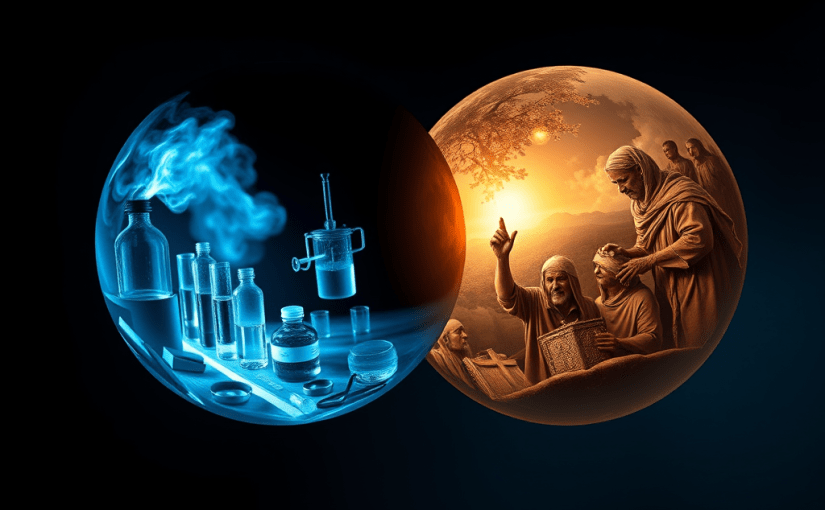
Atheists not scientific about religion

    For the past few decades, atheists have been speaking freely about their lack of faith. In part they have been emboldened by two vociferous atheists. In both Richard Dawkins’ The God Delusion and Christopher Hitchens’ God Is Not Great: How Religion Poisons Everything, they take the worst examples of religious folly and advocate getting rid of religion because it is an irrational curse on the human race.

    There is no denying that they are both partially right: religion has been the cause of a lot of irrationalism and evil, witch-hunts and terrorism. However, there is also no denying that they are largely wrong: religion has been responsible for untold good. There is not only unhealthy religion, but also healthy religion.

    As my friend Dr. Larry Cooley, a philosopher of science and religion, put it: “From a scientific viewpoint, Dawkins and Hitchens are unscientific when it comes to religion. In formulating a theory, a competent scientist tries to account for all the data.” It’s surprising that Dawkins, a respected scientist in the field of genetics, would throw out the scientific method when it comes to religion. In arguing that we should get rid of religion, both he and Hitchens have not taken into account all the data about bad science and good religion.

    It would be easy to attack science based on all the evil it has brought upon the human race. Science and the technology that derives from it have brought us all manner of weapons of war: bombs, machine guns, tanks, and biological and chemical warfare. Science has been responsible for the maiming and deaths of hundreds of millions of people.

    Science has also robbed people of hope for the future. I remember thinking in the 1980s that my family and I probably had no future because of the constant threat of nuclear war. Now, people in their twenties tell me they have no future because of the destruction of rain forests, pollution, and global warming brought upon the human race by science and technology: bulldozers, chain saws, cars, planes, and factories. Science is once again threatening our planet with destruction. Science has totally failed to bring us the utopia promised by the Enlightenment. One could argue that science is evil and should be done away with.

    On the other hand, Dawkins and Hitchens have not taken into account all the data about good religion. The World Council of Churches and the Vatican have issued and implemented numerous statements and strategies about war, social justice, poverty, hunger, welfare, and the environment. Most universities and hospitals in the western world began under the sponsorship of Christian churches. Here in London, Ontario, for example, St. Joseph’s Hospital began as a mission of the Sisters of St. Joseph, and Parkwood Hospital began with the Women’s Christian Association. The University of Western Ontario began with Huron College, an Anglican seminary.

    The whole Canadian system of universal health care happened because of the efforts of a Baptist minister, Tommy Douglas. Our legal system and moral code are based on Judeo-Christian precepts. As Michael Coren once said, “Quite simply, without Christian groups and Christian people, the social network of Canada would collapse. This is not hyperbole. Walk along almost any main street and look at the names of the houses, associations, and institutes that work for the poor.”  In London, we have the Salvation Army and numerous soup kitchens sponsored by churches, and most churches educate their congregations about social justice issues and engage in charitable activities here and abroad. 

    Countless missionaries have brought not only religion but also education and medicine to developing countries. I think of my friend Dr. Harold Fast, a Mennonite who lived and died selflessly helping thousands of Muslims as a medical missionary in Pakistan. Save a Family Plan, operating out of St. Peter’s Seminary here in London, has helped tens of thousands of the poorest of the poor in India become self-sufficient.

    On an individual level, religion has given billions of people a sense of significance, that their lives have transcendent value and meaning, that they are more than a cog in the drudgery of daily existence. Religion has brought people a sense of personal ethics, community, comfort, and hope for the future.

    The problem in the world today is not science or religion. The problem, and the glory, is human nature. As human beings, we have the capacity to take these two great endeavors of the human spirit, science and religion, and make them into something very compassionate or very destructive. Dawkins and Hitchens seem to miss altogether the fact that, whether as scientists or religionists, we are capable of unlimited good and evil. Religion, at least, predicts this.

    The most serious criticism of fundamentalist atheists like Dawkins and Hitchens is their inadequate scientific method: not taking into account all the data about healthy religion and unhealthy science makes them incompetent thinkers from their own scientific viewpoint.

Bruce Tallman is a London spiritual director and educator of adults in religion: brucetallman.com.


EVOLUTION AND CONSCIOUSNESS

Dear Friends,

On September 7 the London Free Press published my article below under the title “Evolution leads to cosmic consciousness”

It is 689 words, so when you have 2 minutes, why not give it a quick read?

Blessings and peace,

Bruce Tallman

Spiritual Director

www.brucetallman.com

Mystics give us a bigger vision of where we are evolving

    Sri Aurobindo was a Hindu mystic. Teilhard de Chardin was a Christian mystic. They never knew of the other’s work. Despite this, they both came to the same momentous conclusion. The direction of evolution is toward divinization. This means God is fully alive in every human being.

    In books like The Future Evolution of Man (Aurobindo) and The Phenomenon of Man (Teilhard), they both outlined the earthly process. It moves from rocks and water (matter) to plants (sensitivity). Then it progresses to animals (feelings), leading to humans (thought). Finally, it reaches the spread of the great religions (spirit). The goal of evolution is greater and greater consciousness, from matter to spirit. We are heading towards God (Cosmic Consciousness) being all in all.

    Of course, since we have free will, if we choose hate and war over love and peace, we could destroy ourselves. The planet might be destroyed with us. Divinization is not a guaranteed process.

    In the past one hundred or so years new technologies such as radio, television, Internet, smartphones, and now artificial intelligence have been growing our consciousness at light-speed. These are all new stages of the world-wide evolution of humanity.

    Mystics and scientists have come to the same conclusion: everything is interconnected and one. The pandemic also forced unitive thinking on us: we are all in this together. As well the climate crisis forces us to see our interconnectivity: our energy use affects everything else.

    Richard Rohr, a Franciscan priest, has written about order, disorder, and re-order. For hundreds of years white males have dominated the planet, making decisions affecting everyone. The modern means of communication, particularly the Internet, have gradually dissolved this domination, allowing suppressed voices to speak: women, blacks, indigenous, and LGBTQ2SA+ people. All these new voices have also expanded our consciousness. Domination by white males is rapidly becoming a thing of the past.

    Our consciousness is expanding. We are now aware of stages of faith. The group stage loves order and simply believes what others say. The personal stage loves asking questions and deconstructing everything, particularly religion. At this stage people often feel they are losing their religion and leave their church, synagogue, mosque, or temple. This stage however is in danger of getting stuck in disorder. And disorder is the case for many young people today – they have never experienced even the group stage of faith and so have no spiritual foundation to build their lives on. 

    The final stage of faith is mysticism where you accept that those previous stages had their role to play. As Rohr says, you need somewhere to discover that some things are holy, and church is a good place to start. But the mature person grows their consciousness beyond that and eventually realizes that everything is holy: every creature is a face of God. The local church still has a role to play however: starting people on the road to oneness, holiness, justice, and mysticism.

    White male domination now senses that all these new voices are creating disorder and is trying to re-establish their authority and order, for example, “Make America Great Again,” or by arch-conservative bishops in the Catholic church trying to take the church back to the 1950s, before Vatican II (1962-65), which they perceive as disorder. But history always works as a spiral: two steps forward, one back, but ever onward (unless we destroy it).

    The Spirit of God is moving us inexorably towards re-order – towards unity, mysticism, and justice for all voices. This is what people like Aurobindo, Teilhard, Thomas Merton (a Catholic monk), Rohr, Matthew Fox (an Anglican priest), Brian McLaren (a Protestant minister), and Ilia Delio (a Franciscan sister and expert on Teilhard), advocate in their many books.

    Pope Francis also advocates this in his attempt to make the church “synodal,” that is, one where lay Catholics have a voice in church governance, not just priests and bishops. Despite this being opposed as disorder by some bishops, the church will likely continue on its road to inclusion, unity, and mysticism as this seems to be where God is leading it, and all of evolution.

Bruce Tallman is a London spiritual director and religious educator of adults. http://www.brucetallman.com

THE MAGIC ELIXIR

Tremendous change has happened since the Middle Ages:

Renaissance/Reformation/Enlightenment/Evolution/World Wars –

which makes theologians ask 

“What is modernity?/theology?/Christianity?”

but whatever it is, theology is secondary to liberating praxis –

solidarity with the poor must be the center of Christianity –

theology is subordinate to justice –

Jesus, like Buddha, came to liberate 

not speculate

another major development is Technology

which increases our ability to meet every human need

but hypnotizes the Masses into believing 

life is only about meeting economic needs –

we have gained the world 

but lost our souls

long before this, right back in biblical times

Christianity was corrupted by unconscious worldliness –

scholars agree on three “Pauls” in the Christian scriptures: 

the radical/conservative/reactionary Pauls –

Paul probably did not write Colossians and Ephesians –

fake authorship was common throughout the ancient world

and Paul goes from a theology of liberation in Romans/Corinthians

to a theological conservative in Colossians/Ephesians

who in these later books believes Christians can own slaves

for their own economic gain

but the Quran says “The riches and progeny of unbelievers

will profit them nothing when it comes to Allah –

they will inhabit the Fire –

believers put their trust in God”

so being Christian (or Muslim) never ceases to be challenging 

we always get pierced by the horns 

of scientific materialism or world-escaping piety

however modern theologians such as Ileo Delia 

avoid the conservatizing/privatizing/sickening of the Masses

and allow us to drink a magic elixir

made by swirling together central ideas from some august believers:

Merton/Teilhard/Panikkar/and Griffiths

that give us a robust/healthy modern faith.

“I AM” IS GREATER THAN “AI”

The small ego – the things we identify with –

our education/work/marital status/wealth –

our possessions can possess us

and hand the reins to EGO (Edging God Out):

our attachment to our self-image instead of to God.

The small ego is a necessary part, but not the whole

of who we are, and breaking free of it into the whole

liberates us from just being a part.


Even the small ‘I,’ the ego, cannot love

because it is always in one of four small ‘c’ modes:

calculation/control/competition/comparison.

Comparison with others = judging = anti-love.


To end the violence all around us

we first need to end the violence within us –

technology will not save us but “I AM” can

and meditation – listening to silence – the language of God

within us and around us – can help.


Quantum theology believes:

  1. the ‘shadow’ is a real and powerful dimension of all life
  2. the shadow cannot be eradicated
  3. the more we try to eradicate it, the more power we give it
  4. the shadow is a powerful force for creativity if we integrate it.


Because our shadow and God wrestle within us

most people relate to the sacred

with a sense of ambivalence – a mixture of

trust/antitrust/approach/avoidance.


But there is no need to be afraid –

the Godhead is a Goodhead.

In fact, it’s all good – Teilhard de Chardin saw that

even technology can provide a ground for religious development –

something that, rather than destroying us

with AI like CHATGPT

technology could take us to a higher level

of consciousness and union in love –

telescopes let us see into the past

and just how great/good/glorious God is

and always has been

and always will be.

REDEEMING TECHNOLOGY

If we are going to save humanity from technology

we need to emphasize the human need for

love/friendship/meaning/freedom.

This is where religion can be extremely valuable –

in humanizing technology.


On the positive side of technology,

Pierre Teilhard de Chardin, a Jesuit priest

envisioned technology gathering human energy

deepening love/global consciousness

and an awareness of ‘interbeing’ –

we are all part of an interweaving body

of life/love/motion we call the Uni-verse –

the One Cosmic Poem.


The problem with our contemporary world

is dissociating art/morals/technology

from each other and from religion:

not only pre-rational mythic spirituality

was rightly rejected

but also rational postmodern spirituality –

postmodern/liberal/intellectual humans

were left to answer the deepest question

“What is of ultimate concern?”

with only art/morals/technology

allowed to give an answer –

progressive religion was excluded from the debate.


In spite of this we have made moral progress –

we now recognize systems of injustice

rather than individuals cause immoral behaviour –

we have lifted the burden of responsibility off each person

and placed it squarely on the shoulders of corrupt systems

the individual is inevitably enmeshed in.


In any case, Truth cannot impose itself on our hearts

except by virtue of it being true.

Religions therefore must be free to speak their truth

without trying to coerce civil society.


Healthy spirituality could be an anchor for civilization

preventing it from being swept away by the current –

the overwhelming flood of technology.

FULL LIFE IN AN “AI” UNIVERSE

We are called to see God in all things

including our astounding science/tech innovations

and use them for the service of God

and everyone’s eternal happiness.

But since love is not part of the knowing process

of artificial intelligence/silicon chips/robots

technology takes over as our guide, not religion

and leads us into a posthuman world.

Edwin Hubble discovered the universe continually expands –

a major revolution in scientific understanding

of a former/fixed/static universe:

the universe will dissipate and end.

Expecting “The Universe” to do things for you –

“Ask the Universe to help you,” or as many say 

“Put your request out there and the Universe will grant it” 

is folly.

It is God who grants things. 

The reason for the Incarnation 

is the excess mercy and love of God.

Incarnation consummates the universe

and is willed by God entirely for itself

not as an afterthought

brought in to deal with sin. 

First of all, God wanted to show us 

how to be fully alive through Jesus the Incarnate Christ.

It is in our ordinary daily lives

where loving like Jesus

and bringing in transforming grace

happens in our relationships 

with spouses/children/friends/parents/coworkers.

When you enter fully into the Present

you alleviate confusion/suffering 

and touch the Prince of Peace and your own Buddhahood –

Buddhists practice Presence through conscious breathing.

Prayer is not primarily thinking and saying holy words –

it is a stance, a way of living continually in Presence

being aware of Presence, and enjoying Presence.

THE INTER-SPIRITUAL GOLD STANDARD

Inter-spirituality – religions getting along

and learning from each other – is an ideal

like the ethical gold standards:

economic egalitarianism

abandonment of militant nationalism

nuclear disarmament

which are promoted by globalism

and multiculturalism.

Conservative spirituality needs to loosen up

its fixation on ethnocentric myth

and learn how the Spirit expresses itself

in worldcentric reason

and postconventional love.

The Church is both human

since it exists within time

and is subject to forces of history and culture

and it is also divine

because it resolutely presses towards

the final Kingdom/Queendom/Kindom of God.

“Christians must resolutely strive towards

justice in the real, ambiguous world

where grace and sin abound.”

– Reinhold Niebuhr

The idea of God/Christ/religion evolving

rests on the notion that humans evolve –

in fact, technology has become so pervasive

we have evolved into a new species –

techno-sapiens.

At the microlevel of subatomic particles

there is an unceasing flow of energy

too vast for our minds to comprehend.

The Universal Christ is this energy incarnate

in every church/religion/all humans/the universe –

the Universal Christ is the inter-spiritual

gold standard.

Cosmic Lovemaking

A COSMIC, SPIRITUAL VIEW OF MAKING LOVE

    If God is love, the universe is grounded in love and exists by and for love. Love is the purpose of the universe.

    It was out of wanting to share love that God created the universe in such a way that matter intrinsically evolves towards spirit, and Earth went from rocks and water to human beings. Things have gone from pre-personal to personal and are heading towards the super-personal where all are filled with God and love God in return.

    Humans are at the center of this personalization process, not some accidental branch on the tree of evolution. And the process was furthered when Jesus said the greatest commandments are to “Love God with all your passion, prayer, intelligence and energy, and love others as well as you love yourself” (Luke 10:27 as translated by Eugene Peterson in The Message).

    Ilia Delio, a Franciscan nun, wrote in a chapter titled “Love, Sex and the Cosmos” that sex is basically spiritual. The sacred life-force that drives the evolution of the universe moves us from within with unitive desire. We all want union as intimately as possible with another human being. Sexual intercourse was meant by God to be the apex of the personalization of the cosmos, an integral part of our personal fulfillment with a beloved soulmate we can share life and love with.

    Going even further, sexual intercourse could be thought of as the primordial sacrament, since God’s first words to humans were “be fruitful and multiply” (Genesis 1:28) and without sex there would be no human race, religion, church or sacraments. 

    Given the sacredness of sexuality, how did we end up with a widespread culture of sexual abuse and rape, as the “Me Too” movement testifies?

     One explanation was given by Martin Buber, the great Jewish theologian, who wrote in his spiritual classic I and Thou that there are two basic ways of relating to everything: I-Thou and I-It. The I-Thou way sees everything as a sacred “Thou” full of the presence of God, including humans, animals and all of nature. 

    However, in a technological consumer culture we tend to relate to everything as an It, that is, as a soulless object to be used for our own self-centered purposes. 

    A young woman once said “I decided to get married because I am fed-up with the ‘hook-up’ culture where you are expected to have sex on the first date. I want true intimacy not fake ‘intimacy,’ a code word our culture uses for sexual intercourse. It is easy to bare your body and have sex; it is hard to bare your soul and make love.”

    Not everyone can have sexual intercourse, but anyone can make love in the sense of opening up your soul and sharing who you really are with others. Single people, the elderly and even vowed celibates can make love in this sense. William Johnston, a Jesuit writer on Christian mysticism, described in his autobiography Mystical Journey how he and Amy Lim, a Japanese nun, had a decades-long intimate but non-sexual relationship when he taught spirituality and theology in Japan.

    To learn more about making love in the spiritual sense, I would recommend Embracing the Beloved: Relationship as a Path of Awakening which describes a Buddhist way of intimacy as a “tandem inner journey towards spiritual realization.” Or read Pope John Paul II’s personalist “theology of the body” as popularized by Christopher West.

Bruce Tallman is a London spiritual director, marriage coach and religious educator of adults. brucetallman.com 

Love, Sex and True Intimacy

If God is love, the universe is grounded in love and exists by and for love. Love is the purpose of the universe.

    It was out of wanting to share love that God created the universe in such a way that matter intrinsically heads towards spirit. Through evolution creatures became more and more capable of love. Four billion years ago, Earth was rocks and water. Now there are human beings. Things have gone from pre-personal to personal and are heading towards the super-personal where all are filled with God and love God in return.

    This fits with Jesus saying the greatest commandments are to “Love God with all your heart, soul, mind and strength, and to love others as you love yourself” (Luke 10:27). Or as Eugene Peterson has it in The Message: “Love God with all your passion, prayer, intelligence and energy, and love others as well as you love yourself.”

    Ilia Delio, a Franciscan nun, wrote in The Unbearable Wholeness of Being: God, Evolution and the Power of Love in a chapter titled “Love, Sex and the Cosmos” that sex is basically spiritual. It is the sacred life-force that drives the universe moving us from within with unitive desire. We all want union as intimately as possible with another human being. Sexual intercourse is the zenith of the personalization process of the universe, meant by God to be part of the way we find personal fulfillment.

    Making love, in a broader sense, is the primordial “sacrament” that is the primordial “visible sign of God’s invisible love.” Making love underlies the seven church sacraments: baptism, reconciliation, communion, confirmation, marriage, holy orders and healing the sick. By “making love” I am not referring here to “sexual intercourse,” although intercourse could also be considered the primordial sacrament as God’s first words to humans were “be fruitful and multiply” (Genesis 1:28). Without intercourse there would be no human race, religion, church or sacraments. 

    Given all this, how did we end up with a widespread culture of sexual abuse and rape, as the “Me Too” movement testifies?

     One explanation is that, as Martin Buber, the great Jewish theologian, wrote in his spiritual classic I and Thou, there are two basic ways of relating to everything: I-Thou and I-It. The I-Thou way sees everything as full of the presence of God. Everything is a sacred Thou, including humans, animals and all of nature.

    However, in a technological consumer culture we tend to relate to everything as an It, that is as a thing to be used for our own self-centered purposes. We tend to use nature and humans as if they were things divorced from us.

    A young woman once said “I am getting married because I got fed-up with the ‘hook-up’ culture where you are expected to have impersonal sex on the first date. It is easy to bare your body and have sex; it is hard to bare your soul and make love. I want true intimacy not fake ‘intimacy,’ a code word our culture uses for sexual intercourse.”

    Sexual intercourse is for the few, but anyone can make love in the sense I am using it here, that is, opening up your soul and sharing who you really are with others. Vowed celibates and single people can make love in this sense. William Johnston, a Jesuit and leading writer on Christian mysticism, describes in his autobiography Mystical Journey how he and Amy Lim, a Japanese nun, had a decades-long intimate but non-sexual relationship when he lived and taught spirituality and theology in Japan.

    For more information on how to make love in the spiritual sense, I would recommend Embracing the Beloved: Relationship as a Path of Awakening which describes a Buddhist way of intimacy as a “tandem inner journey towards spiritual realization.” Or read Pope John Paul II’s “theology of the body” as popularized by Christopher West.

    At this Valentines/Family Day time of year, may we all learn to make love, that is, love one another as well as we love our self, opening our soul to our partners, family and friends and thus continue the universal personalization process initiated by God.

Bruce Tallman is a London spiritual director, marriage coach and religious educator of adults. brucetallman.com