THE GREAT LOVER

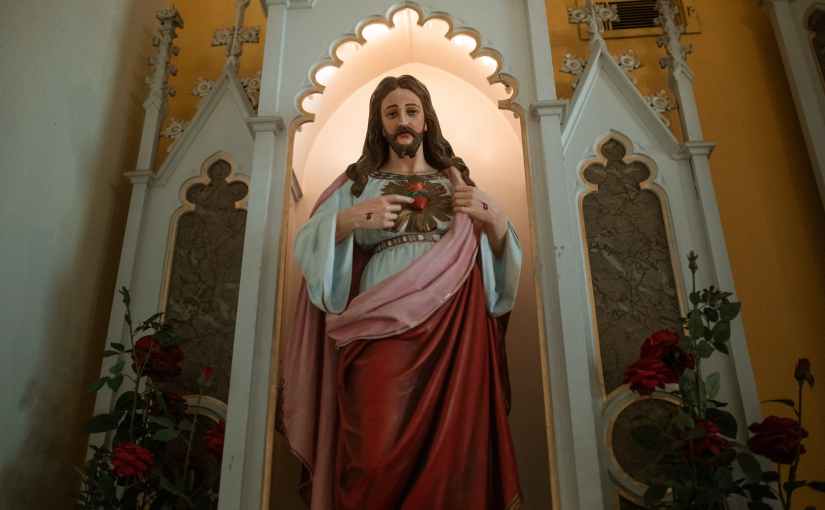
The Great Lover calls all of us

the outsider/sinner/violent

into the Ocean of Mercy called God:

“I did not come to make the virtuous

feel good about themselves,

I came for those who need healing.”

– Jesus

Once in the Ocean you can dive to the depths:

“There are two healing demands

if you take up the contemplative life:

forsaking the world’s evil

and purifying your conscience of all sin

through the sacrament of reconciliation.”

– The Cloud of Unknowing

Both Christianity and Buddhism encourage people

to reject all earthly aspirations.

Instead, people rejected religion

which works well for them

until there is serious suffering.

People losing their religion

may be entering a spiritual wasteland

or travelling into a mythic desert

where they can start a new spiritual search

for the God old, ossified institutions have lost.

Perhaps religion is all made up anyway –

our minds cannot grasp infinity

so we invoke concepts like beginning and end

Alpha and Omega, Incarnation and Resurrection

as dominant myths to help us cope

with our Infinite God and infinite universe

even though God is fully present everywhere

including in your own heart and soul.

Though God is in, over, through, and as us

“We do not see things as they are,

we see them as we are. We hear religious texts

according to our own level of consciousness

which is always developing.” – Richard Rohr

The first worldwide developmental Axial Age

was 500 BCE to 100 CE –

the rise of the great religions, east and west.

The second Axial Age began in 1600 CE

with the labor pains of science –

a massive revolt against Aristotle

and his deductive method of arguing from effect to cause.

Science was inductive/experimental/observational/pragmatic

thus, studying people’s approach to God (religious studies)

began to displace the science of God (theology) –

God became an object of academic study

instead of the Author of Living Faith.

Reason has overcome myth

and been a handmaid of Spirit

in achieving real freedom

rather than mythic freedom.

A person might worship an Egyptian god

but must overlook the great pyramids

were built by slaves.

Like the United States, Egypt was

“The land of the free

and the home of the slave.”

The mythic God – the angry old Sky-Man

brought hierarchical oppression to slaves and Catholics

but the Spirit brings democracy and real liberation.

With real liberation has come

bodily and sexual liberation –

It is not right for a human to act like an angel

denying all desires and pleasures.

God has designed us so that

certain desires and pleasures are natural for us –

to be human is more godly than to be angelic.

The lingam, the giant stone phallus in Hindu temples

represents the mythic god Shiva

and is an all-encompassing symbol

representing a multitude of ideas and emotions

which have little to do with penises and sex.

Other religious symbols like the Cross

represent many ideas and emotions other than

human cruelty and suffering.

The courage to suffer is an affirmation of one’s essential nature

but courage may require the Cross in your own life –

sacrificing other essentials such as pleasure or happiness

or even your life.

When you accept that ‘everything belongs’

you can accept suffering and death –

only the ego fears suffering and death –

whereas your true life, your soul

is hidden with Christ in God

and All things, even death, work for the good

for those who love the Great Lover.

THE INTIMACY OF GOD

Atheists believe we cannot make

any absolute statements about God

so the word ‘God’ is meaningless

and science can explain everything

so God is unnecessary.

Modernity separated the big three:

art, morals, and science

but its big mistake

was leaving out the big fourth:

religion, which draws the big three together –

there was no cohesion

so science dominated art and morals

and became the new religion of intellectuals.

But science and technology have no room

for the human person –

by kicking humans out of world center

into a vast impersonal universe

they kicked God out too –

they not only displaced God

they displaced humans

as God’s image.

What satisfies the soul is not knowing all

scientific knowledge

but doing the purpose

for which we were created: to love God.

The spiritual exercises of Ignatius of Loyola

are thus far more important

than any science textbook.

Catholic theology has always been pro-science

and insisted that faith and reason

are not opposites or enemies –

if you cannot give reasons for your faith

you become extremely devout

but an irrational/dangerous fundamentalist

who loves God

and blows people to Kingdom-Come.

Christians should be pro-science and pro-evolution

since evolution constantly drives toward

spiritual transcendence –

higher/more inclusive/more conscious orders

from atoms to senses to neocortex.

The Hindu Dance of Creation is all around:

clouds streaming, trees swaying, sunlight sparkling

on water and snow.

The Incarnate God shows God’s face everywhere –

God’s passionate embodiment demands

whole new ways of relating to bodies:

healing/sexual tenderness/compassionate justice.

The masculine in us tends toward

agency/rules/individualism/visions.

The feminine in us tends toward

communion/connection/relationships/touch.

Each person needs their whole self

and sexual relations between women and men need

the energies/polarities/excitement

of opposites becoming One.

The truth is: certain desires and pleasures

are willed by God – to not accept pleasure

is to not accept our humanity

and to arrogantly oppose God’s will.

Buddhists, on the other hand

preach detachment from pleasure and pain –

their key is not doctrines

about God/self/no-self

but nonattachment to illusion –

seeing the nature of reality

living according to reality

not words or concepts.

For Celts, reality is not

immediately visible/quantifiable by science

but the invisible world of

symbol/sacrament/myth.

To Celts, you are already holy

through the free gift of the Holy Spirit

the Divine Indwelling.

Authentic religion is about subtraction

letting go of the False Self

not creating a new Holy Self

not addition – with religion less is more –

letting go of the ego

and letting the Flow

carry you.

Surrender to the Great Mystery

is the key that unlocks

all world religions.

COSMOLOGY, SCIENCE, SPIRIT AND SUFFERING

Since the birth of science

Christianity no longer has an effective cosmology

and its followers have difficulty 

relating their faith to the world of science.

Meanwhile, secular culture sees its purpose as 

personal fulfillment and social progress

and religion as having little to do with

solving temporal problems.

Peoples’ loss of faith in the institutional church

and their search for meaning outside church

was instigated by God 

the Hound of Heaven who always pursues and finds us.

This is the mysticism of today

an attempt to find and experience the True God

rather than the Lego god constructed piece by piece

through pre-set definitions of churches.

The downside of abandoning religion

is that secularists suffer tremendously

 – always dissatisfied – never able to fill their soul’s God-hole.

To dissolve suffering due to dissatisfaction

with who we are and where we are

we are forced to give up some basic assumptions:

that we can have it all, get it all together

have lasting security, all pleasure and no pain.

In spite of these assumptions

or perhaps because of them

things fall apart.

Crucifixion is symbolic in its universal sense 

of destruction – that is an inevitable part

of evolution unfolding and necessary

for the birth of new life.

Secular people need to embrace poverty like Francis of Assisi:

“Blessed poverty even in this life

gives to souls who love her

the ability to fly to heaven.

Poverty guards the armor of true humility and charity.” 

Even Karl Marx was an anti-materialist 

when he wrote (well before intelligent phones):

“All our technological progress results in 

endowing material things with intellectual life

and stunts human development by materialism.”

Eastern religions share this anti-materialism

but their solution to the suffering caused 

is to desire less

whereas in western religions the solution is

to desire more – desire God –

until you reach God you have not desired enough.

But Christian theology to be relevant must gain a foothold 

in the new science that is replacing spirituality

for so many in Generations X to Z.

We need to see Spirit behind scientific revolution –

Spirit had to, thru Reason, free the Spirit 

trapped in the mythology of a distant heaven

and so break the chains

of the oppressed here on Earth.

Thomas Aquinas, a Dominican who dominated

Christian thought for centuries

was no Platonic contemplative

in love with incorporeal essences

but a Christian who contemplated the divine light

in every created thing here and now.

Heaven is NOW. In YOU.

Fully realizing that you are Spirit/divine

only happens if your Higher Self

takes compassionate action

letting Spirit into your whole life.

Otherwise, you stunt your development

if your Higher Self exists

only in the ivory tower of your intellect 

and never in your emotions, senses and body.

The laws of our mind, emotions and body

are one with the laws of the 

universe, galaxy and planet

that birthed us as its children.

Spirit driving science and evolution

gives us a new Christian cosmology.

TWO AGES

Michel Foucault believed the sciences of man

furthered scientism

the belief science has all the answers

which led to the “Age of Man”

in which humans are studied as

objects of scientific investigation –

B. F. Skinner’s behaviorism

treats humans as “Its”

with no subjectivity.

Science can give us concrete information

about the flow of evolution and our place in it

but not a framework for ultimate meaning –

the purview of theology and religion.

There is a different way of looking at salvation – 

God saves us from ourselves

by giving us meaning.

With meaning, little else is needed

without meaning we are caught up in endless

addictive consumerism, rivalry, competition

endlessly rolling the stone up the mountain

only to watch it roll down again

as others out-compete us.

But there is positive meaning and negative meaning.

Martin Luther’s meaning in the 16th century 

created the perfect storm for anxiety:

focus on sin, the wrath of God, heaven and hell

coupled with new printing press technology

to spread the Message, rats to spread the Bubonic Plague

and the dissolution of ecclesial order

an “Age of Anxiety” blossomed 

whose rotting fruit persists to this day.

Believing, as Luther did, 

that we are a solid, separate self

traps us in self-centeredness

but as we work through the chakras in order

we are liberated from successive prisons:

chakras 1,2,3: egocentric food, sex, power

chakras 4,5: ethnocentric love and communication 

chakras 6,7: world-centric mindfulness and spirituality.

The ‘porous’ non-separated self gives and receives:

as living beings, we are part of the close-knit family 

of living organisms that evolved one from another

over billions of years, products of immensely creative

energy-exchanges of matter and spirit that makes us one with

stars, galaxies, and everything.

Pharisaism symbolizes the self-centered self –

identification with your own self-righteousness

no shadow; no need of conversion

which ironically blocks your path to God

and your compassion for others –

being in touch with shadow means

you know you need, and others need

God’s grace.

To break addiction to yourself 

(the only way to liminal space/transformation)

you must change your usual patterns:

fasting not eating, silence not talking,

anonymity not fame, displacement not status,

poverty not money.

Realizing that all desires are good

and the problem is only selfish misuse of desire

many mystics gave up asceticism:

punishing their bodies, suppressing their desires.

Meister Eckhart for one

replaced asceticism with non-attachment.

Desires are good, but on the other hand

pain burns through illusions

of false pleasures

and shows us what is truly beautiful.

But what you see, the beauty of pain or pleasure

depends on how you choose to see:

positive or negative, blessing or curse.

Why is the Holy Spirit within everyone 

but not everyone realizes it?

Because God does not force anything on anyone

that they didn’t desire and choose – 

human freedom is respected –

and the freedom of the Holy Spirit 

to overcome anxiety

and the limits of science. 

DOGMA-KOANS

Catherine of Siena pondered 

two most important 

human states: being and non-being

and thought: God reveals God 

by revealing humans to humans

no one understood that

but she died at 33

Doctor of Church.

In Christ reside

all treasures and wisdom,

primary model of universe’s design

God’s plan: evolutionary unfolding of Cosmic Christ

Divine Love, the heart

of evolutionary universe

constantly giving birth.

Every human relationship a birth, a search

for love, love of self and God

the summum bonum, greatest good

Love the focal energy

giving meaning to all.

With Jesus Law is written 

on hearts not stone tablets 

outer authority: scripture and tradition 

balanced with Inner Authority: True Self.

Each stage: egocentric-ethnocentric-worldcentric 

involving greater care and compassion

hierarchy of love not power.

A Buddhist hierarchy: 

In first watch of night 

Buddha experienced previous incarnations

In second watch 

Buddha received divine eye of omniscient vision

In third watch 

Buddha understood Chain of Causation

At dawn 

Buddha reached perfect enlightenment.

Macquarrie versus Rahner: 

Buddha no “anonymous Christian”

Buddha teaches Christians

everything holy: 

frogs, poison ivy, enemies

so only one God, one truth 

one human and natural community.

Becoming a child

really hearing bird sing 

really seeing blue sky

makes real touch of Holy Spirit.

Splitting things 

spiritual/secular

led Church to “contemptus mundi”

world-contempt.

Church sinned against Truth 

when suppressed 

science as secular

science is search 

for God’s Truth.

Polarity-thinking misses much 

prayer-thinking takes in: 

ownership of my failings 

compassion for others’ failings.

Enneagram Five’s 

greatest gift and sin:

detachment

essence of Buddhism.

Relativists assume 

one interpretation of life 

good as any other.

If true

dogmas become dazzling mysteries

koans 

for pondering 

over and over.

Bruce Tallman

May 20, 2021

ONE COSMIC FAMILY

In Heidegger’s concept of “Being”

God is no concept

no transcendent Creator-God

but Activity in the World

Self-Giving Presence.

All mystics agree

no magical/mythical Being 

totally transcends the world

but Infinite Consciousness 

lives in the world

in community, in peoples’

joys and sorrows.

Augustine sees

the wicked try to flee 

God

who is everywhere –

God the One

who never abandons the wicked

in their sin and sorrow.

Infinite Consciousness

is Being

“I Am” in Church

Beloved Community

born of Spirit, born of humans

Sacrament of Divine Liberation.

Although the anti-Paul 

in Timothy I and II 

wrote women into silence 

in Church

St. Thecla, second century celibate-ascetic 

Church-Leader

was more popular than the Virgin. 

Black-and-White thinking

separating soul (good) from body (bad)

made men uncomfortable

with women’s bodies and sexuality

but feminist theologians see

Wisdom as Co-Creator 

working in female (and male) bodies

creating right relationships.

Womanist theologians see

God and God’s desires

in daily intimacy, daily communion

with God’s Beloved People

the Everlasting Rock of the spiritual life.

Christians and Buddhists

mindlessly practicing rituals 

find little joy 

because human meaning 

is evolution becoming aware of itself,

Infinite Consciousness 

becoming mindful.

Like Hindu and Taoist mystics

scientists now open their eyes

and see the universe for the first time

as a unified web.

Like a spider’s web 

shimmering in the sun after rain

God catches scientists 

in the web of life.

No longer pure observers

scientists now see everything

not as objects or idols

but as icons

of Infinite Consciousness

Brother Sun, Sister Moon 

and all things 

dancing in 

One Cosmic Family.

ETERNAL LOVE

Our True Self is Love.

Christ’s Sermon

the Magna Carta

of Love’s Reign:

where Love rains 

we are soaked

and the False Self washes away.

Early on 

women preached and prophesied Love

in Church!

And Augustine marinated in

Manichean theosophy

Italian scepticism

Neo-Platonic mysticism

until he discovered Love

and conversion.

But when Patriarchs

settled the Canon

of Scripture

and blew everyone away

including Gospels of

Thomas, Magdalene and Philip

the nonviolent Reign of Love 

in Jesus and Paul

subverted into Apocalypse

in Revelation – 

the rain of blood 

up to horses’ saddles.

Things devolved further

until Meister Eckhart

preached Love

to tormented and bewildered 

Peasants.

Following the Crucified 

brooks no romanticizing Love

always a hard workout

Salvation won non-violently

in fear and trembling.

Now salvation of humans

and salvation of nature

inextricably bind each other

and we know

matter flows

the reign of lava

evolving, self-transcending 

into higher and higher

consciousness

until God reaches down 

or emerges up 

into infused contemplation

called by Ignatius of Loyola

“consolation without previous cause” –

a gift we neither cause nor deserve

of God’s all-embracing

Presence.

In Pure Land Buddhism

monks invoke Buddha

till Enlightenment:

the Realization

Pure Land is in us.

But even internal Pure Lands 

flow impermanently

unlike the Rain of Love.

Eternal God:

not ever-lasting but 

ever-Present

“I Am”

NOW

without time.

As Wittgenstein wrote:

“Eternal life belongs 

to those who live in the 

Present.”

Eternal Life is NOW

life in permanent Love of

Presence.

Cosmic Lovemaking

A COSMIC, SPIRITUAL VIEW OF MAKING LOVE

    If God is love, the universe is grounded in love and exists by and for love. Love is the purpose of the universe.

    It was out of wanting to share love that God created the universe in such a way that matter intrinsically evolves towards spirit, and Earth went from rocks and water to human beings. Things have gone from pre-personal to personal and are heading towards the super-personal where all are filled with God and love God in return.

    Humans are at the center of this personalization process, not some accidental branch on the tree of evolution. And the process was furthered when Jesus said the greatest commandments are to “Love God with all your passion, prayer, intelligence and energy, and love others as well as you love yourself” (Luke 10:27 as translated by Eugene Peterson in The Message).

    Ilia Delio, a Franciscan nun, wrote in a chapter titled “Love, Sex and the Cosmos” that sex is basically spiritual. The sacred life-force that drives the evolution of the universe moves us from within with unitive desire. We all want union as intimately as possible with another human being. Sexual intercourse was meant by God to be the apex of the personalization of the cosmos, an integral part of our personal fulfillment with a beloved soulmate we can share life and love with.

    Going even further, sexual intercourse could be thought of as the primordial sacrament, since God’s first words to humans were “be fruitful and multiply” (Genesis 1:28) and without sex there would be no human race, religion, church or sacraments. 

    Given the sacredness of sexuality, how did we end up with a widespread culture of sexual abuse and rape, as the “Me Too” movement testifies?

     One explanation was given by Martin Buber, the great Jewish theologian, who wrote in his spiritual classic I and Thou that there are two basic ways of relating to everything: I-Thou and I-It. The I-Thou way sees everything as a sacred “Thou” full of the presence of God, including humans, animals and all of nature. 

    However, in a technological consumer culture we tend to relate to everything as an It, that is, as a soulless object to be used for our own self-centered purposes. 

    A young woman once said “I decided to get married because I am fed-up with the ‘hook-up’ culture where you are expected to have sex on the first date. I want true intimacy not fake ‘intimacy,’ a code word our culture uses for sexual intercourse. It is easy to bare your body and have sex; it is hard to bare your soul and make love.”

    Not everyone can have sexual intercourse, but anyone can make love in the sense of opening up your soul and sharing who you really are with others. Single people, the elderly and even vowed celibates can make love in this sense. William Johnston, a Jesuit writer on Christian mysticism, described in his autobiography Mystical Journey how he and Amy Lim, a Japanese nun, had a decades-long intimate but non-sexual relationship when he taught spirituality and theology in Japan.

    To learn more about making love in the spiritual sense, I would recommend Embracing the Beloved: Relationship as a Path of Awakening which describes a Buddhist way of intimacy as a “tandem inner journey towards spiritual realization.” Or read Pope John Paul II’s personalist “theology of the body” as popularized by Christopher West.

Bruce Tallman is a London spiritual director, marriage coach and religious educator of adults. brucetallman.com 

INTERFAITH PANDEMIC LESSONS

INTERFAITH LESSONS FROM A PANDEMIC

    In Falling Upward Richard Rohr talks about the “spirituality of subtraction,” the value of letting go. The first half of life is about gaining: an education, job, home, marriage, and children. The second half is about subtraction: the kids move out, we downsize our housing, retire, start to lose our health, friends or spouses die, etc. 

    In a spirituality of subtraction, we learn four main spiritual values: humility, gratitude, simplicity/poverty and solidarity/community. A number of spiritual leaders from various traditions have noted that a crisis can speed up this process. 

    Humility. The former Archbishop of Canterbury, Rowan Williams, stated in a talk in our city a year ago, that we all tend to be “cultural snobs,” that is, we think our culture is superior to all others. There may have been famines, wars and plagues throughout history, but this couldn’t possibly happen to us because we are so scientifically superior. 

    The point was to not get too self-assured. My priest in Winnipeg, Fr. Firmin Michiels, similarly told the congregation “Don’t pray for success, pray for strength when everything falls apart.” This is a frequent theme in every religion. “When people say ‘peace and security,’ then sudden destruction will come upon them” (I Thessalonians 5:3). COVID-19 has subtracted the illusion of our cultural-scientific omnipotence.

    Gratitude. Omar Ricci, an imam at the Islamic Center of Southern California, gave a talk titled “Thank God for the coronavirus.” Not that God caused the virus, but we should thank God for this reminder we are not in control and always depend on God. Thank God for this reminder to be grateful for all things, particularly things we take for granted like groceries and good health. Thank God for reminding us life is fragile and “we had best appreciate the miracle of life God has given us.”

    A rabbi at Chabad Lubavitch, a Hasidic community in Bozeman, Montana, noted that “Jews have always said that for every breath we take, we should thank God.” In light of the respiratory problems caused by COVID-19, “it’s become very real.”

    The Buddhist attitude of gratitude towards any crisis has been summed up in four words by the well-known monk Thich Nhat Hanh “No mud, no lotus.”

    Simplicity/Poverty. In Hinduism, the goal at the end of life is to become a “sannyasin,” a holy man or woman who renounces all the trappings of society and chooses to be reduced to nothing but his or her relationship with God. 

    All this stripping away is mirrored in Christianity in people who take religious vows of poverty, chastity and obedience. Jesus himself emptied and “humbled himself and became obedient to the point of death – even death on a cross” (Philippians 2:8).

    The spirituality of subtraction is about emptying the ego of self-centered pride so that God can fill you. In general, a good day for the ego (a day of gain) is a bad day for the soul, and a bad day for the ego (loss) is a good day for the soul. Subtraction is meant by God to edge the ego out, reversing Wayne Dyer’s definition of “ego:” “edging God out.”

    Solidarity/Community. Churches are experiencing what they have always given intellectual assent to – that the church is not buildings but the “ecclesia” – the community. They are reaching out online far beyond their normal congregations. Adam Ericksen, a United Church of Christ minister in Milwaukie, Oregon has noted that “the role of the church in this moment is to make sure no one falls through the cracks.”

    Beyond churches, mosques and synagogues, God’s work is going on everywhere, in every single person who makes the decision to love their neighbor as themselves: health care and grocery workers and everyone sacrificing themselves in inconvenient self-isolation in order to keep others healthy.

    This time of subtraction will hopefully continue to be a time of great spiritual growth.

Bruce Tallman is a London spiritual director, marriage preparation specialist and religious educator of adults. brucetallman.com

Love, Sex and True Intimacy

If God is love, the universe is grounded in love and exists by and for love. Love is the purpose of the universe.

    It was out of wanting to share love that God created the universe in such a way that matter intrinsically heads towards spirit. Through evolution creatures became more and more capable of love. Four billion years ago, Earth was rocks and water. Now there are human beings. Things have gone from pre-personal to personal and are heading towards the super-personal where all are filled with God and love God in return.

    This fits with Jesus saying the greatest commandments are to “Love God with all your heart, soul, mind and strength, and to love others as you love yourself” (Luke 10:27). Or as Eugene Peterson has it in The Message: “Love God with all your passion, prayer, intelligence and energy, and love others as well as you love yourself.”

    Ilia Delio, a Franciscan nun, wrote in The Unbearable Wholeness of Being: God, Evolution and the Power of Love in a chapter titled “Love, Sex and the Cosmos” that sex is basically spiritual. It is the sacred life-force that drives the universe moving us from within with unitive desire. We all want union as intimately as possible with another human being. Sexual intercourse is the zenith of the personalization process of the universe, meant by God to be part of the way we find personal fulfillment.

    Making love, in a broader sense, is the primordial “sacrament” that is the primordial “visible sign of God’s invisible love.” Making love underlies the seven church sacraments: baptism, reconciliation, communion, confirmation, marriage, holy orders and healing the sick. By “making love” I am not referring here to “sexual intercourse,” although intercourse could also be considered the primordial sacrament as God’s first words to humans were “be fruitful and multiply” (Genesis 1:28). Without intercourse there would be no human race, religion, church or sacraments. 

    Given all this, how did we end up with a widespread culture of sexual abuse and rape, as the “Me Too” movement testifies?

     One explanation is that, as Martin Buber, the great Jewish theologian, wrote in his spiritual classic I and Thou, there are two basic ways of relating to everything: I-Thou and I-It. The I-Thou way sees everything as full of the presence of God. Everything is a sacred Thou, including humans, animals and all of nature.

    However, in a technological consumer culture we tend to relate to everything as an It, that is as a thing to be used for our own self-centered purposes. We tend to use nature and humans as if they were things divorced from us.

    A young woman once said “I am getting married because I got fed-up with the ‘hook-up’ culture where you are expected to have impersonal sex on the first date. It is easy to bare your body and have sex; it is hard to bare your soul and make love. I want true intimacy not fake ‘intimacy,’ a code word our culture uses for sexual intercourse.”

    Sexual intercourse is for the few, but anyone can make love in the sense I am using it here, that is, opening up your soul and sharing who you really are with others. Vowed celibates and single people can make love in this sense. William Johnston, a Jesuit and leading writer on Christian mysticism, describes in his autobiography Mystical Journey how he and Amy Lim, a Japanese nun, had a decades-long intimate but non-sexual relationship when he lived and taught spirituality and theology in Japan.

    For more information on how to make love in the spiritual sense, I would recommend Embracing the Beloved: Relationship as a Path of Awakening which describes a Buddhist way of intimacy as a “tandem inner journey towards spiritual realization.” Or read Pope John Paul II’s “theology of the body” as popularized by Christopher West.

    At this Valentines/Family Day time of year, may we all learn to make love, that is, love one another as well as we love our self, opening our soul to our partners, family and friends and thus continue the universal personalization process initiated by God.

Bruce Tallman is a London spiritual director, marriage coach and religious educator of adults. brucetallman.com