From Winning to Losing: Navigating life’s Challenges

The universe is all about loss – things are constantly becoming, that is, changing. Nothing stands still, so we are constantly losing the way things were. Loss is built into the very fabric of reality and is essential to all life. Every creature is born, grows, and then dies.

       The first half of life is about winning, getting, and accumulating. Most people gain an education, their first big job, a spouse, a house, and children in the first half of life. The second half of life is about losing: the children grow up and move out, friends start dying, your spouse may leave you or die, you may be downsized, you retire, you may move out of your house, and your health starts to deteriorate.

       Eastern societies had a way of coping with these losses. There were four recognized stages of life: student, householder, withdrawal from active life to contemplate your losses and death, and finally, leaving everything to become a holy man or woman. In Western societies, there is no conscious process like this – you are supposed to keep accumulating throughout your life.

       Therefore, it’s a shock when we start to lose, but contrary to what we all believe, we are more losers than winners in Western societies. Loss always begets sadness, and the rapid change in our culture means rapid loss. However, we have no structured life stages that can help us cope with this. This may explain why we have suffered an epidemic of depression, as witnessed by the high proportion of the population that is on anti-depressants.

       We believe we are a society of winners because the media emphasizes the lifestyles of the rich and famous. What it doesn’t highlight is the thousands of people who tried but failed at becoming an American or Canadian Idol, or the five hundred individuals who applied for one job and didn’t get it, or the team that lost. The media makes everyone who is not a superstar feel inadequate, and so, alongside the epidemic of depression, we also struggle with a plague of diminished self-esteem.

       All these losses have four main purposes. First, to gain wisdom. In the first half of life, you grow in knowledge and material things; in the second half, you are meant to grow in wisdom about spiritual things, a spirituality of subtraction. The second purpose is to gain compassion. You can only open your heart to the suffering of others to the extent that you have suffered yourself. Thirdly, all these small losses are meant to prepare you for the biggest loss of all, your own death, in which you literally lose everything. Finally, these losses are meant to motivate you to search for and find the only permanent thing, that is, God.

       In the face of financial meltdowns and all the other losses in our lives, the only real losers are the ones who have not gained compassion for the setbacks and struggles of others and the wisdom to know that all of us die and all things pass away except God.

       Christians believe in a man who was arguably the biggest loser of all time. He started his earthly life in an adoring family and was adored by wise men and angels. He ended his life on earth publicly humiliated and put to a grisly death by the secular authorities as a criminal and by the religious authorities as a heretic. He failed his divine mission, failed everyone, even God.

       However, Jesus clung to the bitter end to his faith that the one thing no one can lose is God’s love, and so God rewarded him for this faithfulness. Two thousand years later, he still has more followers than anyone in history, people who come together to adore the wisest and most compassionate person who ever lived and, therefore, the biggest winner of all.

Bruce Tallman is a London spiritual director and educator of adults in religion.. http://www.brucetallman.com.

NOBLE HEART AND SOUL

Religious questions used to be “What do you believe?”

“What happens in the afterlife?”

Now they are “How is belief possible in our secular age?”

“Who do you believe?” that is “Who is your authority

on questions of religion?” – less and less it is

popes/priests/catechisms

and more and more it is

Google/friends/social media


but in medieval times, Bonaventure’s theological method

was based on spiritual searching – a quest for truth –

not ideological confirmation of my biases

but something far greater – something

that binds us together despite our differences


if Bonaventure were alive today

he would include eastern religions

in his quest for truth because

contrary to most peoples’ presuppositions/biases

the First Buddhist Precept is a celebration of life

a reverence for living life to the full

cultivating compassion and vowing

to never kill anything


whereas some secular people kill their own soul

although they have not died physically

they have died the “second death” mentioned in Revelation –

their soul has been lost and destroyed –

they have cast themselves into hell –

a hell of their own making


but in Buddhism the “noble heart,” the “bodhichitta”

is always present in us no matter how

selfish/depressed/fearful we are –

like an unblemished jewel the bodhichitta

can always be rediscovered

and heal us


similarly, according to Henri Nouwen

the soul can always be refound

in solitude –

the great furnace of transformation –

where constantly happens

a great struggle with the devil

and a great encounter with God.

HEAVEN/HERE/NOW

By reversing the relationship between being and union

Teilhard de Chardin overturned classical metaphysics

and introduced a new principle of reality – hyperphysics –

being comes out of union not vice versa –

the whole/community precedes the individual.


According to the great Protestant theologian Paul Tillich

communal non-being threatens humanity in three ways:

  1. our ontic self-affirmation is threatened:

relatively by ‘fate’ (contingent/circumstantial/existence)

absolutely by death

  1. our spiritual self-affirmation is threatened:

relatively by emptiness

absolutely by meaninglessness

  1. our moral self-affirmation is threatened:

relatively by guilt

absolutely by condemnation.


And according to Richard Rohr’s Immortal Diamond

we cannot discover our True Self

until we overcome the four splits of the False Self:

  1. our idealized self split from our shadow self
  2. our mind split from our body
  3. our life split from our death
  4. our self split from others.


But Christ unites all/overcomes all non-being/splits

makes invisible visible/incomprehensible comprehensible –

God became human so that Christ may be first

not only in the spiritual realm

but also in the material realm.


If we could trust that “Your name is already written

in heaven” as Jesus said, it would immediately resolve

our most basic anxiety – that we are not good enough –

and would make all competing/criticizing/conquering unnecessary –

we would no longer suffer condemnation by ourselves/others/God.


Material things cannot dwell in each other

but spiritual things can: God/humans/all angels

dwell in each other in all joy and happiness

though we discern it not – unless we wake up to hyperphysics

and discover heaven/here/now.


BUTTERFLIES AND DEATH

Convergent evolution comes from and heads towards

maximum consciousness/Alpha and Omega/the Cosmic Christ.

The human soul that was always there becomes conscious

when human consciousness emerges

from the general groping of Nature towards self-reflection.

We are unique in that we reflect on things.

We are the universe becoming conscious of itself/

reflecting on itself/learning to direct itself

and its unconscious groping processes.


The original Greek word for “soul,” “psyche”

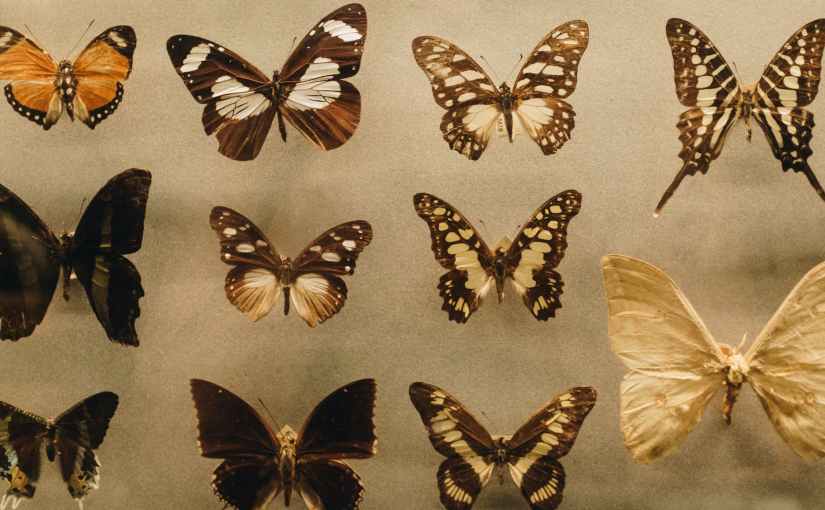
literally means “butterfly” because the soul/true self

is elusive/hard to pin down in an exotic butterfly case.


Fundamentalists need humility to understand

the Absolute Truth they think they have

only exists in the Mind of God –

humans are always groping/searching for their soul.


And arguments for the immortality of the soul

do not alleviate the universal/inescapable/

existential anxiety about death

which cannot be argued away –

fear of death drives humans toward evil

and so “Reasonable people, devoted to rationalism

fail to perceive either the depths of evil

or the depths of the holy.” -Dietrich Bonhoeffer


Not overthinking about death

and living in the Now with the Divine Present

alleviates the death-grip of evil:

Breathing in I relax my body

(reduces stress)

Breathing out I smile

(relaxes hundreds of facial muscles)

Dwelling in the Present Moment

(brings happiness here and now)

I know it is a Wonderful Moment

(brings pleasure/peace of mind/spirit/soul).

LIBERATION THROUGH MINDFULNESS

All ‘holons’ (living systems)

have four fundamental capacities:

self-preservation/self-adaptation/

self-transcendence/and self-dissolution.

The 100 billion people who have come and gone

have always been caught up in ‘I’/‘We’/and ’It’ –

and they have always created ‘Its’ –

institutions/governments/religions

to control them and tell them what to do.


Persons with an insecure

or particularly avoidant ‘attachment style’

are much more prone to dramatic religious conversion –

out of a deep need for security

they follow religious authorities without question

and become fundamentalists in every religion.


However, when people go to retreat centers

often the monks teach them mindfulness

and that everything can be done mindfully

whether praying/walking/eating/working.

This new level of consciousness

liberates those with a fundamentalist bent.


Still, shadow projections can prevail

in every human conflict. The need to be

right/get your way/dominate/control others

can cause the breakup of relationships –

friendships/marriages/families.


But children and parents at least

help each other by standing together

through hardships at every stage:

infancy to old age –

through every manner of challenge

until death parts them

but even then, wise spouses

bravely accept and esteem widowhood

as a continuation of their marital vocation –

even death can be overcome with mindfulness.


THE ENERGY THAT UNITES ALL

Though humans are made of both body and soul

they are one

and through them the material world

reaches its crown

and raises its voice

to praise its Creator.


Therefore, the only gift God requires of us

is our being – with all its imperfections.

When we realize we are lovable

because God loves us

despite our weakness/sin/imperfection

it quickens our self-love.


For the great Anglican theologian John Macquarrie

even our limitations and death point to transcendence –

death gives structure and perspective to life

and raises the hope of immortal life.


Therefore, we should approach our earthly life

not as a problem to be solved

but as an adventure to be lived

with our mind and heart open to whatever arises

until Sister Death welcomes us into life forever

in the glorious presence of our Creator.


Spirituality is giving life one’s all.

Therefore, anyone who gives their all

to their family/work/country/justice/art

is a spiritual person – whether they acknowledge God or not.


For many men, all-out devotion to their work or their family

is their way of being good/spiritual/a saint –

maybe they are not workaholics

maybe they are addicted to love.


After all, deep erotic energy exists at the heart of the cosmos

and becomes manifest in human ministry/family life/marriage/sexuality –

the desire to love and be loved – the One Source of spirituality and sexuality –

this desire is the cosmic energy  

that unites God/humans/the universe.

3 Big Ideas for May 29, 2019

  1. Teilhard de Chardin’s insight into love-energy as the core energy of evolution – evolution always moves towards creating creatures with a greater capacity for love (from invertebrates to vertebrates to mammals to humans) – this gives a new perspective on the nature of cosmic reality. If everything is internally related by love, nothing is autonomous or independent. For any creature, to “be” is to “be-with” or to “inter-be.” We are all “interbeings.” Everything depends on everything else. For you to exist, you need clouds and rain and seeds and soil and farmers. Whatever we are doing to the Earth we are doing to ourselves. This awareness has to be our new foundation: the Earth is us and we are the Earth.
  2. Any student of comparative mythology knows that, throughout the ancient world, there are common themes of death and resurrection and overcoming our mortality with immortality. Osiris and Mithra and Adonis are supposed to have achieved this. However, in Jesus the Christ, the myths became reality. God entered history and changed it forever.
  3. In God’s plan, the Cosmic Christ, who becomes incarnate as a human being, has universal primacy and universal meaning in human history. He becomes the arrowhead that points us towards our next stage of evolution: to become divinized human beings. Of course, we can only do this if we get our egos out of the way and let God’s Spirit fill us to the brim.

3 Big Ideas for May 15, 2019

  1. Teilhard de Chardin was a Christian mystic who believed that love and energy are the foundation of the cosmos. This “love-energy” is the source of the universe’s intelligibility and therefore the basis of knowledge. This leads philosophy out of the impasse of making matter the basis of all empirical knowledge. Philosophers have traditionally made love secondary to knowledge – you have to first know something before you can love it. But for lovers of God like Teilhard, love is the source and goal of all knowledge.
  2. Christian martyrs were willing to die for their faith because they believed “all is one” – everything, including life and death, is under the care of God. Now we have arrived at a similar state by the reverse process: we no longer believe there is a God, all is passing away, and therefore all is meaningless. Without God, all is not one, it is zero. The martyr was willing to die for God, but would the secular non-believer be willing to die for zero? This is important when you are speaking truth to power and fighting injustice.
  3. Almost everything wrong with the world has to do with the way the “It” of institutions can be misaligned, out of control, and disconnect with the “I” and the “We.” The personal is destroyed by the impersonal when corporations, governments, and religious institutions become out of touch with the people they are meant to serve, and only serve themselves. The result is exploitation of others for money or sex, and rape of the planet’s resources on which we all depend. Unitive thinking, the idea that all is one, keeps the “It” of hierarchies connected to the common good, the “We.”