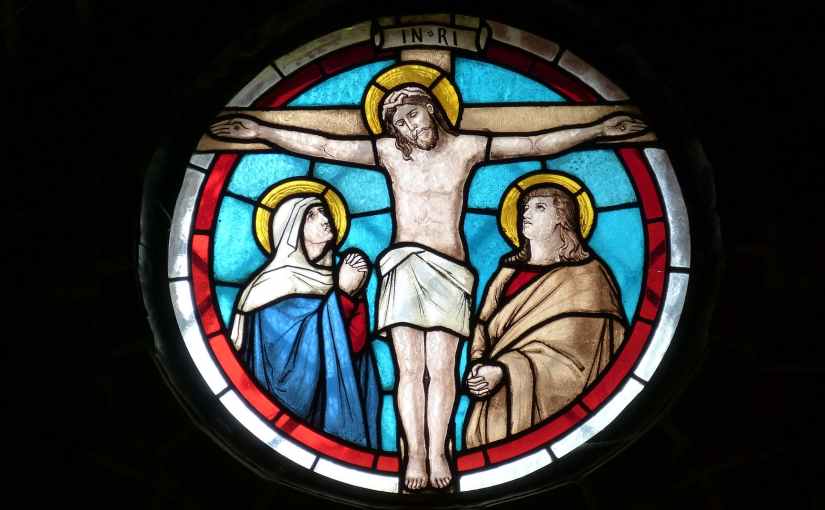
TAKING THE HARD/EASY ROAD WITH CHRIST

Jesus was a layman with no formal training as a priest

he was at parties and in the streets

far more than at liturgy. Yet the early Church

created elaborate liturgies to worship a man

who never asked to be worshiped

only followed. Worship is easy, following is hard.

So, we took the easy road.


Circa 250 AD Christians took the road to the desert

to escape Decian persecution/corruption/decadence

of the Roman Empire. Like Moses/Elijah/Jesus

they were convinced that in the absolute silence of the desert

they could hear God speak again.

In the desert they learned for all time

that God is in the present moment, the NOW.


In our NOW, people in both individualist and collectivist societies

feel anxiety about death/non-being.

Capitalist/ego societies encourage individuals

to assert themselves against the threat of non-being

whereas communist/state societies allay anxiety

with massive military parades and rituals

signifying the collective will survive

individual non-being – being part of the collective

saves you from death.


But both the capitalist and communist credos

are heresy. In Jesus the Christ one evolves

from fragmentation and alienation

of the individual and the masses

to wholeness and integration

from nihilism and irony

to deep meaning and value

from scarcity to abundance

from self-centeredness to self-transcendence.


When capitalism and communism both fail to satisfy the soul

it humbly turns back to God and finds

“Your soul is who you are in God and who God is in you.

Nothing more, nothing less” – Richard Rohr

and taking the hard road is surprisingly easy in Christ

who said “Take my yoke upon you for my yoke is easy

and my burden is light” – Matthew 11:28-30


CHALLENGING OUR PARADIGMS

The new cosmology revealed by science

like the parables of Jesus

shatters our old paradigms

and challenges us to broader/more inclusive thinking.


Irenaeus had a cosmic Christology

largely lost because the Church Fathers

focused on practical/down-to-Earth matters

such as combating Arianism

which claimed Christ is not divine.

The Council of Nicea (325 AD) asserted that

Christ’s incarnation saves us and deifies us –

we become like Christ.


Theology has always been otherworldly –

about metaphysics – “What is the nature of God

and God’s Kingdom?” – things ultimately ineffable

instead of teaching us how to live the teachings of Jesus.


Teilhard de Chardin’s hyper-physics (union before being)

overthrew metaphysics focused on

stasis/unchangeability/sameness.

Union always searches for ‘moreness’ –

more being/consciousness/love –

it is never satisfied with the status quo.


But in the West, religion has done our work

for us: scholars and bishops have told us

what to know not how to know

and what to see not how to see.

The result? People who never had to think

and are unable to comprehend

great and holy things.


Still, a spirit of prayer pervaded the Second Vatican Council

and reading the documents of Vatican II

can be a form of ‘lectio divina.’

The Council encouraged all believers to put prayer first

urged people to pray while reading scripture

pray for the conversion of hearts

and begged all of us to follow the ways of

universal love/peace/justice –

it was a fresh take

on an old paradigm.

IDEAS, RELIGIOUS ATHEISTS AND SUFFERING

For Paul Tillich every aspect of culture –

a new law/painting/political movement

is charged with religious meaning

because it is part of the dynamic energy of God.


Every culture subsists in ideas –

Notre Dame Cathedral in Paris began as an idea

and Meister Eckhart knew what every true intellectual knows:

the importance of ideas for peoples’

freedom/courage/integrity

so, when he was shown Notre Dame he said

“I would trade it all for John Chrysostom’s manuscripts.”


However, there are narrow and broad ideas –

ideas can be limiting or fulfilling.

As Kierkegaard wrote: “the cultured despisers of religion”

“The New Atheists” such as Richard Dawkins, rightfully attack

immature fundamentalist claims of biblical literalism

but mature believers promote the idea

that knowledge born of faith, like poetry, music, theatre or any art

enables us to see reality more deeply than science can.


The Church may reject atheism, but does not reject atheists –

it takes them and their profound questions very seriously

and just like religion, atheism can be narrow or broad

limiting or fulfilling – Buddhism is essentially atheistic

or at least indifferent to the “God question.”

According to Theravada Buddhists, Buddha was an atheist

but manifested the highest humanity and helped multitudes –

his only concern was not God but eliminating suffering.

Anyone who eliminates suffering is a Buddhist.

Therefore, Jesus was a Buddhist. But Buddha was just human,

and when Jesus opened his heart at baptism in the Jordan River

the Holy Spirit descended on him like an eagle

and he manifested as not just human

but the Son of God called to redeem all suffering

through carrying his cross out of love for all humans.

Humans are God’s constant Cross.


Those who are truly guided see this

and when tried/visited with affliction

they say “Surely to God we belong and to God we return”

and in temptation/trials/suffering they take comfort

in being “hidden with Christ in God” (Colossians 3:3).

LIVING IN BABYLON

Major structural injustices in which we

live/move/have our being

create haves/have-nots

and are hugely immoral – but most religions

while preaching personal and interpersonal ethics

ignore systemic evil and most believers accept

massive injustice as “the way things are” never asking

“How can individuals be moral in an immoral culture?”


The typical response of Christians living in

our Babylonian culture, in exile, is:

try to be faithful husbands and wives

raise virtuous children who are

compassionate/contemplative/seek justice

and who kick at the darkness till it bleeds daylight.


Catholics adopt Protestant practices:

daily Bible reading/speaking in tongues

and Protestants adopt Catholic practices:

praying the Divine Office and trying out

Benedictine/Franciscan/Ignatian prayer styles

and perhaps this is the Holy Spirit

weaving the entire Church together

so we all may be one

or maybe this is just rearranging

the deck chairs on the Titanic

as long as the structural injustices persist.


Hopefully, the Contemplative Way

will save and transform us:

because sometimes contemplatives

as they are liberated from all addictions/attachments

gain psychic powers/siddhis such as

telepathy and clairvoyance – genuine contemplatives

always hide these super-powers

but maybe they could use them to fight injustice?


In any case, the ultimate secret of the spiritual life:

“ever-present divine awareness” is not hard to attain

for anyone and is impossible to avoid

according to Lao Tzu/Shankara/Paul/Augustine/

Plotinus/and Teresa of Avila because it is always there

and awareness of the divine is the only thing

that makes living in Babylon bearable.

FALLING (SUPER-SPIRITUAL) STARS

Many people have a multi-faith identity:

Catholic/Protestant; Buddhist/Jewish;

Baptist/Episcopalian; Christian/Hindu.


People are called in many different ways

but if you refuse God’s call

you turn the adventure/your true life

into meaningless boredom/a wasteland/

death.


Our only true greatness lies in

the humility of living faithfully.

The purer our faith, the closer we come to God.

The one who desires to exalt herself/himself

with extraordinary sexual or mystical experiences

becomes less/not more in the eyes of God.


If you can abandon all desire 

for the fruits of your actions/results

you can perform freely/without attachment

your duty – to love.


One’s duty may be to be a good spouse –

the intimate partnership of married life and love

has been established by the Creator

and is defined/qualified/bounded

by the Creator’s laws/thou-shalt-nots –

THOU SHALT NOT: lie/steal/covet thy neighbour’s

wife/husband/commit adultery.


Like Ravi Zacharias, Jean Vanier was a super-saint –

his work with the developmentally delayed

in L’Arche/the Ark became world-wide

group homes for those rejected by society

and his book Becoming Human

helped us discover our common humanity

the journey from loneliness to belonging

and to a love that includes all –

people of multiple faiths and no faith

people able/differently abled/disabled –

Vanier was a saint until the MeTooMovement

caught him with his pants down

with multiple women. Another spiritual superstar

had fallen – to everyone’s utter dismay.

RETURNING TO RADICAL AMAZEMENT

The sexual/social/self-preservation drives

are the raw material of who we are as humans

and so cannot be killed off

although ascetics try their hardest.


According to Rohr/Rolheiser/Fox

these drives are all good and just need to be

harnessed/channeled/integrated not killed off

so they give energy to our spiritual endeavours

and serve us not destroy us – they are good

not evil monsters/dragons/demons.


According to Immanuel Kant as you move morally

from being biocentric (sex and survival) to egocentric

to ethnocentric to worldcentric (universal compassion)

you also discover your higher/truer/deeper self.


If you expand your heart and mind infinitely

you come to God’s Infinite Love, the “Ultimate Thou”

and to your self as the “Ultimate I”

culminating in the “Ultimate I-Thou Relationship.”


But as we take on jobs/get married/join religions

everyone pressures us to do

in order for us to live up to their ideals

and as we shove more and more stuff

into our shadow-bag

by midlife we are a mere slice

of the 360-degree-self we started with.


We become fraught with “sins of omission”

including: not living lives of justice/

not being transformed/being ‘born again’

only once instead of many times/

leaving creativity/divinization/original blessing/

the cosmos out of our theology.


Radical Amazement by Judy Cannato

invites us back into contemplative awe/awareness

of black holes/supernovas/the wonders of the universe

 which are the key to self-transformation

and transformation of the world.


OVERCOMING OUR SHADOW AND OUR SUFFERING

Theologians try to make Christianity relevant

by showing theology follows scientific methods

or correlating it to some current philosophy

or urgent need: racism, nuclear war, climate change

but the problem behind all problems

is dualistic non-unitive thinking in the form of individualism.


Individualism, the triumph of the individual

the foundation of American culture, is ironically false freedom:

separation from others and therefore separation from God

who in Jesus exhorted us to “love others as our self”

and “love our enemies.”


America is ironically “Land of the free and home of the slave”

according to the artist formerly known as “Prince.”

Ironically too, America will only overcome its shadow history

by embracing it: “Taking up your cross today

means owning your own shadow

which is the essence of ethics/

integrity/spirituality/religion.” – Carl Jung

First recognize the log in your own eye

before trying to take out the speck in your neighbour’s eye.

Otherwise, you project your shadow onto others

and force them to carry your darkness.


We can use everything that happens in us

and that happens to us, to wake up:

Buddhism exhorts us to resolve the dualistic struggle

by embracing difficulties (our crosses)

and by meditating day and night.

“Seek in reading and you will find in meditating;

knock in verbal prayer and it will be opened to you

in contemplation” – Guigo the Carthusian.


But contemplation is always beyond us:

beyond art/philosophy/theology

even beyond discussion or explanation –

the language of God

is silence.


But the language of the blind and deaf Helen Keller is

“Life is full of suffering

and it is also full of the overcoming of suffering.”

REDISCOVERING THE GREAT CHAIN OF BEING

Starting with Copernicus and then Galileo,

heliocentrism – the Sun as the center of things

not the Earth – the new cosmology

totally upset the watermelon cart

displaced God’s immutability/hierarchy/

humans as the center of the universe/

our race as the center of God’s care/

the stable relationship between self/cosmos/God

was completely disrupted.


No wonder Alan Watts, who embraced eastern mysticism,

noted that modern culture is peculiar:

every other culture, East and West,

from 6000 years ago to the birth of modern science

believed in the Great Chain of Being.


However, we can rediscover this Great Chain

by recognizing our bodies, thru sexual intercourse

have been coming out of each other:

male out of female, female out of male

since day one – the whole human race is one –

one flesh/one body/one blood.


And now in addition we recognize

that it took the universe 13.7 billion years

to create YOU – from atoms/molecules/cells/

multicellular organisms/vertebrates/

your thousands of ancestors/to YOU –

YOU are 13.7 billion years old –

think about it – YOU are made of the dust of stars –

stardust – and God chose YOU

before the foundation of the universe.


Other scientists further disrupted all things –

besides Darwin, the new physics

changed our view of the cosmos

as dynamic and relational not static.

And new quantum laws incorporated chance

and indeterminism. But chance does not change

the cosmos into a lottery –

it is the way the universe explores

and realizes its potential:

the divinized human being –

YOU filled to the full with GOD.

REDEEMING TECHNOLOGY

If we are going to save humanity from technology

we need to emphasize the human need for

love/friendship/meaning/freedom.

This is where religion can be extremely valuable –

in humanizing technology.


On the positive side of technology,

Pierre Teilhard de Chardin, a Jesuit priest

envisioned technology gathering human energy

deepening love/global consciousness

and an awareness of ‘interbeing’ –

we are all part of an interweaving body

of life/love/motion we call the Uni-verse –

the One Cosmic Poem.


The problem with our contemporary world

is dissociating art/morals/technology

from each other and from religion:

not only pre-rational mythic spirituality

was rightly rejected

but also rational postmodern spirituality –

postmodern/liberal/intellectual humans

were left to answer the deepest question

“What is of ultimate concern?”

with only art/morals/technology

allowed to give an answer –

progressive religion was excluded from the debate.


In spite of this we have made moral progress –

we now recognize systems of injustice

rather than individuals cause immoral behaviour –

we have lifted the burden of responsibility off each person

and placed it squarely on the shoulders of corrupt systems

the individual is inevitably enmeshed in.


In any case, Truth cannot impose itself on our hearts

except by virtue of it being true.

Religions therefore must be free to speak their truth

without trying to coerce civil society.


Healthy spirituality could be an anchor for civilization

preventing it from being swept away by the current –

the overwhelming flood of technology.

TRANSFORMING GLOBALIZATION AND THE UNIVERSE

The Interspiritual Age believes the spreading

of world religions as an offshoot of globalization

will create a global spirituality.


People need to remember how

the ancient religions of the East

thru the deepest longings/joys/sorrows of civilizations

strengthened and expressed the nobility of humans

how their temples have been home to

contemplation and prayer

how they shaped Eastern history and culture

and have been doorways to God

thru the Universal Christ –

the Way, the Truth, and the Life.


All people become contemplative

whenever God discovers God thru them.

Contemplation is God contemplating God thru us.


When people of any religion abandon themselves to God

God takes away everything they have

and returns it to them in a new form –

God takes away all natural objects

and returns them all as supernatural gifts.


In a previous generation ‘supernatural’

was a banned word in theology

but Baron Friedrich von Hugel recovered it

because humans need both the Transcendent Wholly Other

as well as the Immanent Wholly Here and Now –

but monism and pantheism both leave one or the other out.


The Universal Christ as exemplar/model of the universe

teaches us two things about created reality:

Divine Love is integrated into the Creation

and the destiny of the universe is not destruction

but resurrection/transformation/glorification

in God.